


High Temperature Ceramic Filter
In industrial environments where process temperatures exceed the limits of standard polymers and even some metallic alloys, the high temperature ceramic filter serves as a critical component for fluid and gas purification. These filters are engineered to withstand extreme thermal gradients, aggressive chemical environments, and high-pressure differentials that would compromise the structural integrity of conventional filtration media. For engineers and technical procurement teams, understanding the material science and mechanical properties of ceramic filtration is essential for optimizing system uptime and ensuring product purity.
Industrial filtration often requires a balance between permeability and filtration efficiency. In high-heat applications, such as hot gas filtration in power generation or molten metal purification in foundries, the choice of filter media directly impacts the total cost of ownership (TCO) and the longevity of downstream equipment. While Kaifil specializes in advanced stainless steel filtration solutions, which can be explored on our Main Page, ceramic filters represent a specific subset of technology designed for temperatures often exceeding 800°C (1472°F).
Understanding High Temperature Ceramic Filter Technology
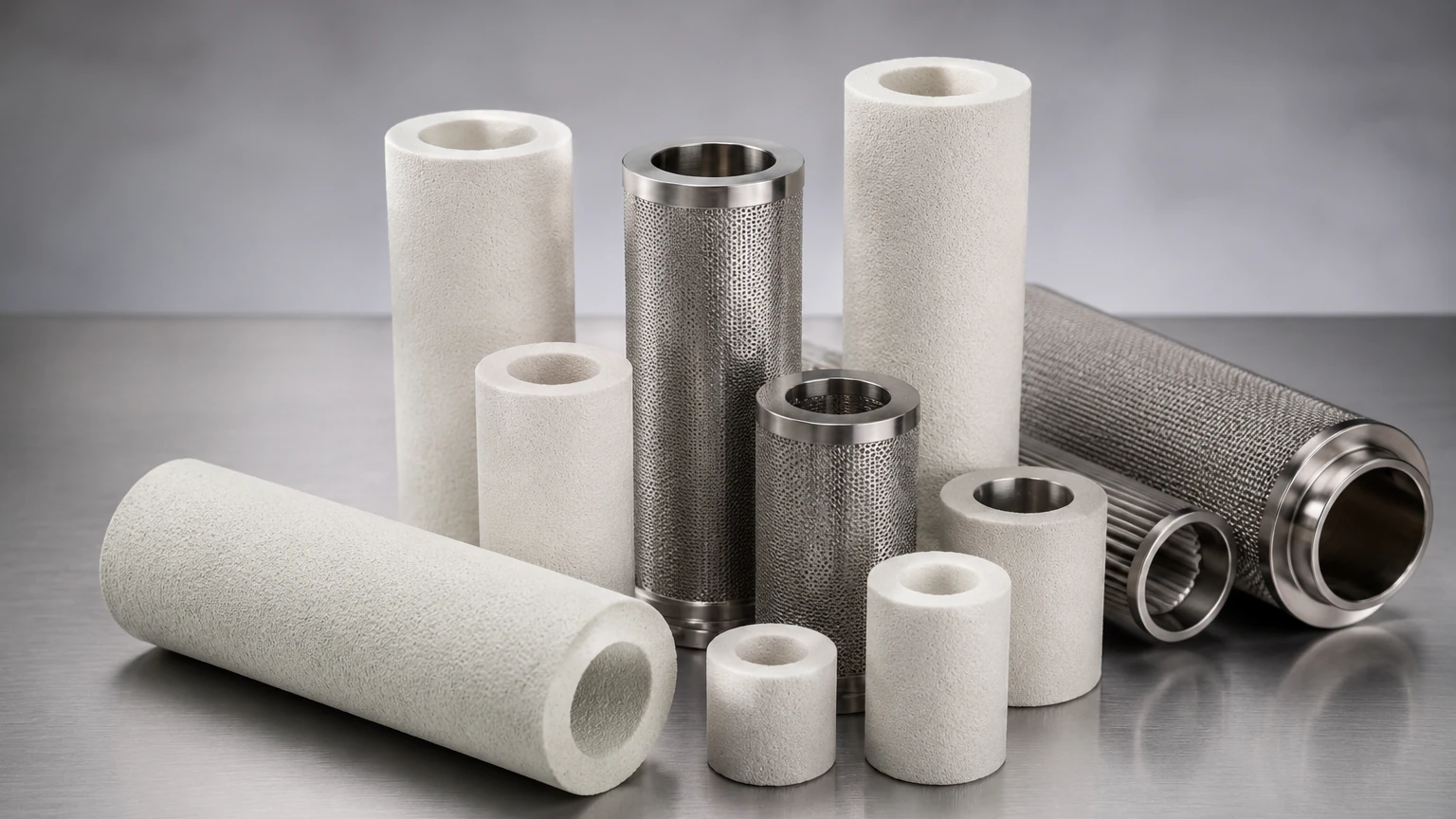
The performance of a high temperature ceramic filter is primarily determined by its material composition and its pore morphology. Unlike woven wire mesh, which relies on a geometric weave, ceramic filters typically utilize a porous, tortuous path structure created through sintering or specialized casting processes.
Material Composition
Common materials used in the construction of these filters include:
* Alumina (Al2O3): Known for its excellent chemical stability and resistance to oxidation. It is frequently used in chemical processing and molten aluminum filtration.
* Silicon Carbide (SiC): Offers superior thermal shock resistance and high mechanical strength. SiC filters are preferred in applications with rapid temperature fluctuations.
* Zirconia (ZrO2): Utilized for the most extreme temperatures, particularly in the filtration of molten steel and superalloys, where chemical inertness at high heat is paramount.
* Cordierite: Often selected for its low thermal expansion coefficient, making it ideal for automotive exhaust and kiln applications.
Pore Structure and Tortuosity
The filtration mechanism in ceramics is often a combination of surface filtration and depth filtration. The "tortuous path" refers to the winding route a fluid must take through the ceramic matrix. This structure increases the probability of particle impingement on the pore walls, effectively capturing sub-micron contaminants even at high flow velocities.
Key Engineering Considerations for Thermal Stability
When specifying a high temperature ceramic filter, engineers must look beyond simple micron ratings. The interaction between the filter and its environment at elevated temperatures introduces several mechanical challenges.
Thermal Shock Resistance
One of the primary failure modes for ceramic filters is thermal shock. This occurs when a rapid change in temperature creates a steep thermal gradient within the material, leading to internal stress and eventual cracking. Engineers must evaluate the material’s thermal expansion coefficient and thermal conductivity. Silicon carbide generally outperforms alumina in this regard, making it more suitable for batch processes where the filter is frequently heated and cooled.
Creep and Structural Integrity
At high temperatures, materials can undergo "creep," a slow deformation under constant mechanical stress. A ceramic filter must maintain its shape and pore size under the pressure of the process flow. If the material softens or deforms, the filtration efficiency will drop, and the pressure drop across the filter will increase unpredictably.
Chemical Compatibility at Heat
Chemical reactions that are negligible at room temperature can become aggressive at 1000°C. For instance, in gasification processes, the presence of alkali vapors can react with certain ceramic binders, leading to the degradation of the filter matrix. Selecting a binder-free or chemically matched ceramic is vital for long-term stability.
Comparing Ceramic and Stainless Steel Filtration Media
For many industrial applications, there is an overlap between where a high temperature ceramic filter and a sintered stainless steel filter can be used. Choosing the right medium requires a technical comparison of their mechanical properties.
| Feature | Ceramic Filters | Sintered Stainless Steel |
| :— | :— | :— |
| Max Operating Temp | Up to 1700°C | Up to 500°C (Oxidizing) / 900°C (Reducing) |
| Ductility | Brittle (Low impact resistance) | High (Ductile and robust) |
| Customization | Limited to casting/molding | High (Weldable, machinable) |
| Cleaning | Thermal or chemical | Ultrasonic, backwashing, chemical |
| Thermal Shock | Moderate to High | Excellent |
| Cost | High initial cost | Moderate to High |
Stainless steel filters, such as those found on the Kaifil Main Page, offer significant advantages in terms of durability and ease of installation. They can be welded into housings and are not prone to catastrophic brittle failure if dropped or subjected to mechanical vibration. However, when the process temperature exceeds the oxidation limit of the alloy, ceramic becomes the only viable solution.
Performance Metrics: Permeability and Filtration Efficiency
The efficiency of a high temperature ceramic filter is measured by its ability to remove specific particle sizes while maintaining a manageable pressure drop. This is governed by Darcy’s Law, which relates flow rate, fluid viscosity, and the pressure gradient across the porous medium.
Pressure Drop (Delta P)
In high-temperature gas filtration, the viscosity of the gas increases with temperature. This means that a filter that performs well at 20°C will exhibit a much higher pressure drop at 600°C, even if the flow rate remains constant. Engineers must size the filter surface area to account for this increased resistance to avoid excessive energy consumption or system backpressure.
Capture Mechanisms
Ceramic filters utilize three primary mechanisms to capture particulates:
1. Inertial Impaction: Larger particles cannot follow the fluid streamlines around the ceramic fibers or pores and collide with the media.
2. Interception: Particles follow the streamline but come close enough to the media surface to be captured.
3. Diffusion (Brownian Motion): Very small particles move erratically and eventually contact the filter surface. This is particularly effective in gas filtration.
Industrial Applications for High-Heat Filtration
The unique properties of the high temperature ceramic filter make it indispensable in several heavy industries.
Hot Gas Filtration
In biomass gasification and coal-fired power plants, the syngas produced contains high levels of fly ash and carbon particulates. These must be removed at high temperatures to protect downstream turbines or catalysts. Ceramic candle filters are the industry standard here, as they can operate continuously at 400°C to 900°C.
Molten Metal Purification
In the foundry industry, ceramic foam filters are used to remove oxides and non-metallic inclusions from molten aluminum, iron, and steel. Removing these impurities is critical for preventing defects in the final casting and improving the mechanical properties of the metal.
Chemical and Petrochemical Processing
High-temperature reactors often require the recovery of expensive catalysts. Ceramic filters provide the necessary thermal and chemical resistance to separate catalysts from hot product streams without the risk of metallic contamination.
Selection Criteria and Total Cost of Ownership (TCO)
When purchasing a high temperature ceramic filter, the initial price is only one component of the TCO. Engineers should confirm the following data points with manufacturers before procurement:
1. Regeneration Capability: Can the filter be cleaned? Ceramic filters are often cleaned via "back-pulsing" with compressed gas or through thermal regeneration (burning off organic contaminants). The number of cleaning cycles a filter can withstand before the pore structure degrades is a key metric for ROI.
2. Mounting and Sealing: Because ceramics and metals have different thermal expansion rates, the sealing mechanism between the ceramic filter and its metal housing is a common failure point. Specialized gaskets or spring-loaded mounts are often required.
3. Filtration Rating (Absolute vs. Nominal): Ensure the micron rating is defined under operating temperatures. Some ceramic structures may expand slightly at heat, altering the effective pore size.
4. Mechanical Strength (MOR): The Modulus of Rupture (MOR) indicates the maximum stress the ceramic can withstand before breaking. This is vital for applications with high-pressure surges.
Conclusion
The high temperature ceramic filter is a specialized tool designed for the most demanding thermal environments. While stainless steel filtration remains the standard for many industrial applications due to its versatility and robustness, ceramic media provide the necessary performance when temperatures exceed the metallurgical limits of alloys. By carefully evaluating material properties, thermal shock resistance, and regeneration potential, engineering teams can implement filtration solutions that ensure process stability and equipment protection. For those seeking high-performance metal filtration alternatives, further technical resources and product specifications are available on the Kaifil Main Page.
