


Pp Water Filter
In industrial water treatment and fluid processing, the polypropylene (PP) water filter serves as a fundamental component for sediment removal and pre-filtration. Engineering and procurement teams often specify these filters due to their chemical inertness, cost-effectiveness, and versatility in handling various flow rates. However, selecting the correct PP water filter requires a deep understanding of material science, structural design, and the specific hydraulic demands of the application. This guide examines the technical nuances of polypropylene filtration media, performance metrics, and the engineering trade-offs between disposable polymer filters and permanent stainless steel alternatives.
Understanding the Mechanics of PP Water Filters
A pp water filter operates primarily through depth filtration or surface filtration, depending on its construction. Polypropylene is a thermoplastic polymer produced via chain-growth polymerization from the monomer propylene. In the context of filtration, its high resistance to chemical solvents, bases, and acids makes it an ideal medium for diverse industrial fluids.
Depth filtration occurs when contaminants are trapped within the tortuous path of the filter media's thickness. As fluid passes through the filter, particles are captured throughout the entire cross-section of the material. This mechanism is particularly effective for removing a wide range of particle sizes and providing a high dirt-holding capacity. Conversely, surface filtration, typically found in pleated designs, captures particles on the upstream surface of the media, allowing for higher precision and absolute micron ratings.
Types of Polypropylene Filter Media
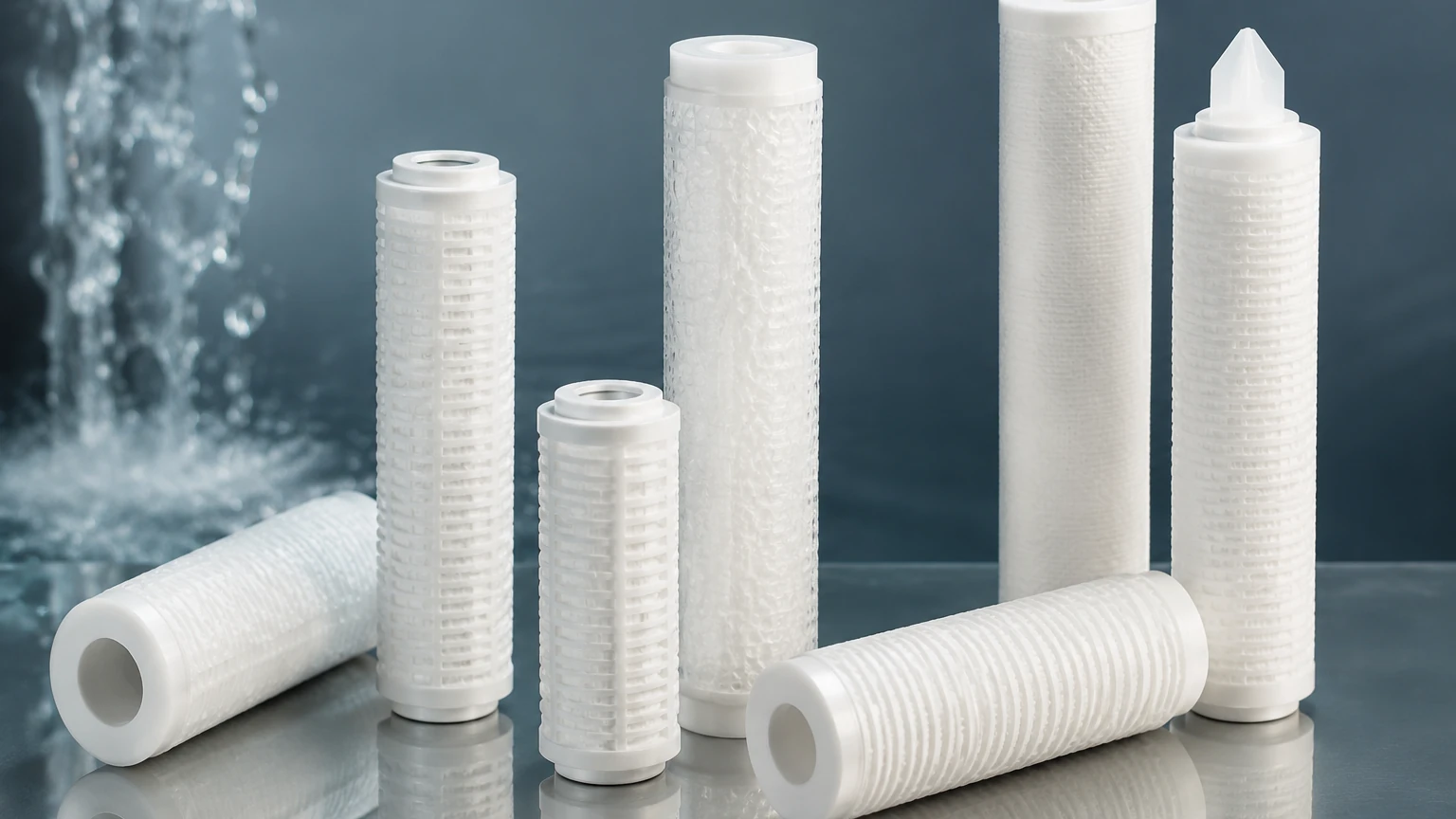
Industrial PP filters are generally categorized into three main types based on their manufacturing process. Each type offers distinct advantages regarding filtration efficiency and structural integrity.
Melt-Blown Filter Cartridges
Melt-blown filters are produced by extruding molten polypropylene polymer through high-velocity air, which breaks the polymer into fine fibers. These fibers are then collected on a rotating mandrel to form a cylindrical filter. The density of the fibers can be varied during the process to create a "graded density" structure—where the outer layers are coarser and the inner layers are finer. This design allows larger particles to be trapped on the outside while smaller particles are captured deeper within the core, preventing premature surface blinding and extending the filter's service life.
String-Wound Filter Cartridges
String-wound filters are manufactured by winding a continuous yarn of polypropylene around a central support core. The winding pattern creates diamond-shaped openings that become progressively smaller toward the center. While these are among the most traditional types of pp water filter, they are often used in high-load sediment applications. However, engineers must be cautious of "media migration," where fibers from the yarn may shed into the filtrate, or "unloading," where high pressure causes the diamond openings to shift, releasing trapped contaminants.
Pleated Polypropylene Filters
Pleated filters utilize a thin sheet of PP media that is folded to maximize the available surface area within a standard cartridge footprint. Because of the increased surface area, these filters exhibit much lower initial pressure drops and can handle higher flow rates compared to depth filters of the same size. Pleated designs are often used when absolute filtration (e.g., 99.9% efficiency at a specific micron) is required, particularly in the pharmaceutical or food and beverage industries.
Technical Specifications: Micron Ratings and Filtration Efficiency
When evaluating a pp water filter, engineers must distinguish between nominal and absolute micron ratings. This distinction is critical for system performance and the protection of downstream equipment like RO membranes or high-precision Main Page components.
* Nominal Rating: This is an arbitrary value assigned by the manufacturer, indicating that the filter can trap a large percentage (often 50% to 80%) of particles of a given size. It does not guarantee total removal.
* Absolute Rating: This refers to the diameter of the largest hard spherical particle that will pass through the filter under specified test conditions. For critical applications, an absolute-rated filter with a high Beta Ratio (the ratio of particles upstream vs. downstream) is necessary.
In industrial settings, the Beta Ratio is a more reliable indicator of performance than a simple percentage. For instance, a Beta 5000 rating indicates that for every 5,000 particles of a specific size entering the filter, only one passes through, representing 99.98% efficiency.
Engineering Considerations: Flow Rate, Pressure Drop, and Chemical Compatibility
Selecting a pp water filter is not merely about choosing a micron size; it involves a complex calculation of hydraulic variables.
Differential Pressure (Delta P)
The pressure drop across a filter is the difference between the upstream and downstream pressure. Every filter has an initial "clean" pressure drop. As the filter accumulates debris, the Delta P increases. Most industrial systems are designed to replace PP cartridges when the differential pressure reaches 1.5 to 2.0 bar (20-30 psi). Operating beyond this point can lead to structural failure of the cartridge or bypass of contaminants.
Chemical and Thermal Limits
While polypropylene is highly resistant to many chemicals, it has a relatively low thermal ceiling. Most PP filters are rated for a maximum operating temperature of approximately 60°C to 80°C (140°F to 176°F). Beyond these temperatures, the polymer may soften, leading to pore deformation or structural collapse. For high-temperature applications or aggressive solvent environments where PP is unsuitable, engineers typically transition to stainless steel wire mesh or sintered metal filters.
Extractables and Surfactants
In high-purity applications, such as semiconductor manufacturing or pharmaceutical processing, the presence of extractables (chemicals that leach out of the plastic) is a concern. High-quality PP filters are often rinsed with ultrapure water during manufacturing to minimize TOC (Total Organic Carbon) levels and ensure compliance with FDA or USP standards.
Comparison: Polypropylene vs. Stainless Steel Filtration Systems
In many industrial environments, the choice between a disposable pp water filter and a reusable stainless steel filter is a matter of long-term operational strategy. While PP filters have a lower upfront cost, they are consumable items that generate waste and require frequent labor for replacement.
| Feature | Polypropylene (PP) Filter | Stainless Steel (SS) Filter |
| :— | :— | :— |
| Initial Cost | Low | High |
| Maintenance | Disposable (Replace) | Cleanable (Backwash/Ultrasonic) |
| Temperature Limit | < 80°C | Up to 500°C+ |
| Pressure Resistance | Moderate | Very High |
| Chemical Resistance | Good (Acids/Bases) | Excellent (Solvents/High Temp) |
| Sustainability | High Waste Generation | Low Waste (Multi-use) |
For applications involving high-viscosity fluids, high temperatures, or where the cost of downtime for filter changes is prohibitive, custom stainless steel solutions—such as those found on the Kaifil Main Page—provide a more robust alternative. Stainless steel mesh can be engineered to specific micron levels while offering the mechanical strength to withstand high differential pressures that would crush a standard PP cartridge.
Maintenance, Service Life, and Total Cost of Ownership (TCO)
The service life of a pp water filter is dictated by the contaminant load of the influent and the total volume of fluid processed. To optimize the TCO, engineers should implement a multi-stage filtration strategy. This involves placing a coarse PP filter (e.g., 20-50 microns) upstream of a fine PP or membrane filter (e.g., 1-5 microns). This "sacrificial" pre-filtration protects the more expensive fine filters, reducing the overall frequency of replacement.
Monitoring is essential. Automated systems equipped with differential pressure sensors can alert operators exactly when a filter change is required, preventing both premature replacement (which wastes money) and late replacement (which risks system damage). When calculating TCO, procurement teams must factor in:
1. The unit cost of the cartridges.
2. Shipping and storage costs.
3. Labor costs for replacement.
4. Disposal costs for contaminated filters.
5. The cost of potential downtime during changeovers.
Selection Guide for Industrial Applications
To ensure the selected pp water filter meets the application requirements, engineers should confirm the following data points before purchase:
1. Fluid Characterization: What is the chemical composition? Are there oils or solvents present that could degrade polypropylene?
2. Contaminant Profile: Is the sediment hard and angular, or soft and gelatinous? Gelatinous particles often require pleated filters with higher surface areas to prevent rapid clogging.
3. Flow Requirements: What is the peak flow rate? Sizing a filter housing for the maximum possible flow ensures that the clean pressure drop remains low.
4. Target Particle Size: What is the sensitivity of the downstream components? If protecting a high-pressure pump, an absolute-rated filter is usually mandatory.
5. Regulatory Compliance: Does the filter need to meet FDA, EC, or Halal requirements for food contact?
For many facilities, the transition from disposable polymer filters to precision-engineered metal filtration is a logical step toward automation and sustainability. While the pp water filter remains a versatile tool for general-purpose water treatment, specialized industrial processes often demand the durability and precision of custom metal components. By analyzing the total lifecycle and performance requirements, technical teams can determine whether a standard PP solution or a high-performance stainless steel system is the most effective choice for their specific operational goals.
