


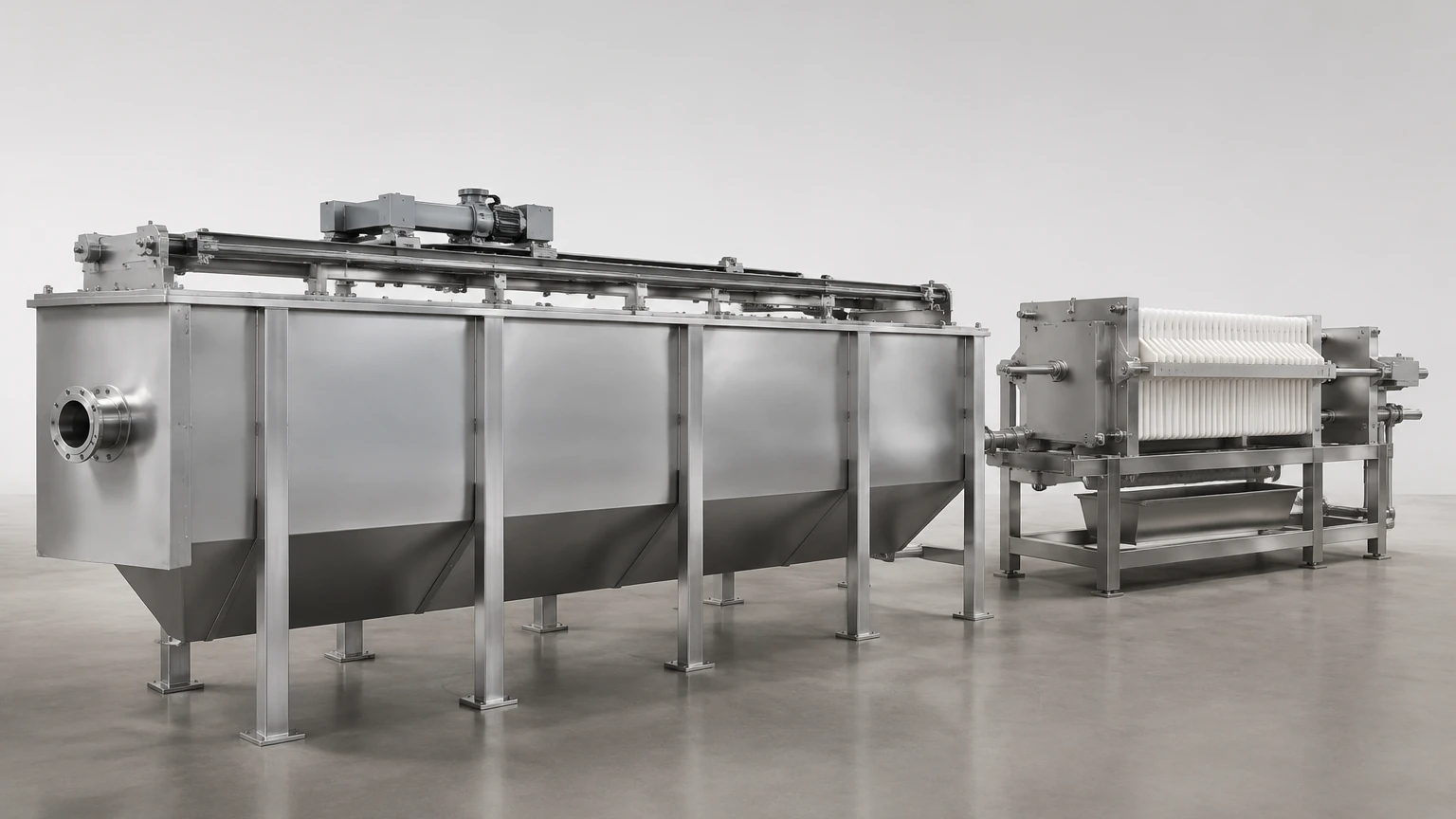
Horizontal Clarifier with Filter Press
In industrial wastewater treatment and process liquid management, the integration of a horizontal clarifier with filter press represents a comprehensive approach to solid-liquid separation. This dual-stage system is designed to handle high volumes of suspended solids, transforming dilute slurries into clear effluent and concentrated dry cakes. For engineers and facility managers, understanding the technical synergy between sedimentation and mechanical dewatering is essential for optimizing plant efficiency, meeting environmental regulations, and reducing disposal costs.
Industrial filtration often requires more than a single piece of equipment. While a clarifier utilizes gravity to settle out the bulk of suspended solids, the resulting sludge often contains too much water for economical disposal or further processing. This is where the filter press becomes indispensable. By combining these technologies, industrial operations can achieve high-clarity water recovery while significantly reducing the volume of waste.
Fundamentals of Industrial Sedimentation and Dewatering
The primary objective of a horizontal clarifier with filter press system is the systematic removal of particles from a liquid carrier. This process generally occurs in two distinct phases: primary clarification and secondary dewatering.
In the primary phase, the horizontal clarifier acts as a low-velocity sedimentation tank. As the influent enters the tank, its velocity is reduced to allow particles with a higher specific gravity than water to settle to the bottom. This process is often enhanced by the addition of coagulants or flocculants, which bind smaller particles into larger "flocs" that settle more rapidly. The clarified liquid overflows at the top, while the thickened solids, known as underflow or sludge, are collected at the bottom.
In the secondary phase, the filter press takes the thickened sludge from the clarifier and applies mechanical pressure to force the remaining liquid through a filter medium. This results in a solid "filter cake" and a high-clarity filtrate. For industries requiring high-performance components, the selection of internal filtration media, such as stainless steel wire mesh or precision-engineered cartridges, is critical to ensuring the longevity and reliability of the entire system.
The Mechanics of a Horizontal Clarifier
The horizontal clarifier is engineered for continuous operation. Its design typically features a rectangular or circular footprint where the flow moves horizontally from the inlet to the outlet. The efficiency of a horizontal clarifier is dictated by the surface loading rate and the detention time.
Key components within the clarifier often include:
- Inlet Stillness Zone: A baffle system designed to dissipate the energy of the incoming flow, preventing turbulence that would interfere with settling.
- Settling Zone: The main body of the tank where gravity separation occurs. In modern high-efficiency designs, lamella plates or inclined tubes may be installed to increase the effective settling area within the same physical footprint.
- Sludge Collection System: A mechanical rake or vacuum system that moves the settled solids toward a central hopper for discharge.
- Effluent Launder: A collection trough at the surface that captures the clarified liquid.
For many chemical and pharmaceutical applications, the internal components of the clarifier must resist corrosion and high temperatures. This is why stainless steel filtration components are frequently utilized in the overflow and underflow assemblies to prevent contamination and ensure structural integrity under demanding conditions.
Enhancing Efficiency with the Filter Press
Once the horizontal clarifier has concentrated the solids into a manageable sludge, the filter press performs the final dewatering. Unlike the clarifier, which relies on gravity, the filter press is a pressure-driven batch operation. It consists of a series of plates covered with filter media. When the sludge is pumped into the chambers between the plates, the solids are trapped, and the liquid is forced out.
The choice of filter media in the press is paramount. While polymer cloths are common, many specialized industrial processes require the durability of metal components. For instance, in high-pressure or high-temperature hydraulic and chemical applications, stainless steel wire mesh filters provide the necessary mechanical strength to withstand the clamping and pumping forces without deforming.
Using a filter press following a clarifier offers several advantages:
1. High Solids Capture: It can achieve up to 99% solids recovery.
2. Dry Cake Production: The resulting cake is often dry enough to be handled as a solid waste, reducing transportation costs.
- Filtrate Clarity: The liquid recovered from the press is often clear enough to be recycled back into the process or sent directly to a final polishing stage.
The Synergy: Integrating Clarifiers and Presses in One Flow
The integration of a horizontal clarifier with filter press creates a closed-loop or semi-closed-loop system that maximizes resource recovery. The clarifier handles the high-volume, low-concentration influent, while the filter press handles the low-volume, high-concentration sludge.
In a typical configuration, the clarifier's underflow pump is linked to a sludge holding tank. This tank acts as a buffer, ensuring the filter press receives a consistent feed density. If the clarifier is performing optimally, the sludge density will be high, which reduces the cycle time of the filter press and increases the overall throughput of the plant.
Engineers must carefully balance the flow rates between these two units. If the clarifier is undersized, the sludge will be too thin, causing the filter press to run longer cycles with poor cake formation. Conversely, if the filter press is undersized, the clarifier's sludge hopper may overfill, leading to solids carryover in the clarified effluent. For those looking to optimize their filtration setup, consulting a professional manufacturer like Kaifil can provide insights into custom stainless steel components that bridge the gap between these two technologies.
Material Selection and Engineering for Filtration Components
When designing or maintaining a horizontal clarifier with filter press, material selection is the most significant factor in determining the system's total cost of ownership. Industrial environments involving corrosive chemicals, abrasive slurries, or extreme temperatures demand materials that go beyond standard plastics or mild steels.
Stainless steel, particularly grades 304 and 316L, is the industry standard for high-performance filtration components. Its benefits include:
- Corrosion Resistance: Essential for chemical processing and water treatment where pH levels vary.
- Thermal Stability: Maintains structural integrity in high-temperature processes, such as those found in food and beverage sterilization or chemical synthesis.
- Cleanability: Stainless steel surfaces are non-porous and can be easily cleaned or backwashed, which is critical for pharmaceutical and food-grade applications.
At the Main Page of Kaifil’s technical resource center, engineers can find detailed specifications on how custom wire mesh and filter cartridges are engineered to meet these specific industrial demands. Whether it is a custom-sized screen for a clarifier intake or a high-pressure filter element for a hydraulic system associated with the press, precision manufacturing ensures that the components fit perfectly and perform reliably.
Selecting the Right Filtration Media for Demanding Environments
Selecting the appropriate filtration media for a horizontal clarifier with filter press system involves evaluating several technical parameters:
1. Micron Rating: The size of the smallest particle the filter is intended to capture. In a clarifier, this might relate to the screen size of the intake; in a press, it relates to the mesh or cloth weave.
2. Permeability: The rate at which liquid can pass through the media. High permeability reduces the energy required for pumping but must be balanced against solids retention.
3. Mechanical Strength: The ability to withstand the differential pressure during the filtration cycle.
For precision metal filter components, the manufacturing process—such as sintering or specialized weaving—determines these characteristics. Sintered wire mesh, for example, offers excellent fixed pore geometry, ensuring that the filtration accuracy remains constant even under high-pressure pulses. This is particularly useful in the discharge lines of a filter press where a final "polishing" filter may be required to remove any trace fines that escaped the press cloths.
Maintenance and Operational Longevity
To ensure the horizontal clarifier with filter press remains operational with minimal downtime, a proactive maintenance schedule is required. For the clarifier, this includes regular inspection of the rake mechanism and the cleaning of the effluent launders. For the filter press, the primary maintenance task is the cleaning and eventual replacement of the filter media.
Stainless steel filters offer a distinct advantage in maintenance. Unlike disposable polymer filters, stainless steel cartridges and mesh can often be cleaned and reused multiple times. Ultrasonic cleaning, chemical baths, or high-pressure backwashing can restore the flux of a metal filter, significantly extending its service life and reducing the environmental impact of disposable waste.
Common risks to avoid include:
- Media Blindness: Occurs when fine particles become lodged within the pores of the filter. Proper material selection and micron rating can mitigate this.
- Chemical Degradation: Using incompatible materials can lead to rapid failure. Always verify the chemical compatibility of the filter media with the process fluid.
- Pressure Spikes: Sudden increases in pressure can damage internal filter supports. Using reinforced stainless steel cartridges can provide the necessary safety margin.
Conclusion
The combination of a horizontal clarifier with filter press is a robust solution for complex industrial separation needs. By understanding the engineering principles behind sedimentation and pressure filtration, and by selecting high-quality, customized components, companies can achieve superior filtration performance.
For engineers seeking to optimize their systems, the focus should remain on durability, precision, and material compatibility. Utilizing custom stainless steel filtration solutions ensures that even the most demanding applications—from chemical processing to pharmaceutical manufacturing—operate efficiently. To explore specific filtration products and technical support for your next project, visit the Kaifil Main Page for a comprehensive overview of available OEM and customized solutions.
