


How Do You Calculate Net Filtration Pressure
In industrial filtration systems, the efficiency of a process is often dictated by the balance between flow rate and the resistance encountered by the fluid as it passes through a medium. For engineers and technical procurement teams managing high-performance systems, understanding the forces at play is essential. One of the most critical metrics in this domain is net filtration pressure (NFP). While the term is frequently used in biological contexts, in the world of industrial stainless steel filtration, it refers to the effective pressure differential that drives a liquid or gas through a filter element, such as a sintered wire mesh or a pleated stainless steel cartridge.
Accurately determining this value allows for the proper sizing of pumps, the selection of appropriate filter media, and the prediction of maintenance cycles. This guide examines the technical foundations of how do you calculate net filtration pressure, the variables that influence these calculations, and how to apply this knowledge to optimize industrial filtration performance.
Defining Net Filtration Pressure in Industrial Systems
At its most fundamental level, net filtration pressure represents the difference between the forces pushing a fluid through a filter and the forces resisting that movement. In a closed-loop industrial system, this is primarily expressed as the pressure drop ($ΔP$) across the filter medium.
When asking "how do you calculate net filtration pressure," one must look at the hydraulic gradient. In a standard liquid filtration setup, the calculation is simplified to the difference between the upstream (inlet) pressure and the downstream (outlet) pressure. However, for a comprehensive engineering analysis, one must also account for factors like fluid viscosity, the structural resistance of the stainless steel mesh, and the accumulation of contaminants over time.
For those seeking high-performance components to manage these pressures, visiting the Main Page of a specialized manufacturer like Kaifil provides insights into how different media geometries—such as wedge wire or multi-layer sintered mesh—alter the pressure profile of a system.
The Fundamental Formula for Pressure Differential
The most basic way to approach the question of how do you calculate net filtration pressure is through the following equation:
NFP = P_inlet – P_outlet
Where:
* P_inlet: The static pressure of the fluid as it enters the filter housing.
* P_outlet: The static pressure of the fluid as it exits the housing after passing through the filter element.
While this formula provides the "observed" net pressure, it does not explain *why* the pressure is at that level. To understand the engineering behind the filter, we must look at Darcy’s Law, which governs the flow of fluids through porous media.
Applying Darcy’s Law to Stainless Steel Filters
For industrial applications involving stainless steel wire mesh or fiber felt, Darcy’s Law provides a more granular look at how do you calculate net filtration pressure based on the physical properties of the system:
ΔP = (Q · μ · L) / (κ · A)
In this equation:
* ΔP is the pressure drop (Net Filtration Pressure).
* Q is the flow rate.
* μ is the dynamic viscosity of the fluid.
* L is the thickness of the filter medium.
* κ is the permeability coefficient of the specific stainless steel mesh.
* A is the total filtration area.
By rearranging this formula, engineers can determine the required pressure to achieve a target flow rate or, conversely, determine if a specific filter area is sufficient to keep the NFP within safe operating limits.
Key Variables Influencing the Calculation
When performing these calculations, several real-world variables must be accounted for to ensure the theoretical results match the actual performance in the field.
1. Fluid Viscosity and Temperature
Viscosity is perhaps the most significant variable in the NFP equation. A fluid’s resistance to flow changes dramatically with temperature. For example, in hydraulic oil filtration or food processing (such as chocolate or syrup filtration), a drop in temperature increases viscosity, which in turn increases the net filtration pressure required to maintain the same flow rate. If the NFP exceeds the structural limits of the stainless steel cartridge, the element may collapse or bypass.
2. Filter Media Resistance (Clean ΔP)
Every filter medium has an inherent resistance. A 5-micron sintered mesh will naturally require a higher NFP than a 100-micron wire cloth. When calculating system requirements, engineers must start with the "Clean Pressure Drop." This is the NFP measured when the filter is brand new and the fluid is free of contaminants.
3. Contaminant Loading (Dirty ΔP)
As particles are trapped by the stainless steel mesh, the effective pore size decreases and the open area is reduced. This leads to a progressive increase in NFP. The calculation for a "dirty" system must include a safety factor or a defined "terminal pressure drop"—the point at which the filter is considered blinded and must be cleaned or replaced.
Step-by-Step: How Do You Calculate Net Filtration Pressure in Practice?
To perform a practical calculation for an industrial system, follow these steps:
Step 1: Establish Baseline Flow and Viscosity
Determine the maximum flow rate (GPM or L/min) required by the process. Identify the fluid's viscosity at the minimum operating temperature, as this represents the "worst-case" scenario for high pressure.
Step 2: Select the Filter Media and Area
Consult the manufacturer's technical data to find the permeability or the clean pressure drop curve for the specific stainless steel cartridge. Ensure you are using the effective filtration area, not just the outer dimensions of the cartridge.
Step 3: Calculate the Clean Pressure Drop
Using the Darcy-derived formula or the manufacturer’s charts, calculate the initial NFP. For most industrial liquid systems, a clean pressure drop of 2 to 5 PSI (0.14 to 0.34 bar) is considered ideal.
Step 4: Account for Housing Losses
The filter element is not the only source of resistance. The housing inlet, outlet, and internal diversions also contribute to pressure loss. Total NFP is the sum of the ΔP of the housing and the ΔP of the filter element.
Step 5: Determine the Terminal Pressure Drop
Set a limit for when the filter must be serviced. For many stainless steel elements, a terminal NFP of 15 to 25 PSI is common, though some high-pressure hydraulic systems can handle much higher differentials.
Engineering Considerations for Stainless Steel Media
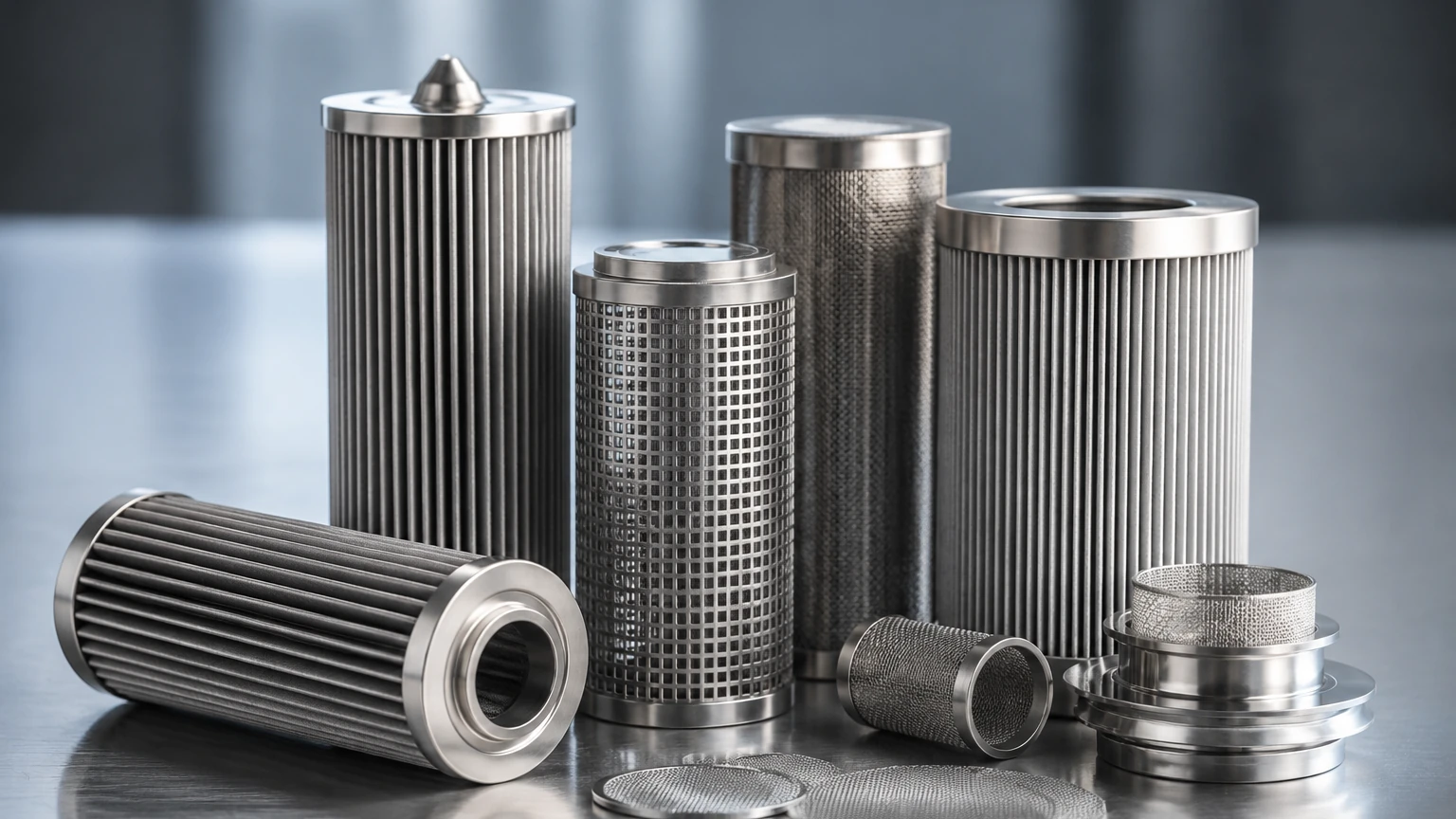
Stainless steel is the material of choice for demanding industrial environments because of its ability to withstand high net filtration pressures without deforming. However, the type of construction significantly impacts the calculation.
* Woven Wire Mesh: Offers a precise pore size and a high open area, resulting in lower initial NFP. It is ideal for surface filtration where easy cleaning is required.
* Sintered Metal Felt: Provides depth filtration. While the initial NFP might be slightly higher than a single-layer mesh, it has a higher dirt-holding capacity, meaning the NFP rises more slowly over time.
* Sintered Mesh Laminates: These combine multiple layers for structural strength. When calculating NFP for these, engineers must account for the added thickness (L) in the Darcy equation, which is offset by the increased structural support that allows for higher operating pressures.
For customized designs that balance these factors, technical teams often look to the Main Page of specialist manufacturers to evaluate which structural configuration best suits their specific NFP constraints.
Common Risks of Incorrect NFP Calculations
Failing to accurately answer "how do you calculate net filtration pressure" can lead to several systemic failures:
1. Pump Cavitation: If the NFP required to pull fluid through a suction-side filter is too high, the pump may experience cavitation, leading to mechanical damage and loss of prime.
2. Filter Collapse: Every filter element has a maximum collapse pressure. If the NFP exceeds this limit because of clogging or high viscosity, the stainless steel structure can fail, releasing contaminants downstream.
3. Inaccurate Flow Control: In precision chemical dosing or pharmaceutical applications, an unexpected rise in NFP can reduce flow rates, compromising the consistency of the final product.
4. Energy Inefficiency: Running a system at a higher NFP than necessary requires more electrical power for the pumps. Optimizing the filter area to reduce NFP is a direct way to lower the Total Cost of Ownership (TCO).
How to Optimize NFP Through Customization
Standard off-the-shelf filters often fail to meet the specific NFP requirements of specialized industrial processes. Customization allows engineers to manipulate the variables in the NFP equation to their advantage.
* Increasing Surface Area: By pleating the stainless steel mesh, the effective area (A) is increased significantly. According to Darcy’s Law, increasing the area inversely reduces the pressure drop, allowing for longer run times between cleanings.
* Material Selection: Using high-permeability alloys or specialized weave patterns can reduce the resistance (κ) of the medium.
* Structural Reinforcement: For high-viscosity fluids, adding a perforated inner core to a stainless steel cartridge allows the system to operate at a higher NFP without the risk of element deformation.
Conclusion: The Importance of Accurate Pressure Management
Understanding how do you calculate net filtration pressure is more than a theoretical exercise; it is a fundamental requirement for the safe and efficient operation of industrial filtration systems. By accurately measuring the pressure differential and understanding the factors—from fluid viscosity to media permeability—that drive it, engineers can design systems that are both robust and cost-effective.
Stainless steel filtration solutions provide the durability needed to handle significant pressure loads, but they must be sized and specified with precision. Whether you are dealing with high-temperature chemical processing or high-flow water treatment, the goal remains the same: maintaining the lowest possible NFP for the longest possible duration.
For those ready to move from calculation to implementation, exploring the technical specifications and OEM capabilities on the Main Page of a professional manufacturer is the next logical step. By collaborating with filtration experts, you can ensure that your system’s net filtration pressure is optimized for your specific industrial environment, ensuring longevity, purity, and performance.
Download How Do You Calculate Net Filtration Pressure as a PDF
