


Hydraulic Filter and Housing
In industrial hydraulic systems, the presence of particulate contamination is the primary cause of component wear, valve stiction, and catastrophic system failure. Maintaining fluid cleanliness is not merely a maintenance task but a core engineering requirement for system reliability. A robust hydraulic filter and housing assembly serves as the critical line of defense, isolating sensitive components from internal and external contaminants. Selecting the appropriate combination of filter media and housing geometry requires a deep understanding of fluid dynamics, pressure requirements, and the specific environmental conditions of the application.
As a manufacturer specializing in stainless steel filtration solutions, Kaifil understands that the efficacy of a hydraulic system depends on more than just the filter element. The housing must be engineered to withstand system pressures, facilitate efficient flow, and allow for seamless maintenance. This guide examines the technical considerations involved in selecting, integrating, and maintaining hydraulic filtration assemblies for demanding industrial environments.
The Role of Filtration in Hydraulic System Longevity
Hydraulic systems operate under high pressure and tight tolerances. Modern hydraulic valves and pumps often have clearances measured in microns. When particles enter these clearances, they cause abrasive wear, which generates more particles in a process known as wear regeneration. Without an effective hydraulic filter and housing, this cycle eventually leads to decreased efficiency, increased heat generation, and eventual system breakdown.
Contaminants enter hydraulic systems through several avenues: built-in contamination from the manufacturing process, ingression through seals and breathers, and internally generated wear debris. The filtration assembly must be strategically placed to address these sources. Whether it is a suction line filter protecting the pump, a high-pressure filter protecting sensitive valves, or a return line filter cleaning the fluid before it enters the reservoir, each component plays a specific role in maintaining the ISO 4406 cleanliness codes required for the system.
Anatomy of a Hydraulic Filter and Housing Assembly
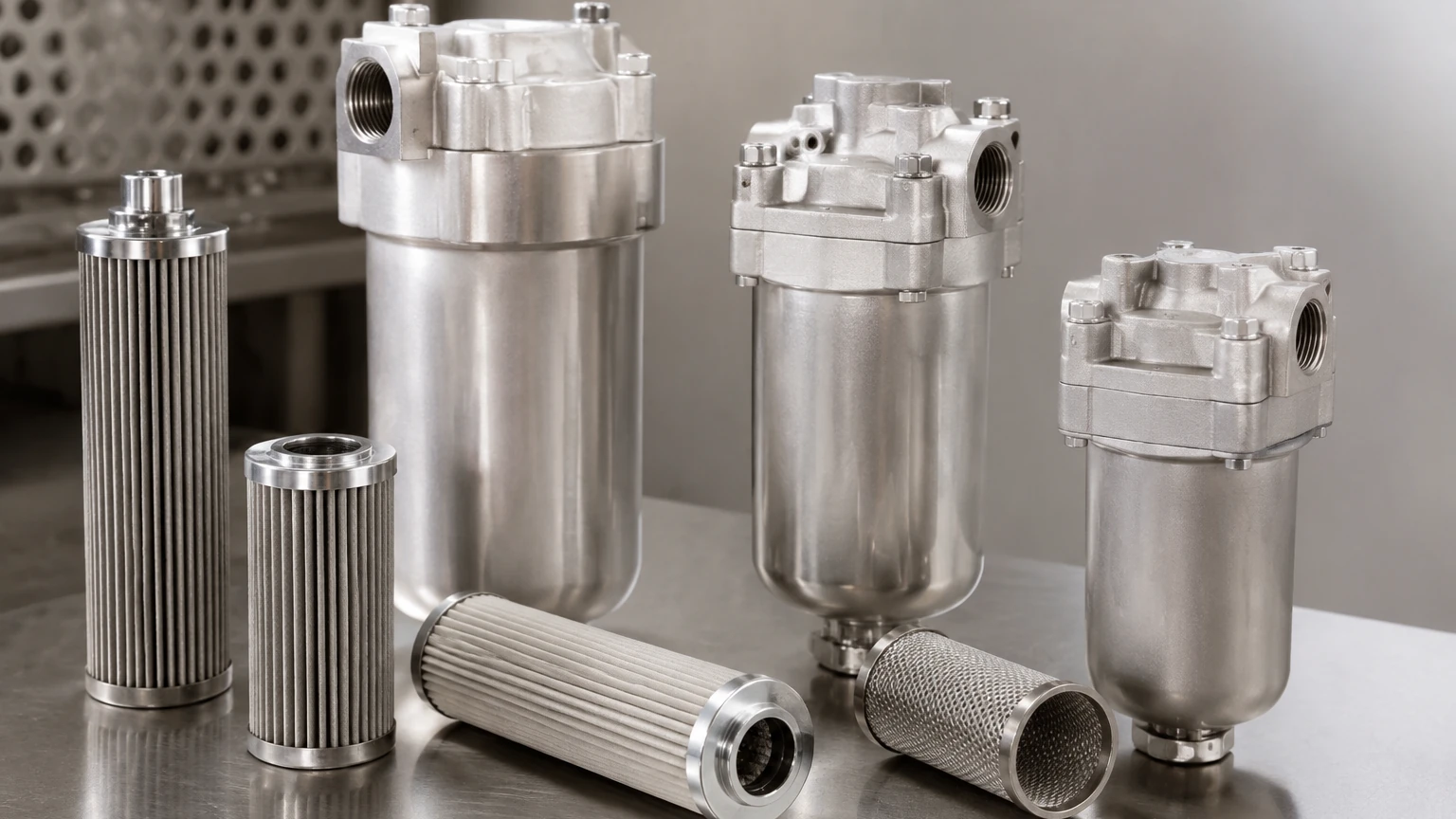
A complete filtration unit consists of two primary components: the housing (the vessel) and the filter element (the media). Understanding the interaction between these two is essential for system design.
The Filter Housing
The housing is the pressure vessel that contains the filter element. It must be designed to handle the maximum operating pressure of the system, including pressure spikes or "water hammer" effects. Housings are typically constructed from aluminum, cast iron, or stainless steel. For corrosive environments or high-purity applications, stainless steel is the preferred material due to its superior durability and resistance to chemical degradation.
Key features of a high-quality housing include:
* Inlet and Outlet Ports: Sized to match system flow rates to minimize pressure drop.
* Bypass Valve: A safety mechanism that allows fluid to bypass the filter element if it becomes completely clogged, preventing the element from collapsing or the housing from bursting.
* Clogging Indicators: Mechanical or electrical sensors that alert operators when the pressure differential across the element reaches a critical threshold.
The Filter Element
The element is the consumable or cleanable part of the assembly. In industrial applications, stainless steel wire mesh elements are often used because they offer high structural integrity and can be cleaned and reused. Unlike disposable cellulose or synthetic media, stainless steel elements can withstand high differential pressures and extreme temperatures without shedding fibers into the fluid stream.
Engineering Considerations for Housing Design
When specifying a hydraulic filter and housing, engineers must account for several physical and operational variables. The goal is to achieve the required cleanliness level with the lowest possible pressure drop ($ΔP$).
Pressure Ratings
Housings are categorized by their placement in the circuit. High-pressure housings, located downstream of the pump, must often withstand pressures exceeding 3,000 to 6,000 PSI. Return line housings, conversely, operate at much lower pressures but must handle high flow surges. It is critical to confirm that the housing's fatigue rating matches the expected cycle life of the machinery.
Flow Dynamics and Pressure Drop
Every component in a hydraulic circuit introduces a pressure drop. The total $ΔP$ of a filtration assembly is the sum of the pressure drop across the empty housing and the pressure drop across the clean filter element. If the housing is undersized, the fluid velocity increases, leading to turbulence and an excessive pressure drop that can trigger the bypass valve prematurely. Engineers should aim for a clean $ΔP$ that is no more than 1/3 of the bypass valve setting.
Seal Compatibility
The seals within the housing (O-rings and gaskets) must be compatible with the hydraulic fluid being used. While Nitrile (Buna-N) is standard for mineral oils, synthetic fluids like phosphate esters or water-glycols may require Viton (FKM) or EPDM seals to prevent swelling and leakage.
Selecting the Right Filter Media for Industrial Applications
The choice of filter media determines the efficiency of the hydraulic filter and housing assembly. For many industrial B2B applications, the transition from disposable elements to permanent stainless steel media provides significant long-term value.
Stainless Steel Wire Mesh
Stainless steel wire mesh filters are ideal for suction lines and high-temperature applications. They provide precise pore sizes and are highly resistant to corrosion. Because they are rigid, they do not experience the "media migration" common in fiber-based filters. For those interested in exploring the technical specifications of these components, the Main Page of the Kaifil website offers detailed insights into material grades and weave types.
Sintered Metal Fiber
For applications requiring high dirt-holding capacity and fine filtration (down to 1-5 microns), sintered metal fibers provide a porous structure that combines the benefits of depth filtration with the durability of stainless steel. This is particularly useful in hydraulic systems operating in harsh environments where element changes are difficult or costly.
Performance Metrics: Micron Ratings and Beta Ratios
To evaluate the effectiveness of a hydraulic filter and housing, engineers rely on standardized metrics defined by ISO 16889 (the Multi-pass Test).
Micron Rating: Nominal vs. Absolute
* Nominal Rating: An arbitrary micrometer value indicated by the manufacturer. It suggests that the filter will stop a percentage of particles of that size, but it lacks a standardized efficiency.
* Absolute Rating: The diameter of the largest hard spherical particle that will pass through the filter under specified test conditions. For critical hydraulic components, absolute-rated filters are mandatory.
The Beta Ratio (β)
The Beta ratio is the most accurate way to represent filter efficiency. It is the ratio of the number of particles of a given size upstream of the filter to the number of particles of the same size downstream. For example, a $β_{10} ≥ 200$ means that for every 200 particles of 10-micron size entering the filter, only one passes through. This equates to 99.5% efficiency. When purchasing a filtration assembly, always confirm the Beta ratio at the specific micron level required by your system's most sensitive component.
Maintenance, Indicators, and Total Cost of Ownership
The most common error in hydraulic maintenance is changing filters on a time-based schedule rather than a condition-based schedule. Changing a filter too early wastes money and risks introducing air or contaminants into the system. Changing it too late allows the system to run in bypass mode, meaning the fluid is not being filtered at all.
Differential Pressure Indicators
A hydraulic filter and housing should always be equipped with a differential pressure indicator. Visual indicators (pop-up pins or gauges) allow for quick walk-by inspections, while electrical indicators can be integrated into the machine's PLC to trigger alarms or shut down the system if the filter becomes blocked. This proactive approach protects the system and optimizes the replacement cycle.
Total Cost of Ownership (TCO)
While stainless steel housings and cleanable elements may have a higher initial purchase price than plastic or carbon steel alternatives, their TCO is often lower. The durability of the housing reduces the risk of leaks and failures, and the ability to clean and reuse stainless steel elements eliminates the recurring cost of purchasing, stocking, and disposing of fiberglass or paper cartridges.
Customization and OEM Solutions in Hydraulic Filtration
Standard off-the-shelf filtration units do not always meet the spatial or performance constraints of specialized industrial machinery. In these instances, custom-engineered solutions become necessary. Customization can involve:
* Non-standard Porting: Adapting the housing to fit specific manifold blocks or unique piping configurations.
* Extreme Environment Adaptation: Utilizing 316L stainless steel or specialized coatings for offshore or chemical processing environments.
* Integrated Manifolds: Combining multiple filtration stages or adding integrated valves into a single housing block to reduce leak points and footprint.
Kaifil specializes in providing these OEM and customized filtration solutions. By working closely with engineering teams, we develop components that meet exact filtration accuracies while ensuring mechanical compatibility with existing hydraulic circuits. From the initial material selection to the final performance testing, our focus is on delivering reliability in demanding industrial environments.
Conclusion
Selecting the right hydraulic filter and housing is a balance of fluid science and mechanical engineering. By focusing on absolute micron ratings, appropriate pressure fatigue limits, and high-quality materials like stainless steel, purchasing teams and engineers can significantly extend the service life of their hydraulic equipment.
Before finalizing a filtration specification, it is essential to confirm the fluid type, flow rates, and the cleanliness level required by the system's most sensitive component. For more information on professional-grade stainless steel filtration components and customized engineering support, visit the Main Page to review product options and application support. Proper filtration is an investment in uptime, and choosing the right partner for your filtration needs ensures that your hydraulic systems operate at peak efficiency for years to come.
