


Laboratory Filter Press
In industrial research and development, the laboratory filter press serves as a critical bridge between bench-top experimentation and full-scale production. Designed to simulate the performance of large-scale industrial filter presses, these compact units allow engineers to evaluate the filterability of various slurries, determine optimal cycle times, and select the most effective filter media. For technical professionals in the chemical processing, pharmaceutical, and food and beverage sectors, understanding the technical nuances of a laboratory filter press is essential for optimizing solid-liquid separation processes.
As a specialized manufacturer of stainless steel filtration solutions, Kaifil recognizes that the accuracy of laboratory testing directly impacts the efficiency of industrial operations. This guide examines the engineering principles, material considerations, and performance metrics associated with laboratory filter presses to assist engineers in making informed technical decisions.
Understanding the Role of the Laboratory Filter Press in Industrial R&D
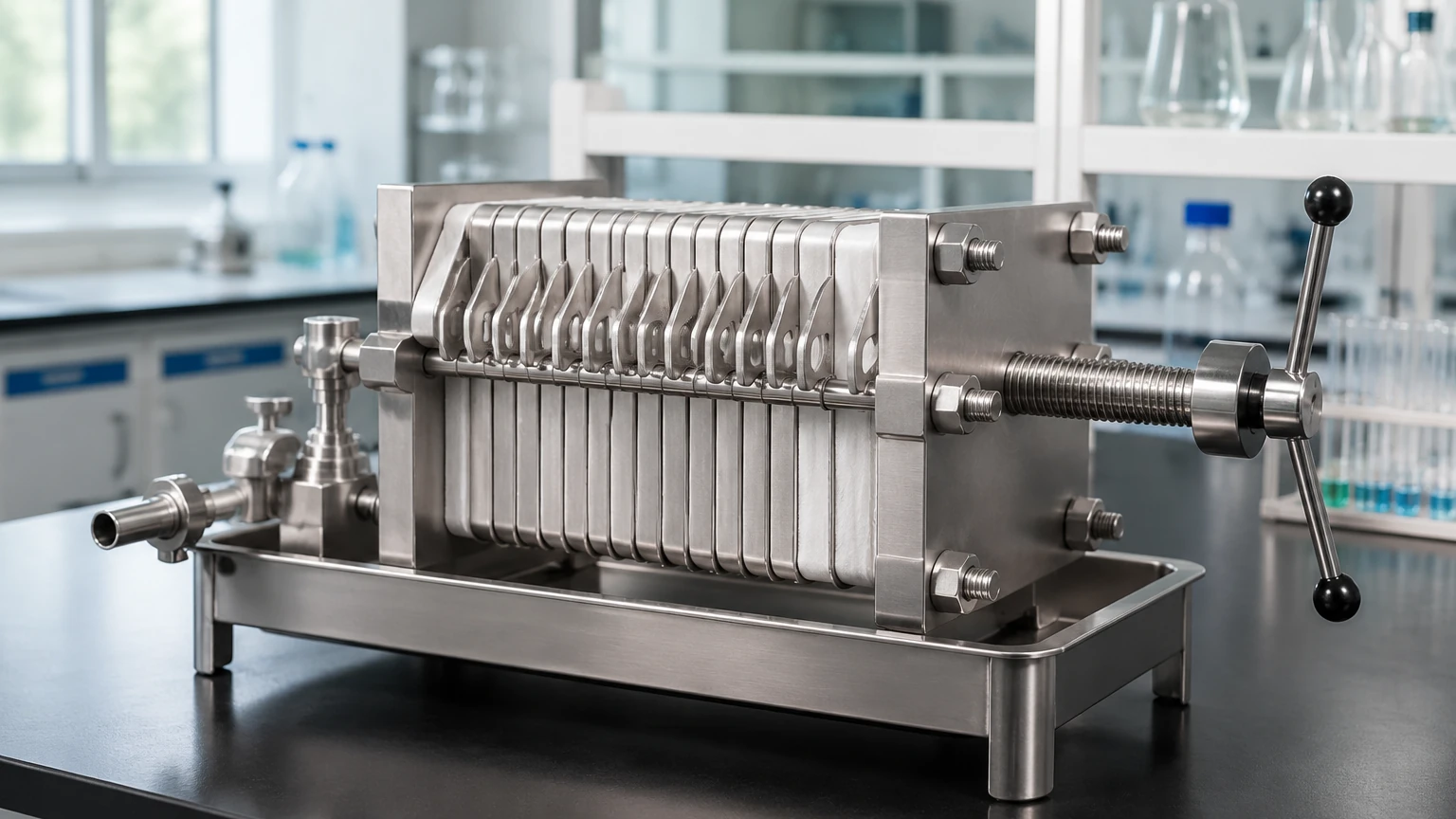
A laboratory filter press is a batch-operation device used to separate solids from liquids through pressure filtration. Unlike continuous filtration systems, the batch nature of the filter press allows for precise control over variables such as pressure, temperature, and cake thickness. In a laboratory setting, these units typically range in size from a few hundred square centimeters to several square meters of filtration area.
The primary objective of using a laboratory filter press is to gather empirical data. Engineers use these units to develop "filterability curves," which plot filtrate volume against time at constant pressure. This data is indispensable when designing a full-scale plant, as it helps determine the required filtration area, the necessary pump capacity, and the expected moisture content of the resulting filter cake.
Furthermore, laboratory-scale testing is vital for testing new chemical formulations or evaluating the impact of pre-treatment steps, such as flocculation or pH adjustment. By performing these tests on a small scale, facilities can minimize waste and reduce the costs associated with trial-and-error at the production level.
Core Engineering Principles and Design Variations
The operation of a laboratory filter press relies on the application of mechanical or hydraulic pressure to force a slurry through a filter medium. The solids are retained on the surface or within the structure of the medium, forming a "cake," while the clarified liquid (filtrate) passes through.
Plate and Frame vs. Recessed Chamber Designs
In laboratory environments, two primary designs are prevalent:
1. Plate and Frame: This traditional design consists of alternating solid plates and hollow frames. The filter medium (such as stainless steel wire mesh or cloth) is placed between the plate and the frame. The slurry fills the frame, and the cake builds up within the hollow space. This design is highly versatile for testing different cake thicknesses by simply changing the frame depth.
2. Recessed Chamber: In this design, the plates themselves have a recessed area. When two plates are clamped together, they form a chamber. This design is often preferred for high-pressure applications and automated cake discharge simulations, as it eliminates the need for separate frames and reduces the number of sealing surfaces.
Pressure Dynamics
Laboratory filter presses are typically operated using either a constant-pressure or a constant-rate filtration method. For most R&D purposes, constant-pressure filtration is used to mimic the behavior of diaphragm pumps or centrifugal pumps. Engineering teams must evaluate how the structural integrity of the filter media—such as precision metal filter components—withstands these pressure differentials without deforming or allowing particle bypass.
Material Engineering: The Importance of Stainless Steel Components
Material selection is perhaps the most critical factor in ensuring the longevity and accuracy of a laboratory filter press. Because these units are often exposed to aggressive solvents, corrosive chemicals, and high temperatures, the choice of construction material must be based on rigorous chemical compatibility standards.
Stainless steel, particularly grades 304 and 316L, is the industry standard for high-performance laboratory filtration. Unlike plastic or coated carbon steel, stainless steel provides superior resistance to corrosion and thermal degradation. In pharmaceutical and food-grade applications, the non-reactive nature of stainless steel prevents batch contamination, ensuring that the laboratory results are a true reflection of the process chemistry.
Kaifil specializes in custom stainless steel filtration solutions, providing components that are engineered to maintain tight tolerances under mechanical stress. When selecting a laboratory filter press, engineers should confirm that all wetted parts—including the plates, manifolds, and internal piping—are constructed from materials that match the intended industrial environment. This ensures that the scale-up data remains consistent when transitioning to large-scale stainless steel filter cartridges or industrial-sized mesh filters.
Optimizing Filtration Efficiency with Precision Filter Media
The performance of a laboratory filter press is fundamentally limited by the quality of the filter media. While the press provides the mechanical structure and pressure, the media performs the actual separation. In modern industrial laboratories, there is a growing shift toward using stainless steel wire mesh filters and precision metal components over traditional fabric cloths.
Advantages of Stainless Steel Wire Mesh
Stainless steel wire mesh offers several technical advantages in a laboratory setting:
* Fixed Pore Size: Unlike textile cloths that can stretch or swell, metal mesh maintains a consistent micron rating, ensuring reproducible results across multiple test runs.
* Thermal Stability: Metal media can operate at temperatures that would melt or degrade synthetic fibers, allowing for the testing of high-temperature chemical processes.
* Ease of Cleaning: Stainless steel components are compatible with aggressive Clean-in-Place (CIP) chemicals and ultrasonic cleaning, reducing the risk of cross-contamination between different slurry samples.
When configuring a laboratory filter press, engineers must select the appropriate mesh weave (such as plain, twilled, or dutch weave) based on the particle size distribution of the slurry. A finer weave provides higher clarity but may increase resistance and cycle time, whereas a coarser weave allows for higher flow rates at the expense of filtrate quality.
Critical Performance Metrics and Scaling Considerations
To successfully transition from a laboratory filter press to a production-scale system, engineers must track several key performance indicators (KPIs) during testing:
1. Specific Cake Resistance: This is a calculated value that describes how much resistance the forming cake offers to the flow of filtrate. It is a fundamental parameter for sizing industrial equipment.
2. Filtrate Clarity: Measured in NTU (Nephelometric Turbidity Units) or ppm, clarity indicates the efficiency of the filter media in capturing fine particles.
3. Cake Moisture Content: After the filtration cycle, the cake is often subjected to an "air blow" or "membrane squeeze." Measuring the residual moisture is vital for industries where the solid cake is the final product or where disposal costs are based on weight.
4. Cycle Time: This includes the time for filling, filtration, cake washing, air blowing, and cake discharge. Laboratory testing helps optimize these phases to maximize the throughput of the eventual industrial installation.
It is important to note that scaling is not always linear. Factors such as wall effects in small lab chambers and differences in feed pump hydraulics can introduce variables. Therefore, engineers often apply a safety factor (typically 1.2 to 1.5) when moving from lab data to full-scale equipment specifications. For more information on how to match laboratory results with industrial-grade components, you can visit the Main Page to review technical specifications for various filtration media.
Operational Maintenance and Cleaning Protocols
Maintaining the precision of a laboratory filter press requires a disciplined approach to maintenance. Because these units are used for multiple different products, preventing "blinding" (the clogging of the filter media pores) is a primary concern.
Cleaning Procedures
In a laboratory environment, manual cleaning is often necessary. After each test, the filter plates should be inspected for residual solids. For stainless steel wire mesh filters, backwashing with a compatible solvent or using an ultrasonic bath is recommended to remove sub-micron particles trapped within the weave. If the media becomes permanently blinded, it will result in artificially high pressure readings and inaccurate scale-up data.
Component Inspection
Regularly inspect the sealing surfaces of the plates. Even minor scratches or deformations can lead to leaking under pressure, which poses a safety risk and compromises the accuracy of filtrate volume measurements. Gaskets and O-rings should be replaced at the first sign of wear or chemical swelling.
Selecting the Ideal Laboratory Filter Press for Specific Industrial Applications
When purchasing or specifying a laboratory filter press, engineering teams should evaluate the following criteria to ensure the unit meets their long-term R&D needs:
* Customization Options: Can the unit be fitted with different types of plates or media? The ability to switch between stainless steel mesh and specialized filter cartridges is highly beneficial for versatile labs.
* Automation Level: While manual units are cost-effective, semi-automated units with digital pressure sensors and flow meters provide more accurate data logging for complex research projects.
* Safety Features: Ensure the unit includes pressure relief valves and robust clamping mechanisms to handle the maximum operating pressures required for the test protocols.
* Supplier Expertise: Partner with a manufacturer that understands the nuances of industrial filtration. A supplier like Kaifil, with experience in providing reliable OEM and customized filtration solutions, can offer valuable insights into material selection and component design.
By focusing on these technical parameters, engineers can ensure that their laboratory filter press provides the reliable data necessary to optimize industrial processes, reduce operational costs, and maintain high standards of product purity. Whether you are working in chemical processing or water treatment, the integration of high-quality stainless steel filtration components is the foundation of a successful separation strategy. For detailed product options and application support regarding precision metal filter components, please refer to our Main Page.
