


Indufil
In the landscape of industrial fluid management, high-performance filtration is a critical safeguard for expensive machinery and sensitive processes. Systems requiring "indufil" standards—often associated with high-pressure oil, gas, and chemical processing—demand components that can withstand extreme operational stresses while maintaining precise filtration accuracy. For engineers and procurement teams, understanding the technical nuances of these filtration elements is essential for ensuring system reliability and optimizing maintenance cycles.
Industrial filtration is not merely about removing particles; it is about managing fluid dynamics, chemical compatibility, and structural integrity under pressure. Whether dealing with hydraulic systems, gas turbines, or chemical reactors, the choice of filter media and housing design directly impacts the total cost of ownership and the operational lifespan of downstream equipment.
The Role of High-Performance Filtration in Critical Systems
High-performance filtration systems, such as those meeting indufil specifications, are primarily utilized in environments where downtime is not an option. These systems are common in the power generation, oil and gas, and petrochemical sectors. The primary function is to protect critical components—such as bearings, seals, and fuel nozzles—from particulate contamination that can lead to abrasive wear or catastrophic failure.
In gas turbine applications, for instance, the filtration of lube oil is paramount. The presence of even microscopic contaminants can cause significant damage to high-speed bearings. Similarly, in chemical processing, the purity of the media determines the quality of the final product and the efficiency of the reaction. High-performance filter elements are designed to provide a high dirt-holding capacity and low initial pressure drop, ensuring that the system operates within its designed parameters for as long as possible.
Technical Specifications of Industrial Filter Elements
When evaluating filtration components, engineers must look beyond basic dimensions. The performance of a filter is defined by several key technical metrics:
Filtration Rating: Absolute vs. Nominal
In critical industrial applications, absolute filtration ratings are preferred. An absolute rating signifies that the filter will remove 99.9% (or a specific Beta ratio, such as $\beta_x \geq 1000$) of particles larger than the specified micron size. Nominal ratings are less precise and indicate a general capability, which may not be sufficient for protecting high-precision machinery.
Beta Ratio ($\beta$)
The Beta ratio is a standard measure of filtration efficiency based on ISO 16889. It compares the number of particles upstream of the filter to the number of particles downstream. For example, a Beta ratio of 1000 means that for every 1000 particles of a certain size entering the filter, only one passes through. This level of precision is often required for indufil-type applications in hydraulic and lubrication systems.
Collapse Pressure
Filter elements must be able to withstand the differential pressure ($\Delta P$) that builds up as the filter captures contaminants. If the differential pressure exceeds the element's collapse rating, the filter media may fail, allowing unfiltered fluid and filter debris to bypass into the system. High-quality stainless steel supports and reinforced cores are used to ensure high collapse resistance, often exceeding 20 bar or more depending on the application.
Material Selection: Stainless Steel and Wire Mesh Engineering
Material selection is one of the most significant factors in filter performance, especially in demanding environments. While disposable fiberglass or cellulose media are common in light-duty applications, industrial-grade filtration often necessitates the use of stainless steel.
Stainless Steel Wire Mesh
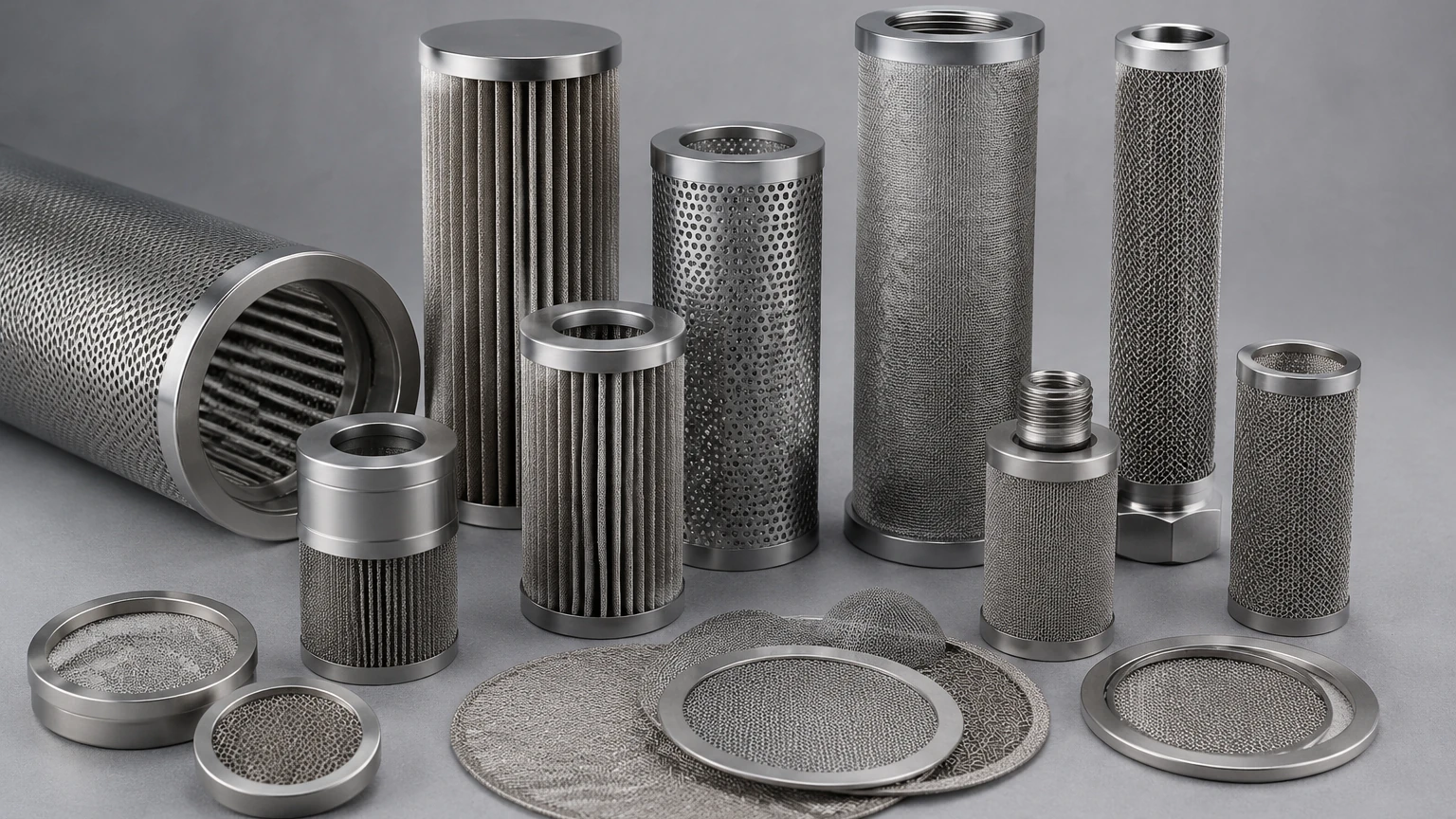
Stainless steel wire mesh filters offer several advantages, including high temperature resistance, excellent chemical compatibility, and the ability to be cleaned and reused. These are typically constructed from 304 or 316L stainless steel. For highly corrosive environments, specialized alloys like Hastelloy or Monel may be used. The mesh can be woven in various patterns—such as plain weave, twilled weave, or Dutch weave—to achieve specific filtration levels and flow characteristics.
Pleated vs. Cylindrical Designs
Pleating the filter media significantly increases the effective surface area without increasing the overall footprint of the filter element. This increased surface area results in a lower face velocity, a lower initial pressure drop, and a much higher dirt-holding capacity. For applications where high flow rates are required within a compact housing, pleated stainless steel elements are the standard choice.
Engineering for Pressure and Flow Stability
The structural design of the filter element must account for the fluid's viscosity, flow rate, and potential pressure surges. In systems where indufil standards are applied, the filter must maintain its geometry under fluctuating loads. This is achieved through advanced manufacturing techniques:
* Support Layers: High-performance elements often feature multiple layers of media. A fine filtration layer is sandwiched between coarser support layers that provide mechanical strength and protect the fine mesh from hydraulic shock.
* End Cap Bonding: The connection between the filter media and the end caps is a common point of failure. In stainless steel filters, TIG welding or specialized adhesive bonding is used to ensure a leak-proof seal that can withstand thermal expansion and contraction.
* Center Tube Strength: The internal core or center tube must be perforated to allow flow while providing the necessary hoop strength to prevent collapse under high differential pressure.
For technical professionals seeking to optimize these parameters, reviewing comprehensive product data on a Main Page can provide insights into how different configurations affect overall system performance.
Customization and OEM Filtration Solutions
Standard off-the-shelf filters often fall short when dealing with unique system constraints or specialized chemical processes. This is where customization becomes vital. Manufacturers like Kaifil specialize in developing bespoke filtration solutions that meet the exact requirements of an OEM or a specific industrial site.
Customization options include:
* Bespoke Dimensions: Tailoring the length, diameter, and fitting types to match existing housings, including those designed for indufil elements.
* Specific Micron Ratings: Engineering the mesh density to target specific contaminant profiles identified through oil analysis or process monitoring.
* Material Upgrades: Substituting standard materials with high-alloy steels or specialized coatings to handle aggressive fluids or extreme temperatures.
By working closely with a manufacturer, engineers can ensure that the replacement elements they procure are not just "will-fits" but are engineered to perform as well as or better than the original components.
Maintenance, Cleaning, and Replacement Cycles
Maintaining a filtration system is a balance between protecting equipment and managing operational costs. Monitoring the differential pressure is the most reliable way to determine when a filter element needs attention. Most industrial systems are equipped with $\Delta P$ indicators or transmitters that signal when a pre-set threshold is reached.
Cleaning Reusable Elements
One of the primary benefits of stainless steel wire mesh filters is their cleanability. Depending on the type of contaminant, elements can be cleaned using:
* Ultrasonic Cleaning: Using high-frequency sound waves in a cleaning solvent to dislodge fine particles from deep within the mesh.
* Backwashing: Reversing the flow of fluid through the filter to flush out contaminants.
* Chemical Cleaning: Using acids or alkalis to dissolve organic or inorganic deposits, provided the filter material is compatible.
It is important to note that repeated cleaning can eventually fatigue the metal or slightly alter the pore size. Therefore, a maximum number of cleaning cycles should be established based on the manufacturer's recommendations and regular bubble-point testing.
Evaluating Total Cost of Ownership in Industrial Filtration
When purchasing filtration components, the initial price is often a small fraction of the total cost of ownership (TCO). A lower-cost, lower-quality filter may lead to higher costs in other areas:
1. Energy Consumption: A filter with a high initial pressure drop requires the pump to work harder, increasing energy costs over the life of the element.
2. Labor Costs: Frequent filter changes due to low dirt-holding capacity increase labor requirements and the risk of system contamination during the change-out process.
3. Equipment Wear: Poor filtration efficiency allows contaminants to circulate, leading to premature wear of valves, pumps, and actuators.
4. Disposal Costs: Disposable elements generate waste and associated disposal fees, whereas cleanable stainless steel elements offer a more sustainable and often more cost-effective long-term solution.
By investing in high-quality, precision-engineered elements that meet the rigorous standards of indufil applications, organizations can significantly reduce their long-term operational risks and expenses.
Conclusion
Selecting the right filtration solution requires a deep understanding of both the process requirements and the engineering capabilities of the filter elements. From material selection and micron ratings to structural integrity and cleanability, every detail matters in high-stakes industrial environments. For those looking to explore a wide range of custom stainless steel filtration options and technical support, visiting the Main Page of a professional manufacturer is the first step toward achieving optimized filtration performance. By focusing on quality and technical precision, engineers can ensure their systems remain protected, efficient, and reliable.
