


Coalescer Filter Design
In industrial processing, the separation of immiscible liquids or the removal of entrained moisture from gas streams is a critical requirement for protecting downstream equipment and ensuring product purity. Coalescer filter design is the engineering discipline focused on facilitating the merging of small droplets into larger ones, which can then be easily separated by gravity. Whether in hydraulic systems, chemical processing, or fuel filtration, the efficiency of a coalescer depends heavily on the interaction between fluid dynamics, material science, and structural engineering.
For engineers and procurement teams, understanding the nuances of coalescer filter design is essential for selecting components that balance filtration accuracy with operational longevity. A well-designed coalescer not only improves separation efficiency but also minimizes maintenance intervals and total cost of ownership.
Understanding the Fundamentals of Coalescence in Industrial Filtration
Coalescence is a multi-stage physical process. In an industrial coalescer filter, the primary goal is to take a stable emulsion or a fine mist and transform it into a manageable state. This typically involves three distinct phases: capture, coalescence, and release.
In the capture phase, fine droplets (the dispersed phase) travel through a continuous phase, such as oil or gas, and come into contact with the filter media. This occurs through mechanisms like direct interception, inertial impaction, or Brownian diffusion. Once captured, these droplets must adhere to the media fibers or mesh.
In the coalescence phase, the captured droplets move along the fibers and collide with other droplets, merging to form larger globules. Finally, in the release phase, these enlarged droplets are pushed through the media by the fluid flow. Because they are now significantly larger and heavier, they can be separated from the main flow via gravity or a secondary separator stage. Effective coalescer filter design ensures that these phases occur without high pressure drops or the risk of "re-entrainment," where droplets are sheared back into smaller sizes by high-velocity flow.
Critical Parameters in Coalescer Filter Design
The performance of a coalescing system is governed by several technical parameters that must be optimized during the design phase. These include media properties, fluid velocity, and the physical characteristics of the fluids involved.
Media Selection and Surface Energy
The choice of media is perhaps the most critical aspect of coalescer filter design. The media must have an affinity for the dispersed phase (the liquid to be removed). For water-in-oil separation, hydrophilic (water-attracting) materials are often used to encourage water droplets to cling to the surface and grow. Conversely, in some gas-liquid applications, hydrophobic coatings may be used on secondary stages to prevent water from passing through.
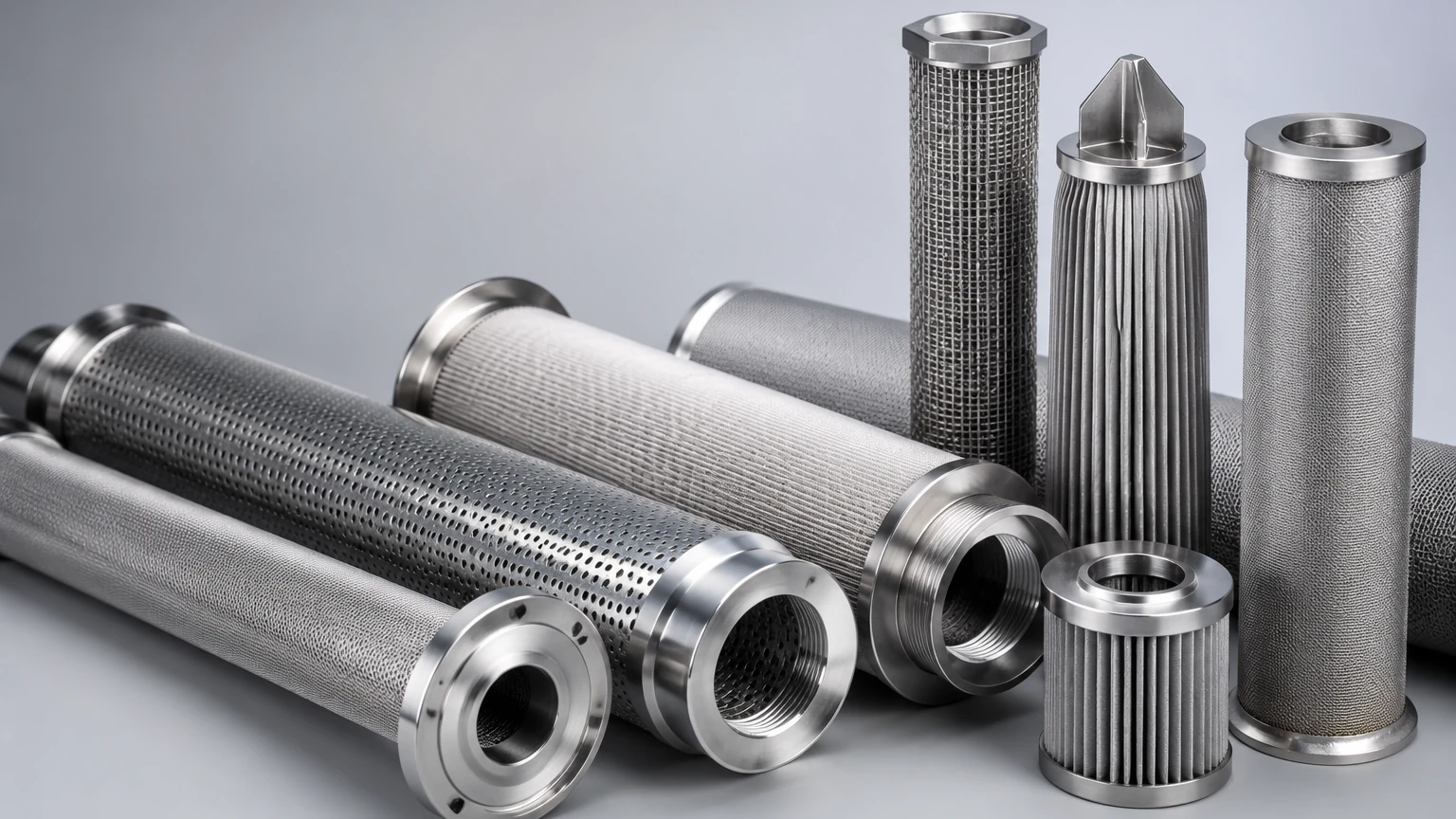
Stainless steel wire mesh and sintered metal fibers are frequently used in high-performance coalescers due to their precise pore structures and ability to withstand harsh chemical environments. The surface roughness and fiber diameter of the stainless steel media are engineered to maximize the surface area available for droplet attachment.
Flow Velocity and Residence Time
Flow velocity significantly impacts separation efficiency. If the velocity is too high, the kinetic energy of the fluid may prevent droplets from attaching to the media or, worse, cause already-formed large droplets to break apart (re-entrainment). Designers must calculate the "face velocity"—the speed of the fluid as it enters the media—to ensure it remains within the optimal range for the specific fluid viscosity and surface tension. Adequate residence time within the media is necessary to allow the coalescence process to complete.
Fluid Properties: Viscosity and Surface Tension
Viscosity affects the mobility of droplets within the continuous phase. High-viscosity fluids resist the movement of droplets, requiring larger filter surface areas or specialized media structures. Surface tension and interfacial tension determine how easily droplets merge. In systems with low interfacial tension (often caused by the presence of surfactants), coalescence becomes much more difficult, requiring advanced media treatments or multi-stage designs.
Material Engineering for Harsh Industrial Environments
Industrial filtration often takes place in demanding environments characterized by high temperatures, high pressures, and corrosive chemicals. In such cases, the materials used in coalescer filter design must be selected for durability as much as for separation efficiency.
Stainless steel (specifically grades 304 and 316L) is the preferred material for many custom filtration solutions. Its inherent resistance to oxidation and corrosion makes it ideal for chemical processing and offshore applications. Furthermore, stainless steel filter elements provide the structural integrity required to withstand high differential pressures without collapsing.
Unlike disposable synthetic media, stainless steel components can often be cleaned and reused, which is a significant factor in reducing long-term operational costs. When designing these filters, engineers must consider the compatibility of the gaskets, adhesives, and support structures with the process fluid to prevent premature failure. For those evaluating technical specifications and material options, visiting the Main Page of a specialist manufacturer can provide deeper insights into the available configurations for specific industrial needs.
Structural Components and Vessel Configuration
A coalescer filter is rarely a standalone element; it is part of a larger pressure vessel system. The internal design of the vessel plays a major role in how well the filter performs.
Vertical vs. Horizontal Orientation
Coalescer vessels are typically designed in either vertical or horizontal configurations. Horizontal vessels are often preferred for liquid-liquid separation because they provide a larger surface area for the droplets to settle out of the flow after they have been coalesced. Vertical vessels are more common in gas-liquid applications where space is limited and the primary goal is to remove liquid mist from a gas stream.
The Role of the Sump and Drainage
Once the droplets have coalesced and grown large enough to fall out of the flow, they must be collected. Coalescer filter design includes a "sump" or collection area at the bottom (for heavier liquids like water) or top (for lighter liquids) of the vessel. The design must ensure that the collected liquid is not agitated back into the clean fluid stream. Automated drain valves and level sensors are often integrated into the design to manage the removal of the separated phase.
Support and Pleating
To maximize the filtration area within a compact footprint, many coalescer elements use a pleated design. Pleating increases the surface area of the stainless steel mesh or fiber, allowing for lower flux rates and better droplet capture. However, the pleat density must be carefully managed; if pleats are too tight, they can trap contaminants and lead to rapid pressure buildup.
Performance Metrics and Selection Criteria
When specifying a coalescer, engineers must look beyond simple micron ratings. The effectiveness of a coalescer is measured by its ability to reduce the concentration of the dispersed phase to a specific level (e.g., reducing water content in fuel from 5,000 ppm to less than 10 ppm).
Beta Ratios and Efficiency
While Beta ratios are traditionally used for particulate filtration, similar efficiency metrics are applied to coalescers to describe the percentage of droplets of a certain size that are removed. A high-efficiency coalescer will typically target droplets in the 0.3 to 10-micron range, as these are the most difficult to separate by gravity alone.
Differential Pressure (ΔP)
The pressure drop across the filter is a key indicator of its condition. A well-designed coalescer should operate with a low initial differential pressure. As the filter captures particulates (which often coexist with the liquid droplets), the ΔP will rise. Designers must ensure the element can handle the maximum expected ΔP in the system without bypassing or structural failure.
Total Cost of Ownership (TCO)
In B2B procurement, the initial purchase price of a coalescer element is only one part of the equation. Factors such as the frequency of replacement, the cost of downtime, and the ability to clean the media significantly impact the TCO. Stainless steel coalescer designs, while often requiring a higher initial investment than disposable glass fiber elements, frequently offer a lower TCO due to their longevity and cleanability.
Customization and OEM Integration for Specific Applications
No two industrial processes are identical, and off-the-shelf filtration solutions often fall short of specific performance requirements. Custom coalescer filter design allows for the optimization of media layers, pore sizes, and hardware dimensions to suit a particular application.
For instance, in the pharmaceutical or food and beverage industries, filters must meet strict sanitary standards. This requires specialized welding techniques and surface finishes on the stainless steel components to prevent bacterial growth. In hydraulic applications, the design must account for rapid pressure fluctuations and high-viscosity oils.
Working with a manufacturer that offers OEM capabilities allows engineering teams to develop filtration components that fit perfectly into existing machinery while meeting precise performance benchmarks. This technical collaboration ensures that factors like chemical compatibility, flow dynamics, and mechanical vibration are all addressed during the design phase, rather than corrected after installation.
By focusing on the rigorous principles of coalescer filter design, industries can achieve superior separation results, protect their high-value equipment, and maintain the highest standards of product quality. Whether the goal is removing water from aviation fuel or recovering valuable catalysts in a chemical plant, the right design makes the difference between process efficiency and costly failure.
