


Industrial Candle Filter
In the landscape of industrial process engineering, the industrial candle filter stands as a critical component for high-precision liquid and gas separation. These filters, characterized by their long, cylindrical shape resembling candles, are designed to provide a large filtration surface area within a compact vessel footprint. For engineers and procurement specialists in sectors such as chemical processing, pharmaceuticals, and food production, understanding the technical nuances of these components is essential for maintaining operational efficiency and product purity.
At Kaifil, the focus remains on the precision manufacturing of stainless steel filtration solutions that meet the rigorous demands of modern industry. Whether utilized for catalyst recovery or the clarification of high-viscosity fluids, the industrial candle filter must be engineered to withstand extreme pressure differentials, corrosive environments, and high temperatures. This guide examines the technical specifications, selection criteria, and engineering considerations necessary for integrating these filters into industrial systems.
Technical Architecture of a Candle Filter
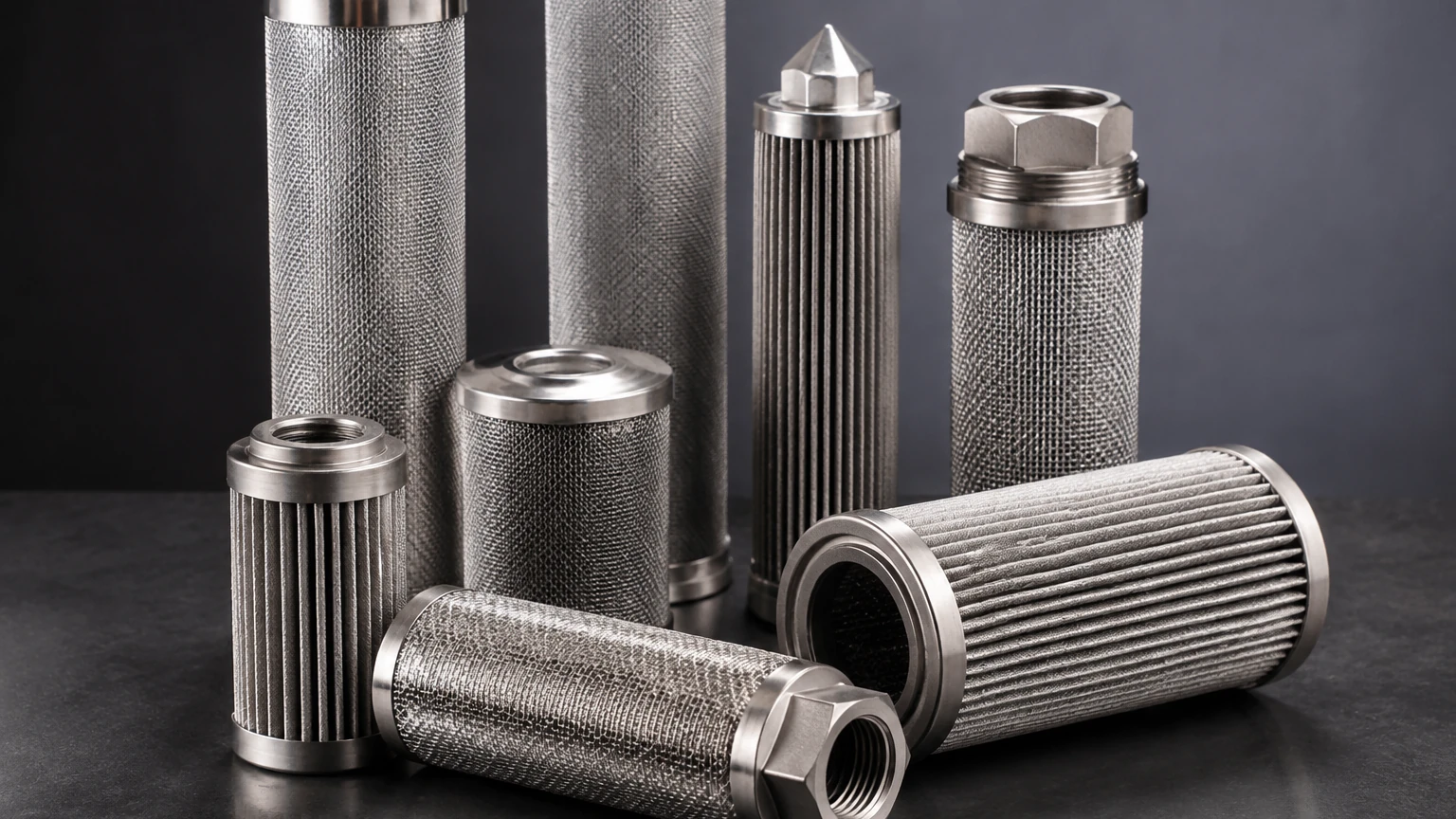
An industrial candle filter is not a singular piece of equipment but an assembly of precision-engineered parts. The core of the system is the filter element itself, which typically consists of a perforated support core wrapped or layered with a filtration medium.
The Support Core
In high-pressure applications, the structural integrity of the filter is paramount. The support core is usually a perforated stainless steel tube or a robust spring-like structure. Its primary function is to prevent the filtration media from collapsing under the weight of the filter cake or the force of the fluid flow. For applications involving frequent backwashing, the core must also resist internal pressure during the cleaning cycle.
Filtration Media
The choice of media determines the filtration accuracy and the longevity of the element. Common materials include:
- Sintered Metal Mesh: Multiple layers of stainless steel wire mesh are sintered together to create a rigid, porous structure. This provides excellent mechanical strength and precise pore size distribution.
- Wedge Wire: Ideal for heavy-duty applications where high mechanical strength and easy cleaning are required. The V-shaped profile of the wire prevents clogging and facilitates efficient backpulsing.
- Random Fiber Felt: Used for depth filtration, this media offers high dirt-holding capacity and is often employed in the filtration of polymers and hydraulic oils.
Engineering Considerations for Material Selection
Material compatibility is a primary concern for any industrial filtration project. Stainless steel remains the industry standard due to its corrosion resistance and thermal stability. However, the specific grade of steel must be matched to the process fluid.
1. AISI 304: Suitable for general industrial use, food and beverage applications, and environments where corrosion risk is moderate.
2. AISI 316L: The preferred choice for pharmaceutical and chemical processing. The addition of molybdenum and a lower carbon content provides superior resistance to pitting and crevice corrosion, particularly in chloride-rich environments.
3. Special Alloys: In extreme cases involving highly acidic or alkaline fluids, alloys like Hastelloy or Monel may be required.
When reviewing options on the Kaifil Main Page, engineers should evaluate the chemical composition of their process stream against these material properties to ensure a long service life and prevent metallic contamination of the end product.
Filtration Principles: Surface vs. Depth Filtration
The industrial candle filter can operate via two primary mechanisms: surface filtration and depth filtration. Understanding which mechanism is at play is vital for predicting the pressure drop and cleaning frequency.
Surface Filtration
In surface filtration, particles larger than the pore size are trapped on the outer surface of the filter medium. Over time, these particles form a "filter cake." In many industrial candle filter systems, this cake itself becomes the actual filtration medium, capable of trapping particles much smaller than the original mesh size. This is common in "pre-coat" filtration systems where a sacrificial layer of diatomaceous earth or perlite is applied to the candles before the process begins.
Depth Filtration
Depth filtration involves trapping particles within the thickness of the filter media. This is achieved using multi-layered sintered mesh or fiber felts. Depth filtration is typically used for fluids with low solids concentration where high clarity is required. While it offers superior dirt-holding capacity, cleaning depth media often requires ultrasonic baths or specialized chemical cleaning rather than simple backpulsing.
Key Evaluation Criteria for Industrial Procurement
When specifying an industrial candle filter for a new or existing system, several performance metrics must be analyzed to ensure the component is fit for purpose.
Filtration Rating (Micron Rating)
Filtration rating is categorized as either nominal or absolute. A nominal rating refers to the ability of the filter to retain a major percentage of particles of a certain size (e.g., 90% of 10-micron particles). An absolute rating implies that 99.9% or more of particles above a specific size are retained. For critical pharmaceutical or fine chemical applications, absolute-rated sintered mesh is often mandatory.
Effective Filtration Area (EFA)
The EFA is the total surface area of the filter media that is exposed to the fluid flow. A larger EFA results in a lower flux (flow per unit area), which in turn leads to a lower initial pressure drop and a longer time between cleaning cycles. Engineers must balance the EFA with the physical constraints of the filter housing.
Differential Pressure (ΔP) Limits
Every industrial candle filter has a maximum allowable differential pressure. Exceeding this limit can result in the bypass of contaminants or permanent deformation of the filter element. It is standard practice to design systems where the filter is cleaned or replaced once the ΔP reaches a predetermined set point, usually well below the structural collapse pressure.
Operational Challenges and Risk Mitigation
Implementing an industrial candle filter system involves managing several operational risks. Addressing these during the design phase prevents costly downtime.
Clogging and Fouling
Clogging occurs when particles become wedged in the pores of the media. In candle filters, this is often mitigated through backwashing—reversing the flow of fluid to dislodge the cake. However, if the particles are "sticky" or if the backwash pressure is insufficient, permanent fouling can occur. Selecting the correct mesh weave, such as a Dutch weave for better release properties, can mitigate this risk.
Chemical Corrosion and Stress Cracking
Even stainless steel can fail if exposed to incompatible chemicals at high temperatures. Stress corrosion cracking (SCC) is a particular risk in pressurized systems. Engineers should confirm the presence of halides or other aggressive ions in the process fluid and consult with the manufacturer to ensure the chosen alloy and heat treatment are appropriate.
Mechanical Fatigue
In systems that utilize frequent backpulsing or experience rapid pressure fluctuations, the filter media is subject to mechanical fatigue. Over time, this can lead to wire breakage in mesh filters. Using sintered media, where the wires are fused at every contact point, significantly enhances the fatigue resistance of the industrial candle filter.
Maintenance and Replacement Cycles
The total cost of ownership (TCO) for a filtration system is heavily influenced by the maintenance regime. Unlike disposable polymer cartridges, stainless steel candle filters are designed for reuse.
Cleaning Protocols
- Backwashing: Automated in-situ cleaning using process fluid or gas.
- Ultrasonic Cleaning: Off-site or out-of-vessel cleaning using high-frequency sound waves in a detergent bath to remove deeply embedded particles.
- Chemical Cleaning: Using acids, alkalis, or solvents to dissolve organic or inorganic scaling.
Determining Replacement
While durable, metal filters eventually reach a point where they can no longer be restored to their original clean pressure drop. This is typically due to irreversible fouling or mechanical wear. Monitoring the "clean ΔP" after each cleaning cycle provides a clear indicator of the filter's remaining service life.
Customization and OEM Solutions
No two industrial processes are identical, which is why customization is a hallmark of high-quality filtration manufacturing. When sourcing an industrial candle filter, the following parameters can often be customized:
- End Fittings: Threaded, flanged, or bayonet-style connections to match existing vessel internals.
- Length and Diameter: Tailored to optimize the EFA within specific housing dimensions.
- Reinforcement: Additional outer guards or inner supports for extreme pressure applications.
Kaifil provides comprehensive OEM support, working closely with engineering teams to develop bespoke filtration components that meet specific flow rates and particle retention targets. By focusing on precision engineering and material integrity, these customized solutions ensure that the filtration system does not become a bottleneck in the production line.
Conclusion: Steps Before Procurement
Before finalizing the purchase of an industrial candle filter, technical professionals should confirm the following data points with their supplier:
1. Fluid Characteristics: Temperature, viscosity, and chemical composition.
2. Contaminant Profile: Particle size distribution, concentration, and morphology (e.g., hard, soft, or fibrous particles).
3. Flow Requirements: Minimum, maximum, and average flow rates.
4. System Constraints: Maximum allowable pressure drop and available space for the filter housing.
By addressing these factors, engineers can select a filtration solution that provides the optimal balance of performance, durability, and cost-effectiveness. For more information on custom stainless steel filtration components and technical support, visit the Kaifil Main Page to explore available product configurations and engineering capabilities.
