


Industrial Dust Collector Market
The industrial dust collector market is a critical segment of the broader environmental control and process safety industry. As global manufacturing standards become increasingly stringent regarding air quality, worker safety, and environmental emissions, the demand for sophisticated filtration systems has transitioned from a secondary operational concern to a primary engineering requirement. For technical professionals and procurement teams, understanding the complexities of this market involves more than just selecting a housing unit; it requires a deep dive into the filtration media, material science, and engineering specifications that ensure long-term operational efficiency.
Industrial dust collection systems are designed to handle high volumes of particulate matter generated during manufacturing processes such as welding, grinding, chemical processing, and food production. The efficiency of these systems is fundamentally tied to the quality of the internal filter components. As a specialized manufacturer of stainless steel filtration solutions, Kaifil provides the precision-engineered components that allow these systems to operate in the most demanding environments. To explore our full range of technical capabilities, you can visit our Main Page.
Understanding the Dynamics of the Industrial Dust Collector Market
The growth of the industrial dust collector market is primarily driven by three factors: regulatory compliance, operational safety, and process purity. Regulatory bodies such as OSHA (Occupational Safety and Health Administration) and the EPA (Environmental Protection Agency) have established strict limits on permissible exposure levels (PELs) for airborne contaminants. Failure to meet these standards can lead to significant fines and legal liabilities.
Beyond regulation, the risk of combustible dust explosions—a major concern in industries handling sugar, flour, wood, and certain metals—has forced engineers to seek out more robust filtration solutions. In these applications, the filtration media must not only capture fine particles but also withstand the mechanical stresses of the cleaning cycles and, in some cases, provide anti-static properties or high-temperature resistance. This has led to a shift in the market toward high-performance materials, including stainless steel wire mesh and sintered metal filters, which offer superior durability compared to traditional fabric or paper media.
Key Filtration Technologies in Dust Collection Systems
Within the industrial dust collector market, several distinct technologies dominate, each suited to specific particle sizes and gas stream characteristics. Understanding these differences is essential for correct equipment selection.
Baghouse Collectors
Baghouses are among the most common types of dust collectors, utilizing long fabric bags to filter air. While effective for large volumes of dust, they are often limited by the temperature and chemical resistance of the fabric. In high-temperature or corrosive chemical processing environments, standard fabric bags fail prematurely, leading to increased downtime.
Cartridge Collectors
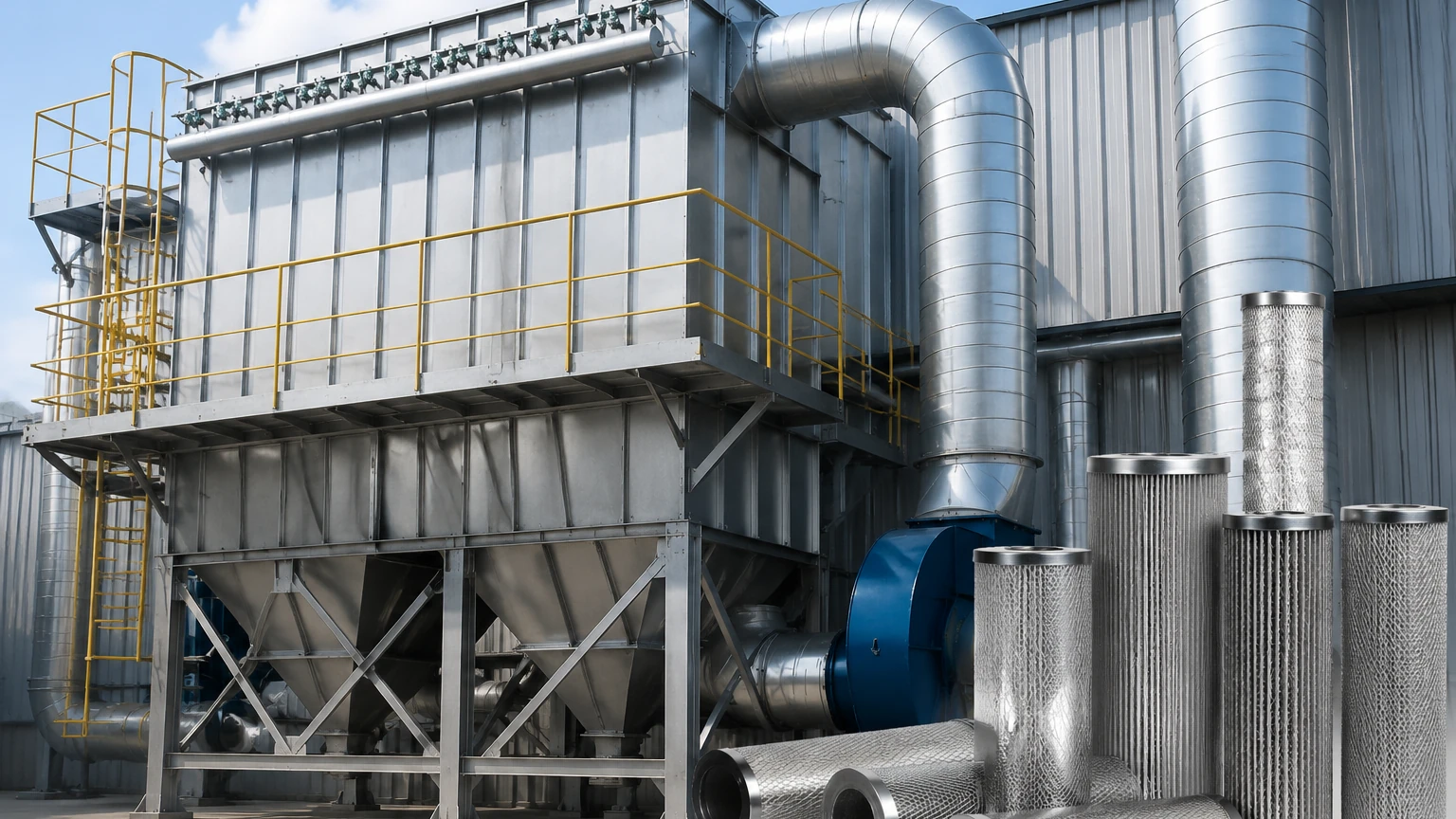
Cartridge collectors use pleated media to provide a high surface area in a compact footprint. These are ideal for fine dust and lower grain loadings. The market is increasingly moving toward specialized metal cartridge filters for applications where moisture, high temperatures, or aggressive cleaning cycles make synthetic fibers impractical.
Sintered Metal and Wire Mesh Filters
For the most demanding segments of the industrial dust collector market, stainless steel wire mesh and sintered metal components are the gold standard. These filters, manufactured by specialists like Kaifil, provide precise micron ratings and can be cleaned and reused multiple times, offering a lower total cost of ownership in harsh environments.
Material Selection: The Advantages of Stainless Steel Media
In the industrial dust collector market, material selection is the most significant factor affecting filter lifespan and performance. While polymer-based media are common, stainless steel (typically grades 304, 316, or 316L) provides distinct advantages that engineers must consider during the design phase.
1. Temperature Resistance: Standard polyester or aramid filters typically fail at temperatures exceeding 200°C. Stainless steel filtration components can operate effectively at temperatures well above 500°C, making them essential for incinerators, kilns, and high-temperature chemical reactors.
2. Chemical Compatibility: Industrial exhausts often contain acidic or alkaline vapors that degrade synthetic fibers. Stainless steel offers exceptional resistance to a wide range of chemicals, preventing premature media blinding or structural failure.
3. Mechanical Strength: In pulse-jet cleaning systems, filters are subjected to rapid bursts of compressed air. Metal mesh filters maintain their structural integrity under these stresses far better than fabric, which can stretch or tear over time.
4. Cleanability: Unlike disposable filters, stainless steel cartridges can be cleaned via ultrasonic baths, chemical cleaning, or back-flushing, allowing them to be returned to service and reducing the waste stream.
Engineering Performance: Pressure Drop and Filtration Efficiency
When evaluating options in the industrial dust collector market, engineers focus on two primary metrics: filtration efficiency and differential pressure (pressure drop).
Filtration Efficiency refers to the percentage of particles of a specific size that the media can capture. For high-precision applications, such as pharmaceutical manufacturing or fine chemical processing, filters must achieve high efficiency at the sub-micron level. Stainless steel wire mesh can be manufactured with extremely tight tolerances, ensuring consistent pore sizes and reliable capture rates.
Pressure Drop is the resistance to airflow caused by the filter media. A high pressure drop requires more energy from the system's fan to maintain the required airflow, leading to higher operational costs. By utilizing advanced pleating techniques and optimized wire diameters, Kaifil designs filter components that maximize surface area, thereby minimizing pressure drop and extending the time between cleaning cycles.
Total Cost of Ownership and Maintenance Strategies
A common mistake in the industrial dust collector market is focusing solely on the initial purchase price of the filter media. Procurement teams should instead evaluate the Total Cost of Ownership (TCO).
While a stainless steel filter cartridge has a higher upfront cost than a disposable fabric bag, its longevity and cleanability often make it the more economical choice over a 3-to-5-year period. Factors to include in a TCO analysis include:
* Replacement Frequency: How often does the media need to be changed?
* Labor Costs: The man-hours required for filter change-outs and system downtime.
* Disposal Costs: Fees associated with disposing of contaminated, single-use filters.
* Energy Consumption: The impact of the filter’s pressure drop on the facility's electricity bill.
Effective maintenance strategies involve monitoring the differential pressure across the filter bank. A sudden drop in pressure may indicate a leak or a torn filter, while a steady, unrecoverable increase indicates that the media has become "blinded" and requires professional cleaning or replacement.
Technical Specifications and Customization in OEM Solutions
The industrial dust collector market is not a one-size-fits-all environment. Many industrial processes require customized filtration components to fit specific housing geometries or to handle unique particulate characteristics.
As an OEM-focused manufacturer, Kaifil specializes in developing custom stainless steel filter cartridges and wire mesh components tailored to these specific needs. Engineering teams should confirm the following specifications before finalizing a design:
* Micron Rating: Absolute vs. nominal filtration requirements.
* Flow Rate: The volume of air or gas (CFM) the filter must handle.
* Operating Pressure: The maximum pressure the filter structure must withstand without collapsing.
* Connection Type: Flange, threaded, or custom fittings to ensure a leak-proof seal within the collector housing.
By working closely with a manufacturer that understands both the material science and the mechanical engineering of filtration, companies can optimize their dust collection systems for maximum uptime and compliance.
Future Trends in the Industrial Dust Collector Market
Looking ahead, the industrial dust collector market is moving toward "Smart Filtration" and increased sustainability. Sensors integrated into the collector housing can now provide real-time data on filter health, allowing for predictive maintenance rather than reactive repairs. Furthermore, the push for a circular economy is driving interest in permanent, cleanable metal filters that eliminate the need for frequent landfilling of used filter bags.
In conclusion, the industrial dust collector market is a complex ecosystem where engineering precision meets environmental necessity. For facilities operating in high-temperature, corrosive, or high-purity environments, the transition to stainless steel filtration components is often the most technically sound and cost-effective path forward. By prioritizing durability and precision in filter selection, engineers can ensure their systems meet today’s rigorous industrial standards while preparing for the regulatory challenges of tomorrow.
For more information on how custom stainless steel filtration can improve your process, explore the resources available on our Main Page.
