


Industrial Filtering Systems
Industrial filtering systems are fundamental to the operational integrity of modern manufacturing and processing facilities. Unlike residential or light commercial filtration, these systems must withstand extreme pressures, corrosive chemical environments, and high thermal loads while maintaining precise particle retention. For engineers and procurement specialists, selecting the right filtration technology is not merely a matter of finding a component that fits a housing; it is an engineering decision that impacts process efficiency, product purity, and the total cost of ownership.
As a specialized manufacturer, Kaifil focuses on providing high-performance stainless steel filtration solutions designed for the most demanding industrial environments. From wire mesh filters to sintered metal cartridges, understanding the mechanics and material science behind these systems is essential for optimizing industrial performance.
The Role of Stainless Steel in Industrial Filtering Systems
In the landscape of industrial filtering systems, material selection is the primary determinant of a system's longevity and reliability. While polymer-based or paper filters are common in low-intensity applications, stainless steel remains the industry standard for critical industrial processes.
Stainless steel, particularly grades 304 and 316L, offers several technical advantages:
1. Thermal Stability: Industrial processes often involve high-temperature fluids or gases. Stainless steel filters can operate at temperatures exceeding 500°C, far beyond the melting points of synthetic alternatives.
2. Mechanical Strength: High-pressure hydraulic systems and high-viscosity fluid processing require filter media that can resist collapse or deformation under significant differential pressure.
3. Chemical Compatibility: In chemical processing and pharmaceutical manufacturing, filters are exposed to aggressive solvents, acids, and bases. 316L stainless steel provides superior resistance to pitting and corrosion.
4. Cleanability: One of the most significant advantages of metal-based industrial filtering systems is that they are cleanable and reusable. Methods such as ultrasonic cleaning, backwashing, and chemical steeping allow these components to be restored to near-original performance, reducing waste and long-term replacement costs.
Core Technologies: Wire Mesh vs. Sintered Metal
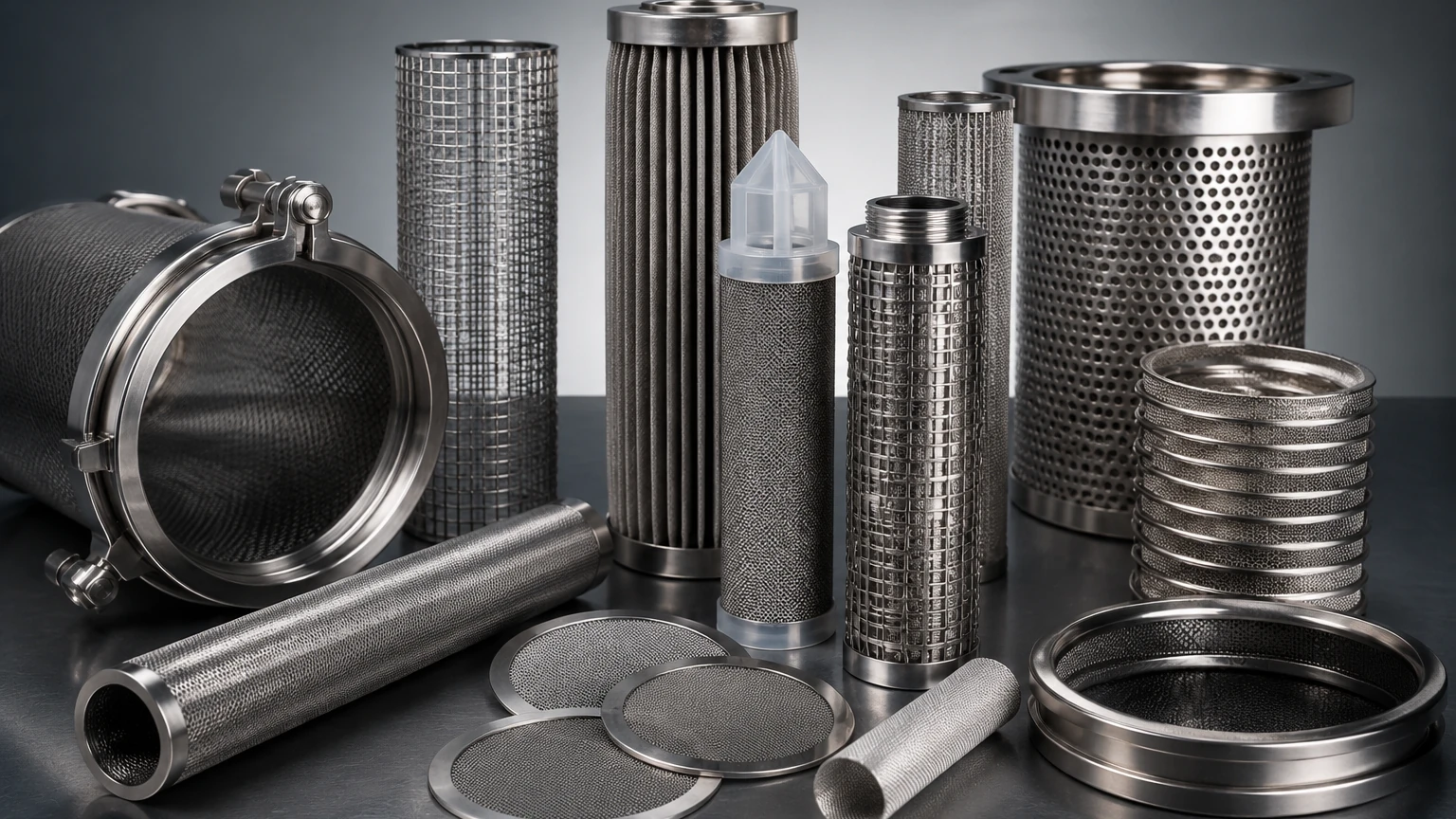
When designing or specifying industrial filtering systems, engineers generally choose between two primary types of metal filter media: woven wire mesh and sintered metal components.
Woven Wire Mesh Filters
Woven wire mesh is a versatile medium used for surface filtration. It consists of metallic wires woven into various patterns, such as plain weave, twill weave, or Dutch weave. The precision of the weave determines the pore size and filtration accuracy. Wire mesh filters are ideal for applications requiring high flow rates and low pressure drops. They are commonly used in water treatment, food and beverage straining, and as protective screens in hydraulic systems.
Sintered Metal Filters
Sintered metal filters are created by fusing multiple layers of wire mesh or metallic powder through a high-temperature vacuum sintering process. This creates a porous, monolithic structure with exceptional mechanical strength. Sintered filters provide depth filtration, meaning they can trap particles within the thickness of the media, not just on the surface. These are the preferred choice for high-pressure gas filtration, polymer melt filtration, and applications where absolute micron ratings are required.
Engineering Considerations for System Selection
Selecting an industrial filtering system requires a detailed analysis of the application’s technical parameters. Engineers must confirm several variables before finalizing a design or purchase order:
Micron Rating: Absolute vs. Nominal
Understanding the difference between absolute and nominal ratings is critical. A nominal rating refers to the ability of the filter to retain a certain percentage (usually 60% to 90%) of particles of a specific size. An absolute rating, however, indicates the diameter of the largest hard spherical particle that will pass through the filter under specified test conditions. In pharmaceutical or precision chemical applications, absolute ratings are often mandatory to ensure product safety.
Flow Rate and Differential Pressure
The relationship between flow rate and differential pressure ($ΔP$) dictates the sizing of the filter. As the filter accumulates contaminants, the $ΔP$ increases. An industrial filtering system must be sized so that the initial pressure drop is low enough to allow for a reasonable service life before the terminal pressure drop is reached, necessitating a cleaning cycle or replacement.
Viscosity and Particle Loading
The viscosity of the fluid significantly impacts the choice of filter media. High-viscosity fluids, such as oils or polymers, require larger surface areas and more robust structural support to prevent the media from tearing. Additionally, the concentration and type of particles (hard vs. soft/deformable) will determine whether a surface filter or a depth filter is more efficient.
Application-Specific Requirements
Industrial filtering systems are not one-size-fits-all. Different sectors have unique regulatory and performance benchmarks that must be met.
* Food and Beverage: Filters must be constructed from FDA-compliant materials and designed for "Clean-in-Place" (CIP) processes. Smooth surfaces and the absence of dead spaces are necessary to prevent bacterial growth.
* Pharmaceutical: High-purity applications require filters with precise absolute ratings and the ability to withstand sterilization processes, such as autoclaving or Steam-in-Place (SIP).
* Chemical and Petrochemical: The focus here is on corrosion resistance and the ability to handle hazardous materials at high temperatures. Sintered 316L or Hastelloy filters are often utilized in these environments.
* Hydraulic and Lubrication: These systems require filters that can handle high-frequency pressure pulsations and provide fine filtration to protect sensitive valves and pumps from wear-inducing particles.
Maintenance and Total Cost of Ownership (TCO)
While the initial capital expenditure for a stainless steel industrial filtering system is higher than that of disposable plastic or paper filters, the Total Cost of Ownership is often significantly lower. The longevity of metal filters—often lasting years rather than weeks—offsets the higher upfront cost.
To maximize the lifespan of these systems, a proactive maintenance schedule is required. Monitoring the differential pressure is the most effective way to determine when a filter needs cleaning. If a filter is left in service beyond its terminal pressure drop, the risk of "media migration" (where the filter material itself breaks down) or "particle bypass" increases, potentially contaminating the downstream process.
Customization and OEM Solutions
Many industrial applications involve unique housing dimensions or specific flow paths that standard off-the-shelf filters cannot accommodate. This is where custom manufacturing becomes essential. Customization options for industrial filtering systems include:
* End Cap Configurations: Threaded, flange, or DOE (Double Open End) fittings to match existing infrastructure.
* Reinforcement Layers: Adding perforated metal cores or outer shrouds to enhance structural integrity in high-pressure environments.
* Pleated Designs: Pleating the wire mesh significantly increases the effective filtration area, allowing for higher flow rates within a compact footprint.
Working with a manufacturer that understands the nuances of metallurgy and fluid dynamics ensures that the final product is optimized for the specific challenges of the application. Kaifil provides comprehensive OEM support, translating technical requirements into durable, high-precision filtration components.
Conclusion
Industrial filtering systems are critical assets that protect downstream equipment, ensure product quality, and maintain process safety. By prioritizing material quality, understanding the technical requirements of the application, and considering the long-term benefits of cleanable stainless steel media, engineering and purchasing teams can achieve superior operational results.
For technical professionals seeking to optimize their processes, it is important to Review product options and application support to ensure the selected filtration solution aligns with the specific demands of their industrial environment. Whether the goal is to improve filtration accuracy or reduce maintenance downtime, the right partnership in filtration engineering is the key to long-term success.
