


Industrial Liquid Filtration Systems
In the landscape of modern manufacturing and processing, industrial liquid filtration systems serve as critical infrastructure for maintaining product purity, protecting downstream equipment, and ensuring process consistency. These systems are not merely peripheral components; they are engineered solutions designed to manage the complex dynamics of fluid flow, particulate load, and chemical interactions. For engineers and procurement specialists, selecting the appropriate filtration technology requires a deep understanding of mechanical properties, material science, and hydraulic performance.
Industrial filtration involves the separation of solid contaminants from a liquid stream. This process is essential across diverse sectors, including chemical processing, pharmaceutical production, food and beverage manufacturing, and hydraulic power systems. The efficiency of these systems directly impacts the total cost of ownership (TCO) by influencing energy consumption, maintenance intervals, and the lifespan of high-value machinery.
Fundamentals of Industrial Liquid Filtration Systems
At its core, the performance of industrial liquid filtration systems is defined by the interaction between the filter media and the process fluid. Unlike residential or light-commercial filters, industrial-grade systems must withstand extreme conditions, including high differential pressures, corrosive chemical environments, and fluctuating temperatures.
Surface vs. Depth Filtration
Understanding the distinction between surface and depth filtration is primary to system selection. Surface filtration, typically achieved through stainless steel wire mesh or precision-perforated metals, captures particles on the upstream side of the media. This method is preferred for applications requiring precise micron ratings and the ability to clean and reuse the filter element.
Depth filtration, conversely, utilizes a thick matrix of fibers or sintered materials to trap particles throughout the thickness of the media. While depth filters often provide high dirt-holding capacity, they are generally more difficult to clean and are frequently treated as consumables. In heavy industrial applications, surface filtration using high-grade stainless steel is often favored for its mechanical robustness and predictable performance.
Engineering Considerations: Material Selection and Compatibility
The choice of material for filter cartridges and components is a primary factor in the reliability of industrial liquid filtration systems. Stainless steel remains the industry standard due to its versatile chemical resistance and structural integrity.
Stainless Steel Grades (304 and 316L)
For most industrial applications, Type 304 stainless steel offers sufficient corrosion resistance and mechanical strength. However, in environments involving chlorides, high acidity, or pharmaceutical-grade requirements, Type 316L is the preferred specification. The "L" denotes low carbon content, which minimizes carbide precipitation during welding, ensuring that the structural joints of the filter remain as corrosion-resistant as the base mesh.
Thermal and Chemical Stability
Industrial processes often involve fluids at elevated temperatures or aggressive pH levels. Metal filtration components excel in these environments where polymer-based filters would soften, degrade, or leach extractables into the fluid stream. Engineers must verify that the seals and gaskets—often made of Viton, EPDM, or PTFE—are equally compatible with the process conditions to prevent bypass or system failure.
Key Performance Metrics for Filter Selection
When evaluating industrial liquid filtration systems, several technical parameters must be analyzed to ensure the system meets the specific needs of the application.
Micron Rating: Absolute vs. Nominal
A common point of confusion in filtration procurement is the difference between nominal and absolute micron ratings. A nominal rating refers to the filter's ability to retain a major percentage (usually 60% to 90%) of particles of a specific size. An absolute rating, however, implies that 99.9% or more of particles at that size are captured. For critical applications, such as protecting high-pressure hydraulic pumps or ensuring pharmaceutical purity, absolute-rated stainless steel mesh is required to prevent downstream contamination.
Differential Pressure and Flow Rate
The pressure drop (ΔP) across a filter element is a function of the fluid's viscosity, the flow velocity, and the open area of the filter media. An optimized industrial liquid filtration system minimizes initial pressure drop to reduce the load on pumps. As the filter accumulates debris, the differential pressure increases. Engineering specifications must define the "terminal pressure drop"—the point at which the filter must be cleaned or replaced to prevent structural collapse or a significant reduction in process flow.
Advanced Filtration Media Technologies
Modern industrial liquid filtration systems utilize various metal media structures to achieve specific performance goals.
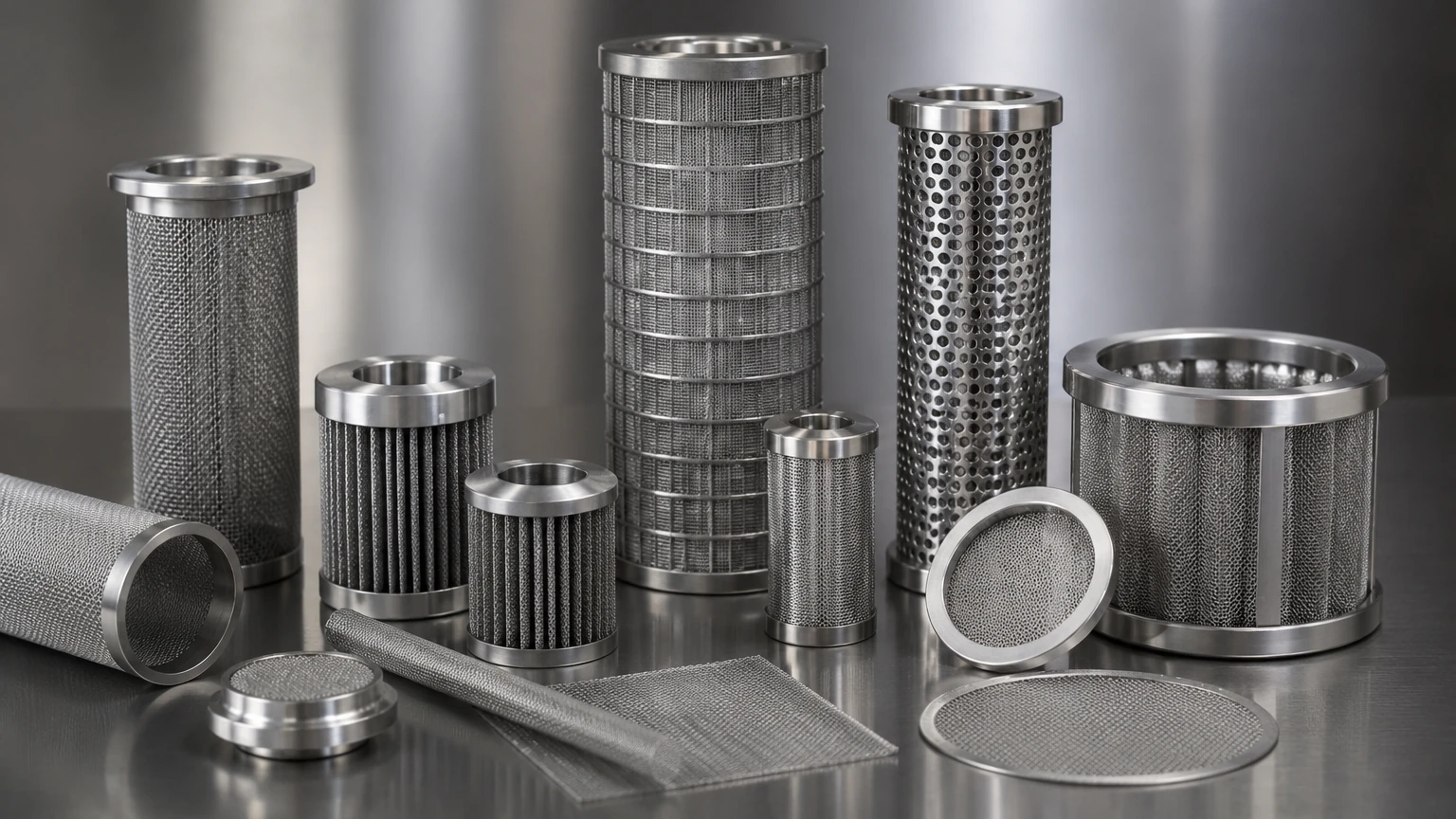
1. Woven Wire Mesh: Available in plain, twilled, or Dutch weave patterns. Dutch weaves, in particular, provide a tortuous path that allows for fine filtration (down to 5-10 microns) while maintaining high mechanical strength.
2. Sintered Metal Fiber: This media consists of non-woven stainless steel fibers that are sintered together to create a high-porosity depth media. It offers excellent permeability and high dirt-holding capacity.
3. Wedge Wire: Ideal for high-viscosity fluids and heavy-duty solids separation, wedge wire screens are non-clogging and provide superior structural strength for backwashing operations.
4. Sintered Mesh Laminates: By bonding multiple layers of wire mesh together through heat and pressure, engineers create a composite material that combines the fine filtration of thin mesh with the structural support of heavy-duty mesh.
Customization and OEM Integration
Standard off-the-shelf filtration units often fail to meet the unique spatial or functional requirements of complex industrial machinery. This is where customized filtration solutions become essential. Customization can involve unique end-cap configurations (such as NPT threads, flange mounts, or 222/226 O-ring styles), specialized lengths to fit existing housings, or reinforced internal cores to withstand high-pressure surges.
For original equipment manufacturers (OEMs), integrating a custom-designed filter element ensures that the filtration performance is perfectly matched to the machine's requirements. This bespoke approach also allows for the optimization of the filtration area, potentially extending maintenance intervals and improving the overall efficiency of the Main Page and associated fluid circuits.
Application-Specific Requirements
Different industries impose unique demands on industrial liquid filtration systems. Engineering teams must account for these regulatory and functional nuances during the design phase.
Chemical and Petrochemical Processing
In these sectors, the primary concern is often chemical compatibility and the ability to handle high-temperature catalysts or aggressive solvents. Stainless steel filter cartridges are essential here, as they maintain their pore geometry even under extreme thermal stress, preventing "unloading" of captured contaminants.
Food, Beverage, and Pharmaceuticals
Filtration in these industries requires strict adherence to hygienic standards. Components must be designed with smooth surface finishes (often electropolished) to prevent bacterial growth and ensure effective Clean-in-Place (CIP) or Steam-in-Place (SIP) cycles. The absence of adhesives or binders in all-welded stainless steel filters is a significant advantage in maintaining product integrity.
Hydraulic and Lubrication Systems
Precision hydraulic systems are highly sensitive to particulate contamination, which can cause premature wear on valves and actuators. Industrial liquid filtration systems in these applications must handle high-velocity flows and protect against "cold start" pressure spikes. High-strength sintered mesh or reinforced wire mesh elements are typically employed to ensure the system remains protected under all operating conditions.
Maintenance, Cleaning, and Lifecycle Costs
One of the primary advantages of stainless steel industrial liquid filtration systems is their cleanability. While the initial capital expenditure (CAPEX) for a stainless steel system may be higher than for disposable polymer filters, the long-term operational expenditure (OPEX) is often significantly lower.
Cleaning Methodologies
* Ultrasonic Cleaning: Uses high-frequency sound waves in a cleaning solvent to dislodge fine particles from deep within the mesh pores.
* Backwashing: Reversing the flow of fluid through the filter to flush out accumulated solids. This is often automated in continuous process systems.
* Chemical Cleaning: Utilizing acids or alkalis to dissolve organic or inorganic scaling, provided the filter media is chemically resistant.
Total Cost of Ownership (TCO)
When calculating the TCO of a filtration system, engineers must consider the cost of replacement elements, the labor costs associated with filter changes, the cost of waste disposal for used cartridges, and the potential revenue loss during downtime. Permanent, cleanable stainless steel elements often reach a break-even point within the first year of operation, especially in high-load or high-flow environments.
Risk Mitigation in Filtration Procurement
Selecting the wrong industrial liquid filtration system can lead to catastrophic equipment failure or product recalls. To mitigate these risks, engineers should confirm the following before finalizing a specification:
1. Validation of Micron Ratings: Ensure the manufacturer provides data on how the micron rating was tested (e.g., via the Multi-Pass Test or Bubble Point Test).
2. Structural Integrity Limits: Confirm the maximum allowable differential pressure (collapse pressure) to ensure the filter will not fail during a pressure surge.
3. Traceability: For pharmaceutical or food applications, ensure the materials used are traceable and meet relevant regulatory standards (such as FDA or EU food contact regulations).
4. Prototyping and Testing: In unique applications, it is often beneficial to perform pilot testing with a custom-designed filter element to verify performance before full-scale implementation.
Conclusion
Industrial liquid filtration systems are foundational to the efficiency and reliability of modern industrial processes. By moving beyond generic solutions and focusing on the technical specifics of material science, hydraulic dynamics, and custom engineering, organizations can achieve superior filtration performance. Whether the goal is to protect sensitive hydraulic components or to ensure the purity of a chemical product, the selection of high-quality stainless steel filtration media provides a durable, cost-effective, and high-performance solution. For technical teams seeking to optimize their processes, reviewing the available engineering options and customization capabilities is the first step toward a more robust filtration strategy.
