


Industrial Plumbing Basket Strainers
In industrial fluid handling systems, the presence of particulate matter—ranging from pipe scale and welding slag to organic debris—poses a significant threat to downstream equipment. Industrial plumbing basket strainers serve as the primary mechanical defense for pumps, valves, meters, and heat exchangers. Unlike simpler Y-strainers, basket strainers are designed for applications requiring high flow capacities and a larger dirt-holding capacity, making them a staple in chemical processing, water treatment, and food and beverage production.
Selecting the correct filtration component requires a deep understanding of fluid dynamics, material science, and the specific mechanical requirements of the piping system. As a professional manufacturer, Kaifil specializes in providing the precision-engineered components that define the performance of these systems. For comprehensive technical data and customization options, engineers often refer to the Main Page of our site to evaluate how specific wire mesh and stainless steel configurations align with their operational needs.
The Mechanical Function of Basket Strainers
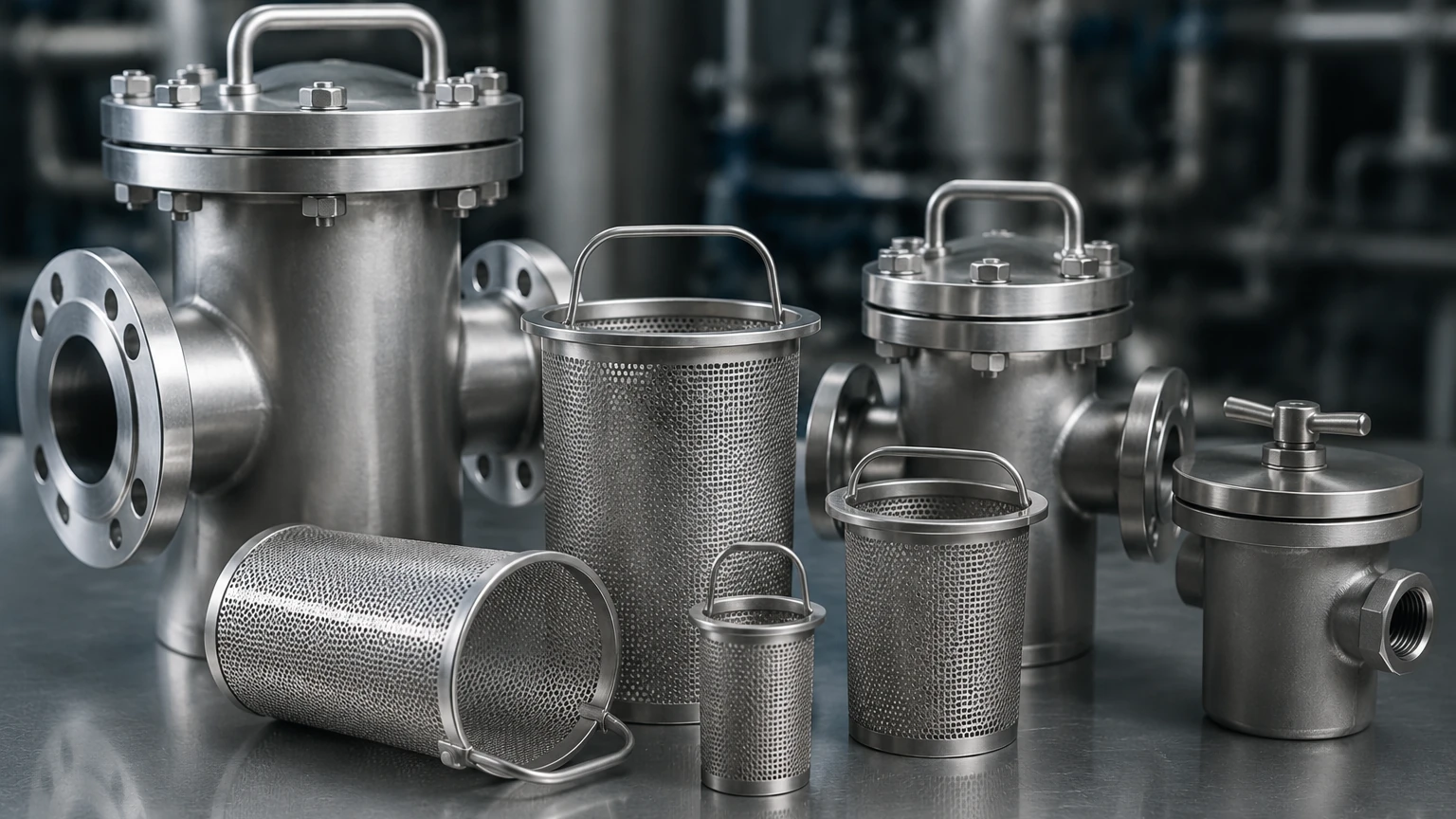
Industrial plumbing basket strainers are closed vessels with a removable screen or basket that intercepts solids from a flowing liquid. The "basket" geometry is critical; it provides a significantly larger surface area than a standard cylindrical filter, which results in a lower initial pressure drop and longer intervals between cleaning cycles.
In a typical installation, the fluid enters the strainer housing and is directed into the top of the basket. As the fluid passes through the perforated metal or wire mesh walls of the basket, solids are trapped inside. Because the debris is collected within the basket, it is easily removed when the unit is opened for maintenance, preventing contaminants from falling back into the downstream piping. This design is particularly advantageous in horizontal piping runs where high-volume filtration is required.
Critical Selection Criteria: Flow Rate and Pressure Drop
One of the most common mistakes in specifying industrial plumbing basket strainers is sizing the unit based solely on the pipe size. While a 4-inch pipe might suggest a 4-inch strainer, the actual selection must be driven by the flow rate (GPM or m³/h) and the allowable clean pressure drop (ΔP).
The Importance of the Open Area Ratio (OAR)
The Open Area Ratio is the relationship between the internal cross-sectional area of the inlet pipe and the total open area of the holes in the strainer basket. For industrial applications, a minimum OAR of 6:1 is often recommended. A higher OAR ensures that even as the basket begins to clog with debris, the pressure drop does not increase so rapidly that it starves downstream pumps or causes cavitation.
Calculating Pressure Drop
Engineers must account for the viscosity of the fluid. While water flows easily through a 100-mesh screen, a high-viscosity oil or chemical resin will experience a much higher resistance. If the pressure drop across the strainer exceeds the system’s design limits, it can lead to structural failure of the basket or mechanical seal leaks in pumps. When evaluating industrial plumbing basket strainers, it is essential to review the manufacturer’s flow curves to ensure the component can handle the maximum expected flow at the highest possible viscosity.
Material Science and Chemical Compatibility
The durability of a strainer is dictated by its materials of construction. In industrial plumbing, the housing and the internal basket must withstand both the internal pressure of the system and the corrosive nature of the fluid.
1. Stainless Steel (304 and 316): These are the industry standards for most industrial applications. SS304 offers excellent strength and basic corrosion resistance, while SS316 includes molybdenum, providing superior resistance to chlorides and acetic acids. For pharmaceutical and food-grade applications, the surface finish of the stainless steel is also a factor, often requiring electropolishing to prevent bacterial growth.
2. Specialty Alloys: In highly corrosive environments, such as seawater intake or aggressive chemical processing, alloys like Monel or Hastelloy may be required for the internal mesh to prevent pitting and stress-corrosion cracking.
3. Seal and Gasket Materials: The choice of O-ring or gasket (EPDM, Viton, PTFE, or Buna-N) is just as critical as the metal. A failure in the seal material due to chemical incompatibility or temperature extremes will lead to external leaks and system downtime.
Filtration Media: Perforated Plate vs. Wire Mesh
The internal basket of industrial plumbing basket strainers usually consists of a heavy-gauge perforated metal sheet which provides structural integrity. However, for finer filtration requirements, this perforated plate is lined with a precision-woven wire mesh.
Perforated Metal
Perforated plates are used for "coarse" straining, typically removing particles 1/32" to 1/4" in size. They are robust and can withstand significant differential pressure. However, they are limited by the physical size of the holes that can be punched into the metal.
Wire Mesh
For finer filtration, stainless steel wire mesh is layered over the perforated support. Wire mesh allows for much higher precision, with the ability to filter down to 5 microns or less. In industrial plumbing basket strainers, the mesh count (the number of openings per linear inch) determines the filtration accuracy. Engineers must balance the need for fine filtration with the reality that finer mesh clogs faster and is more delicate. Kaifil’s expertise in custom wire mesh allows for the development of multi-layered baskets that combine the strength of perforated metal with the precision of fine Dutch weave mesh.
Operational Risks and Maintenance Protocols
Even the best-designed industrial plumbing basket strainers will fail if maintenance is neglected. The primary risk in any filtration system is a "blinded" or clogged basket.
Differential Pressure Monitoring
The most effective way to manage a strainer is through the installation of differential pressure gauges. By measuring the pressure before and after the strainer, operators can see exactly when the basket is reaching its capacity. A common industry standard is to clean the basket when the differential pressure reaches 5-10 psi over the clean drop.
Structural Collapse
If a basket is allowed to clog completely, the full system pressure is exerted against the basket walls. If this pressure exceeds the basket's structural limit, it can collapse (blow out), sending both the collected debris and shards of the basket itself into the downstream equipment. This often results in catastrophic damage to high-speed pump impellers or sensitive instrumentation.
Cleaning Procedures
In many industrial settings, downtime is costly. For systems that cannot be shut down, a duplex basket strainer (which features two strainer chambers and a diverter valve) is used. However, for simplex industrial plumbing basket strainers, features like quick-opening covers (swing bolts or clamped lids) are essential to minimize the time required for manual cleaning.
Customization and Engineering Considerations
Standard off-the-shelf strainers often fail to meet the specific nuances of a complex industrial plumbing layout. Customization is frequently required in the following areas:
* Connection Types: While flanged connections (ANSI or DIN) are standard for large industrial pipes, threaded (NPT/BSP) or socket-weld connections may be necessary for smaller auxiliary lines.
* Steam Jacketing: For fluids that solidify at room temperature (like bitumen or certain resins), a steam jacketed housing is required to keep the fluid at a consistent temperature during the filtration process.
* Magnetic Inserts: In systems where fine iron or steel particles are present (such as hydraulic return lines), magnetic inserts can be added to the basket to capture sub-micron metallic dust that might otherwise pass through the mesh.
* Reinforced Baskets: For high-pressure systems or applications prone to pressure surges (water hammer), reinforced baskets with heavy-duty support grids are necessary to prevent deformation.
Conclusion: Confirming Requirements Before Procurement
Before finalizing the specification for industrial plumbing basket strainers, procurement teams and engineers should confirm a clear set of parameters to ensure long-term reliability. These include:
* Maximum Flow Rate: Ensure the OAR is sufficient for peak demand.
* Fluid Properties: Confirm viscosity at both start-up and operating temperatures, as well as chemical pH.
* Particle Profile: Identify the size and nature (hard, soft, fibrous) of the contaminants to be removed.
* Space Constraints: Basket strainers require vertical clearance for basket removal; ensure the installation site allows for easy maintenance access.
By focusing on these technical boundaries, industrial operators can select filtration solutions that protect their infrastructure and optimize process efficiency. For those seeking specialized manufacturing support and high-performance metal filter components, visiting the Main Page provides access to the technical resources and OEM capabilities necessary for demanding industrial environments.
