


Industrial Strainer Market
In the landscape of modern fluid handling, the industrial strainer market serves as a critical backbone for protecting downstream equipment and ensuring process integrity. Industrial strainers are essentially coarse filters designed to remove larger particulate matter from liquids or gases. By intercepting debris such as scale, rust, or jointing compound before it reaches sensitive components like pumps, valves, and meters, these devices prevent mechanical failure and unplanned downtime. For engineers and procurement professionals, navigating the current industrial strainer market requires a deep understanding of technical specifications, material science, and the evolving demands of various heavy industries.
As industrial processes become more automated and tolerances tighter, the demand for precision-engineered filtration solutions has increased. The move toward higher purity levels in sectors like pharmaceuticals and food processing, combined with the need for robust durability in chemical and oil applications, has shaped the market’s trajectory. This guide explores the engineering considerations, market dynamics, and selection criteria necessary for optimizing industrial filtration systems.
Understanding the Industrial Strainer Market Landscape
The global industrial strainer market is characterized by a shift toward high-performance materials and customized engineering. Historically, cast iron or carbon steel strainers were sufficient for many basic water applications. However, the contemporary market is seeing a significant pivot toward stainless steel and exotic alloys. This transition is driven by the need for corrosion resistance, longer service life, and compliance with stringent hygiene standards.
Key drivers in the industrial strainer market include:
* Stringent Regulatory Standards: Industries such as food and beverage and pharmaceuticals are subject to rigorous health and safety regulations, mandating the use of materials like 304 and 316L stainless steel that can withstand frequent sterilization and resist bacterial growth.
* Infrastructure Expansion: The growth of water treatment facilities and chemical processing plants in emerging economies has spurred a higher volume of demand for standard and custom strainer configurations.
* Operational Efficiency: Modern facilities focus on reducing the Total Cost of Ownership (TCO). High-quality strainers reduce maintenance frequency and protect expensive capital equipment, making them a strategic investment rather than a simple commodity.
For technical teams, staying informed about these market trends is essential for selecting components that align with both current operational needs and future-proofing strategies.
Technical Classifications and Engineering Considerations
When evaluating options within the industrial strainer market, it is vital to distinguish between the various types of strainers based on their mechanical design and application suitability. Each configuration offers specific advantages regarding flow capacity, pressure drop, and ease of maintenance.
Y-Strainers
Y-strainers are the most common type used in pressurized lines. Named for their shape, they are typically used in applications with low concentrations of solids. Their compact design allows for installation in both horizontal and vertical piping. From an engineering perspective, the primary consideration for Y-strainers is the orientation of the "leg" to ensure that the collected debris is properly trapped and can be easily flushed or removed.
Basket (Simplex) Strainers
Basket strainers feature a larger storage capacity for debris compared to Y-strainers. They are designed for applications where higher concentrations of solids are expected. Because the basket is usually accessed from the top, maintenance is simplified, although the flow must be stopped to clean the element. Engineers often specify basket strainers for suction-side pump protection where a low pressure drop is critical.
Duplex Strainers
In processes that cannot be shut down for maintenance, duplex strainers are the industry standard. These systems consist of two separate strainer chambers connected by a diverting valve. When one chamber becomes clogged, the flow is diverted to the clean chamber, allowing the operator to service the dirty element without interrupting the process. This is a crucial consideration in the industrial strainer market for continuous-flow operations like chemical refining or power generation.
Material Selection and Filtration Accuracy
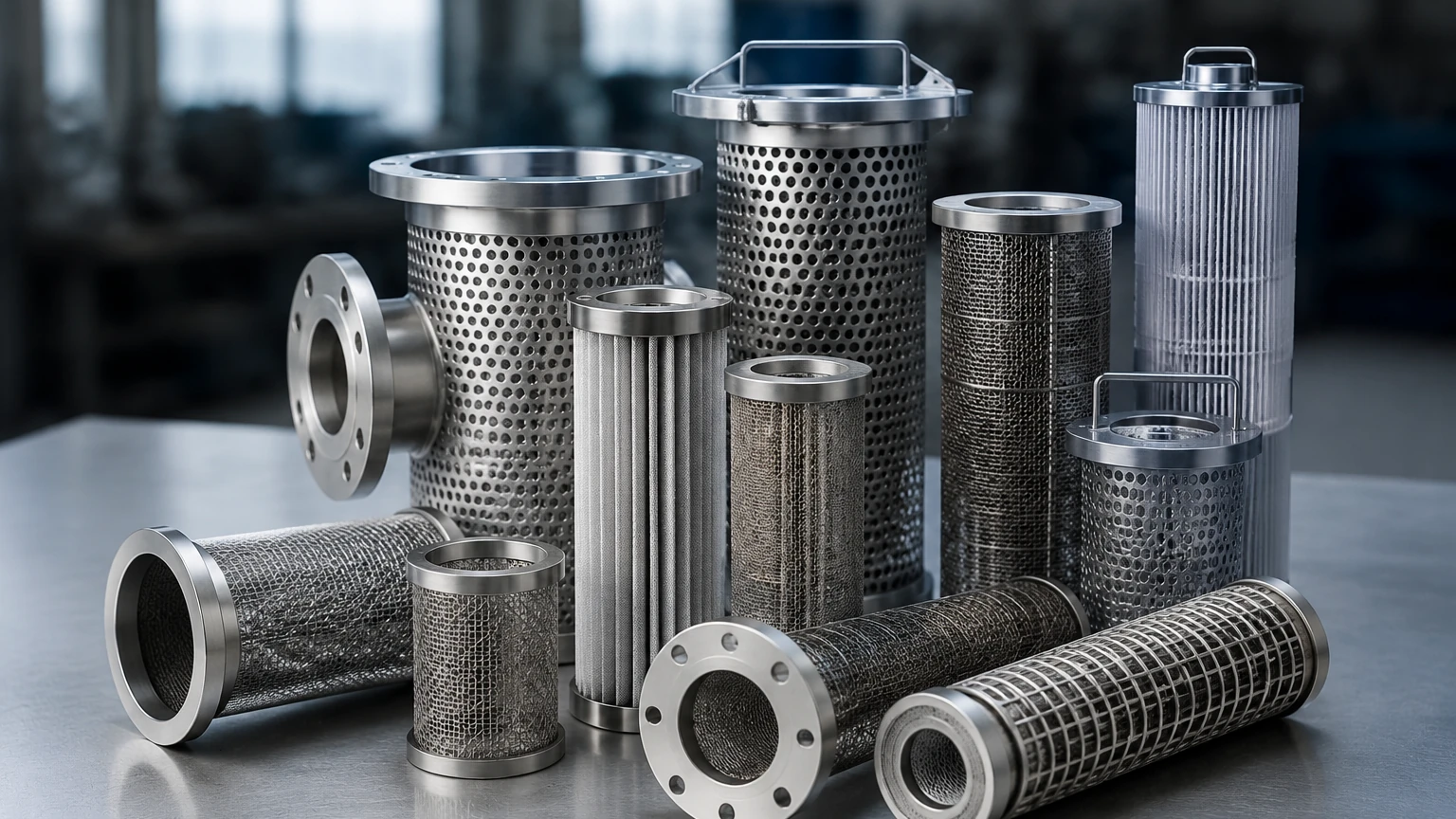
The performance of a strainer is largely determined by its internal element, often a combination of perforated metal and fine wire mesh. Within the Main Page of industrial filtration manufacturers, the emphasis is frequently placed on the selection of the correct alloy and micron rating to balance flow efficiency with protection.
Stainless Steel Dominance
Stainless steel 304 and 316 remain the preferred materials for the industrial strainer market. SS304 offers excellent durability for general industrial use, while SS316 provides superior resistance to chlorides and acetic acids, making it indispensable in marine and chemical environments. For highly corrosive applications, manufacturers may utilize Duplex stainless steel or Hastelloy.
Micron vs. Mesh
Understanding the relationship between mesh count and micron rating is fundamental for engineering teams. Mesh refers to the number of openings per linear inch, while the micron rating defines the actual size of the particles that can pass through. A higher mesh count results in a lower micron rating (finer filtration). However, finer filtration also leads to a higher pressure drop across the element. Engineers must calculate the "Open Area Ratio"—the ratio of the total area of the holes in the element to the area of the inlet pipe—to ensure the strainer does not become a bottleneck in the system.
Key Evaluation Criteria for Procurement
Selecting a supplier in the industrial strainer market involves more than comparing price points. Technical professionals must verify that the product meets specific operational parameters to avoid premature failure or system inefficiency.
1. Pressure and Temperature Ratings: The strainer housing and the internal element must be rated for the maximum operating pressure and temperature of the system. This is particularly important in steam applications or high-pressure hydraulic circuits.
2. Flow Rate and Pressure Drop: Every strainer introduces some resistance to flow. It is essential to review the Cv (flow coefficient) values provided by the manufacturer. A properly sized strainer should typically have a clean pressure drop of no more than 2 psi (0.14 bar).
3. Compatibility of Seals and Gaskets: While the metal body might be resistant to the process fluid, the elastomers used for seals (such as Viton, EPDM, or PTFE) must also be compatible to prevent leaks.
4. Customization Capabilities: Standard off-the-shelf strainers may not fit unique piping geometries or specific filtration requirements. Partnering with a manufacturer capable of custom wire mesh fabrication and precision metal components ensures the strainer integrates seamlessly into the existing infrastructure.
Risk Management and Common Challenges
Despite their relatively simple design, improper selection or maintenance of industrial strainers can lead to significant operational risks. One of the most common issues in the industrial strainer market is the "bypass" effect, where debris slips past the filtration element due to poor sealing or structural failure of the mesh under high differential pressure.
To mitigate these risks, engineers should consider the following:
* Differential Pressure Monitoring: Installing gauges before and after the strainer allows operators to monitor the pressure drop. A sudden increase indicates that the element is clogged and requires cleaning, while a sudden decrease could suggest a ruptured element.
* Structural Integrity of the Element: In high-flow applications, the filtration mesh should be supported by a heavier perforated metal backup tube to prevent collapsing.
* Cleaning Protocols: Reusable stainless steel elements offer a lower environmental impact and long-term cost savings compared to disposable filters, but they require a standardized cleaning process (such as ultrasonic cleaning or backwashing) to maintain their original flow characteristics.
Total Cost of Ownership (TCO) in Filtration
In the competitive industrial strainer market, the initial purchase price is often a fraction of the total cost over the equipment's lifecycle. A lower-quality strainer may have a lower upfront cost but can lead to higher expenses through:
* Increased Energy Consumption: A poorly designed strainer with a high pressure drop forces pumps to work harder, increasing electricity usage.
* Frequent Replacements: Low-grade materials may corrode or fatigue quickly, requiring frequent replacement of the internal elements or the entire housing.
* Product Loss: In industries like food and beverage, a failure in the filtration system can lead to contaminated batches and significant financial loss.
By investing in high-quality, custom-engineered stainless steel solutions, companies can achieve better reliability and lower maintenance costs. Manufacturers that provide technical support and material certifications help purchasing teams make informed decisions that benefit the bottom line in the long run.
Conclusion: Strategic Sourcing in the Industrial Strainer Market
The industrial strainer market continues to evolve as industries demand higher precision and greater durability. Whether protecting a high-pressure hydraulic system or ensuring the purity of a pharmaceutical grade fluid, the choice of strainer is a critical engineering decision. By focusing on material compatibility, precise micron ratings, and the specific needs of the application, technical professionals can ensure their systems operate at peak efficiency.
When evaluating potential partners, it is essential to look for manufacturers who offer deep technical expertise in stainless steel filtration. A manufacturer that understands the nuances of wire mesh construction and precision metal fabrication can provide the customized solutions necessary to meet the rigorous demands of modern industry. As the market moves forward, the integration of high-performance materials and engineering-led design will remain the hallmark of successful industrial filtration strategies.
