


Inline Basket Strainers
In the landscape of industrial fluid handling, the protection of downstream equipment is a primary engineering concern. Inline basket strainers serve as a critical line of defense, designed to remove unwanted solids and particulate matter from liquid streams. Unlike simpler filtration components, these strainers are engineered for high-capacity debris retention and minimal pressure loss, making them indispensable in sectors ranging from chemical processing and water treatment to food production and pharmaceutical manufacturing. As a professional manufacturer, Kaifil specializes in the precision engineering of stainless steel filtration solutions, ensuring that every component meets the rigorous demands of modern industrial environments.
The Role of Inline Basket Strainers in Industrial Fluid Systems
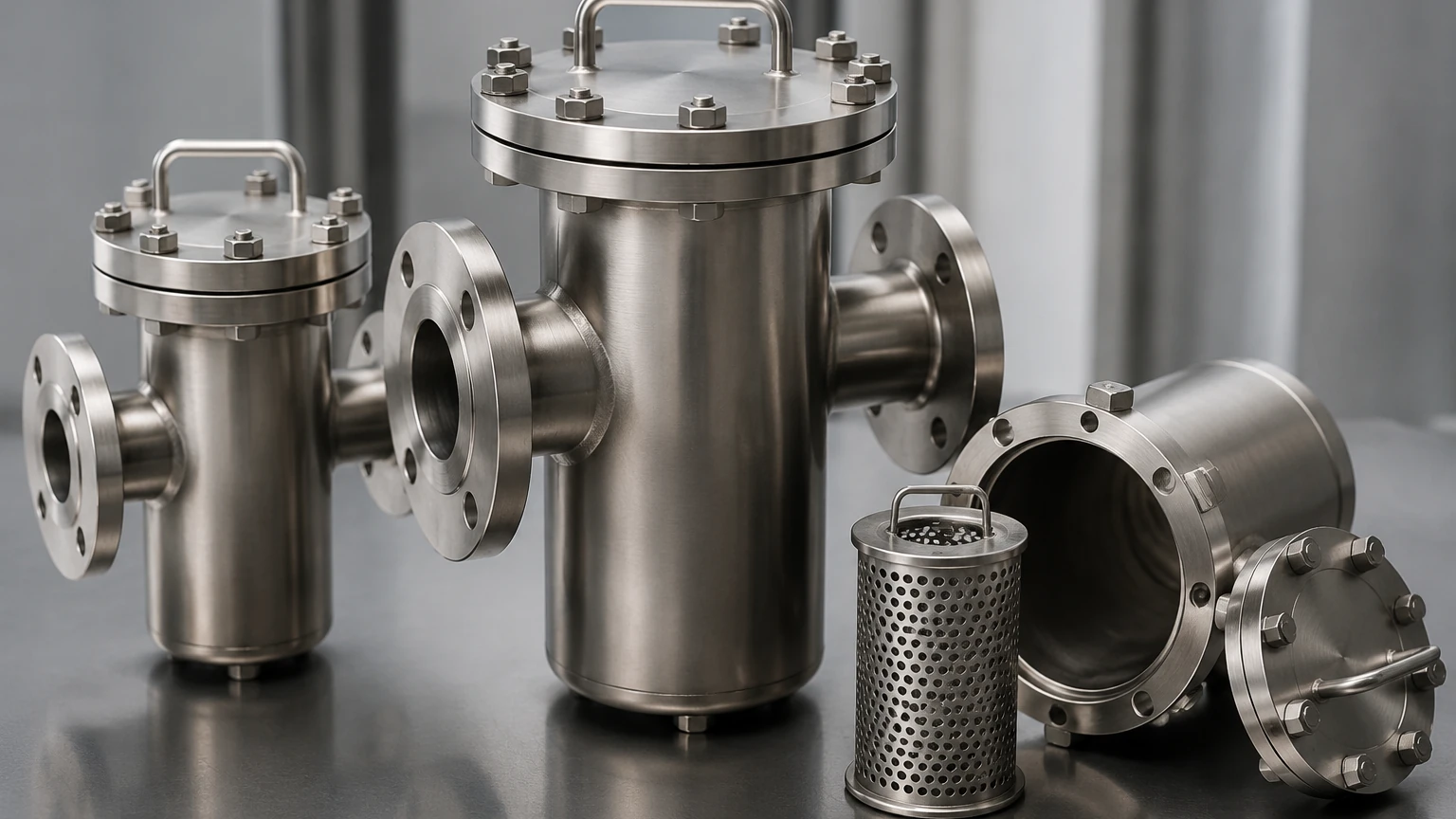
Inline basket strainers are closed pressure vessels containing a removable screen, or "basket," which captures contaminants as fluid passes through the housing. Their primary function is to safeguard expensive and sensitive equipment—such as pumps, valves, flow meters, and heat exchangers—from damage caused by scale, welding beads, or foreign debris.
From a technical perspective, the basket strainer offers a significant advantage over Y-strainers in terms of dirt-holding capacity. Because the basket is typically larger and oriented vertically or at a specific angle within the flow path, it provides a greater surface area for filtration. This design reduces the frequency of cleaning cycles and allows for a lower initial pressure drop across the system. In high-flow applications where downtime is costly, the selection of a robust inline basket strainer is a strategic decision that directly impacts the total cost of ownership (TCO) of the fluid system.
Engineering Dynamics: Flow Velocity and Pressure Differential
When specifying inline basket strainers, engineers must prioritize the relationship between flow velocity and the resulting pressure differential (ΔP). Every filtration element introduces resistance to the flow. This resistance is quantified by the flow coefficient (Cv), which represents the flow rate in gallons per minute (GPM) that will pass through the strainer with a 1 psi pressure drop.
Several factors influence the pressure drop in an inline system:
1. Viscosity: As the viscosity of the fluid increases, the pressure drop across the mesh also increases. High-viscosity fluids like heavy oils or resins require larger housing sizes or coarser mesh to maintain acceptable flow rates.
2. Mesh Size: Finer filtration (smaller micron ratings) restricts flow more than coarse mesh. Selecting an unnecessarily fine mesh can lead to rapid clogging and excessive pressure loss.
3. Percent of Open Area: This refers to the ratio of the total area of the holes in the basket to the total area of the basket material. A higher open area ratio (OAR) generally correlates with a lower pressure drop.
For optimal performance, it is generally recommended that the clean pressure drop should not exceed 2 psi. Once the differential pressure reaches a specific threshold (often 5 to 10 psi above the clean state), the basket must be cleaned to prevent structural damage to the mesh or cavitation in downstream pumps.
Material Science and Chemical Compatibility
Material selection is the foundation of durability in industrial filtration. Inline basket strainers are frequently exposed to corrosive chemicals, high temperatures, and abrasive particles. Kaifil focuses on high-grade stainless steel alloys to meet these challenges.
* SS304: Suitable for general-purpose applications, including water treatment and mild chemical environments. It offers excellent strength and basic corrosion resistance.
* SS316/316L: The industry standard for more aggressive environments. The addition of molybdenum enhances resistance to pitting and crevice corrosion, particularly in chloride-rich environments. The "L" (low carbon) version is preferred for welded components to prevent intergranular corrosion in the heat-affected zone.
* Specialty Alloys: For extreme conditions involving high concentrations of acids or bases, alloys like Monel or Hastelloy may be required, though stainless steel remains the most versatile and cost-effective choice for the majority of B2B applications.
Beyond the housing and basket material, the selection of gaskets and seals is equally vital. Compatibility with the process fluid must be verified for materials such as EPDM, Viton (FKM), or PTFE to ensure leak-free operation and prevent chemical degradation of the seals.
Selecting the Correct Mesh and Micron Rating
The efficiency of inline basket strainers is defined by the basket’s ability to trap particles of a specific size. Engineers must distinguish between "mesh" and "micron" ratings when designing a system. Mesh refers to the number of openings per linear inch, while microns define the actual size of the opening.
For example, a 100-mesh screen has approximately 140-micron openings. If the objective is to protect a nozzle with a 500-micron orifice, a 40-mesh (400-micron) basket would be appropriate. However, if the goal is absolute filtration of fine particulates, a multi-layered sintered mesh or a fine wire cloth reinforced by a perforated metal plate may be necessary.
Kaifil’s expertise in custom wire mesh filters allows for the creation of baskets that balance structural integrity with precise filtration accuracy. In applications where high-pressure surges are common, the basket must be reinforced to prevent "bursting" or collapsing, which could release all captured debris back into the process stream.
Structural Design: Simplex vs. Duplex Configurations
The operational requirements of the facility dictate whether a simplex or duplex configuration is required for inline basket strainers.
* Simplex Strainers: These are used in batch processes or systems where the flow can be intermittently stopped for cleaning. When the basket is full, the system is shut down, the pressure is relieved, and the basket is manually removed and cleaned.
* Duplex Strainers: For continuous-flow applications where downtime is not an option, duplex strainers are the standard. They consist of two separate strainer chambers connected by a diverting valve. When one basket requires cleaning, the flow is diverted to the second chamber without interrupting the process. This ensures constant protection and 24/7 operation.
When evaluating these designs, engineers should consider the space constraints of the installation site and the ease of access for maintenance personnel. Quick-opening covers, such as swing-bolt or clamp-style closures, are often preferred over bolted flanges to minimize the time required for basket servicing.
Installation and Maintenance Best Practices
Proper installation is paramount to the longevity of inline basket strainers. The unit should be installed as close as possible to the equipment it is protecting. It is essential to ensure that the flow direction matches the arrows marked on the housing. Furthermore, providing adequate clearance above or beside the strainer is necessary for the removal of the basket.
Maintenance cycles should be data-driven. Installing differential pressure gauges across the inlet and outlet of the strainer provides real-time feedback on the state of the filter element.
Common Maintenance Steps:
1. Monitor the pressure gauge regularly.
2. Isolate the strainer using upstream and downstream valves.
3. Vent the pressure and drain the housing.
4. Remove the basket and clean it using a soft brush or ultrasonic bath (avoiding tools that could damage the wire mesh).
5. Inspect the gasket for wear and replace if necessary.
6. Reinstall the basket, ensuring it is properly seated to prevent bypass.
Failure to maintain the strainer can lead to a "blinded" basket, which increases the stress on the pump and can eventually lead to a catastrophic failure of the filter media.
Custom OEM Solutions for Specialized Applications
Standard off-the-shelf strainers often fail to meet the unique geometric or performance requirements of complex industrial systems. This is where custom manufacturing becomes essential. For engineers and purchasing teams, the ability to specify custom flange types (ANSI, DIN, or JIS), non-standard housing dimensions, or specialized internal coatings is a significant advantage.
Kaifil provides comprehensive OEM support, working from technical drawings or performance specifications to develop bespoke filtration components. Whether the application requires a specific length-to-diameter ratio to fit into a tight piping skid or a specialized mesh weave for high-viscosity food products, custom engineering ensures that the filtration solution is optimized for the specific application rather than being a compromise.
When sourcing these components, it is crucial to confirm the manufacturer’s quality control processes, including hydrostatic testing and material traceability (MTRs). These documents provide the assurance that the strainer will perform safely under the specified operating pressures and temperatures.
Conclusion
Inline basket strainers are fundamental components for maintaining the integrity of industrial fluid systems. By understanding the nuances of pressure drop, material compatibility, and mesh selection, engineers can significantly enhance the reliability of their processes. High-quality stainless steel construction, combined with precise engineering, ensures that these strainers provide long-term service with minimal maintenance requirements.
For technical teams seeking reliable, high-performance filtration components, partnering with a manufacturer that understands the complexities of industrial applications is vital. To explore a wide range of custom stainless steel filtration solutions and technical support, Review product options and application support at the Kaifil official website. By focusing on durability and precision, Kaifil helps global industries achieve optimized filtration performance and equipment protection.
