


Intake Screens
In industrial fluid handling and water treatment, the integrity of downstream equipment depends heavily on the effectiveness of the initial filtration stage. Intake screens serve as the primary barrier, preventing debris, aquatic life, and large suspended solids from entering pumps, heat exchangers, and sensitive processing units. For engineers and facility managers, selecting the correct intake screen is not merely a matter of sizing a pipe; it involves a complex calculation of hydraulic performance, material longevity, and regulatory compliance.
As a specialized manufacturer of stainless steel filtration solutions, Kaifil provides high-performance intake screens designed to withstand the rigors of industrial environments. This guide explores the technical considerations essential for specifying intake systems that optimize flow while minimizing maintenance overhead.
The Role of Intake Screens in Industrial Filtration Systems
Intake screens are positioned at the very beginning of the fluid circuit. Whether the source is a river, a lake, a cooling tower basin, or a chemical storage tank, these components protect the entire infrastructure. The failure of an intake screen can lead to catastrophic pump cavitation, clogged heat exchanger tubes, and unplanned downtime in critical sectors like chemical processing and power generation.
Beyond simple debris exclusion, modern intake screens are engineered to meet specific hydraulic profiles. They must provide a uniform flow distribution across the entire screen surface to prevent localized high-velocity zones. These zones, often referred to as "hot spots," can pull in more debris than the system can handle or cause impingement of biological organisms, leading to rapid clogging and potential environmental non-compliance.
Engineering Parameters for Intake Screen Selection
When specifying intake screens, engineers must balance several competing technical requirements. A screen that is too fine will clog prematurely, while one that is too coarse will fail to protect downstream components.
Approach Velocity and Through-Screen Velocity
One of the most critical metrics in intake design is the approach velocity—the speed at which the fluid moves toward the screen face. In many jurisdictions, regulatory standards dictate a maximum approach velocity (often 0.5 feet per second or 0.15 meters per second) to protect aquatic life.
Through-screen velocity refers to the speed of the fluid as it passes through the actual openings. High through-screen velocities increase the pressure drop (head loss) and can force compressible debris through the mesh, defeating the purpose of the filter. Designing for a low through-screen velocity requires increasing the total surface area of the screen, which is a primary driver for the physical dimensions of the intake unit.
Open Area Calculations
The "percentage of open area" is the ratio of the total area of the openings to the total surface area of the screen material. For intake screens, a high open area is desirable to minimize flow resistance. However, this must be balanced against structural integrity. In high-pressure or high-flow applications, the screen must be reinforced with internal supports to prevent collapse under the differential pressure caused by debris loading.
Slot Size and Filtration Accuracy
The slot size or mesh opening is determined by the smallest particle that must be excluded to protect the most sensitive downstream component. In cooling water systems, this might be defined by the diameter of the heat exchanger tubes. In pre-filtration for water treatment, the slot size is chosen to reduce the load on secondary sand filters or membrane systems.
Material Performance: The Advantages of Stainless Steel
Industrial intake environments are often corrosive. Whether dealing with brackish water, seawater, or chemically treated process fluids, the material of the intake screen determines its service life. Kaifil specializes in stainless steel filtration solutions because of the material's inherent durability and resistance to various forms of degradation.
Grade 304 vs. 316L Stainless Steel
* Grade 304: Suitable for freshwater applications and general industrial use where moderate corrosion resistance is required. It provides excellent structural strength and cost-effectiveness.
* Grade 316L: The "L" stands for low carbon, which improves weldability and reduces the risk of intergranular corrosion. 316L contains molybdenum, making it significantly more resistant to pitting and crevice corrosion in high-chloride environments, such as seawater or brine handling.
In demanding chemical processing applications, the choice of stainless steel ensures that the intake screens do not introduce metallic contaminants into the process stream while maintaining structural integrity over decades of service.
Structural Designs: Wedge Wire vs. Woven Mesh
The geometry of the filtration media significantly impacts the performance and cleanability of intake screens. Two primary designs dominate the industrial market: wedge wire and woven wire mesh.
Wedge Wire Screens
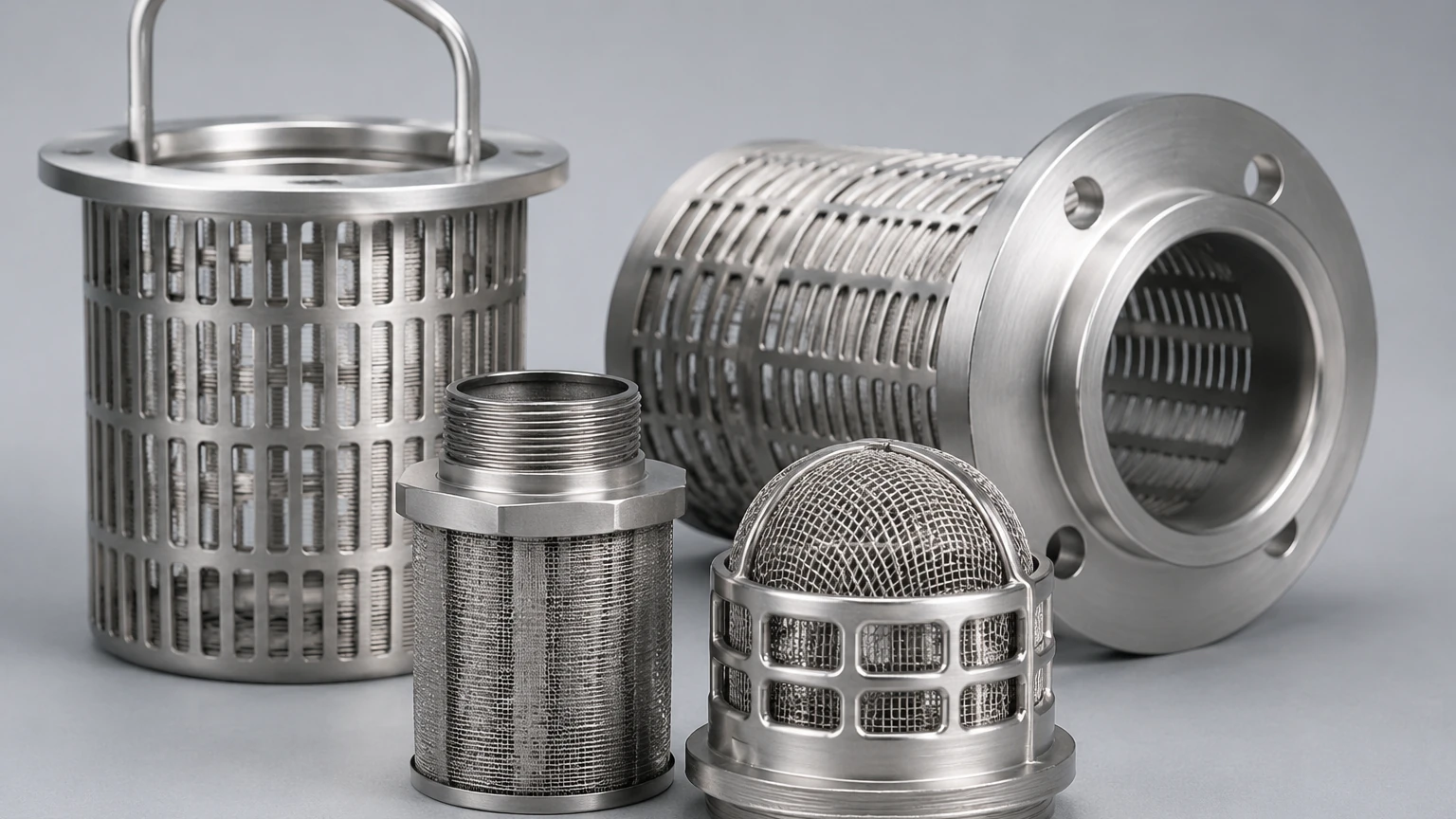
Wedge wire, or V-wire, is the preferred choice for many heavy-duty intake applications. It consists of V-shaped profiles welded onto support rods. This design offers several technical advantages:
1. Non-Clogging Geometry: The V-shaped opening widens inwardly. If a particle manages to pass the outer edges of the slot, it will flow freely through the rest of the screen rather than getting wedged in the middle.
2. High Structural Strength: The continuous welding at every intersection provides a rigid structure capable of withstanding high differential pressures.
3. Ease of Cleaning: The smooth surface and consistent slot geometry make wedge wire ideal for automated backwashing or air-burst cleaning systems.
Woven Wire Mesh Screens
For applications requiring finer filtration accuracy (below 100 microns), woven wire mesh is often employed. While it offers a very high percentage of open area, it typically requires a perforated metal or heavy-duty frame support to handle the mechanical loads of an intake system. Woven mesh is frequently used in pharmaceutical and food-grade intakes where precision is paramount.
Common Risks and Mitigation in Intake Operations
Operating an intake system involves managing dynamic environmental and process conditions. Engineers must account for several common risks during the design phase.
Biofouling and Scaling
In aquatic environments, the growth of algae, barnacles, or mussels can quickly occlude intake screens. Similarly, in chemical processes, mineral scaling can bridge the openings. Mitigation strategies include:
* Material Selection: Using smooth-surface stainless steel to reduce the adhesion of biological organisms.
* Passive vs. Active Cleaning: Passive screens rely on natural currents to sweep away debris, while active systems use mechanical rakes, backwashing, or air-burst systems to clear the screen face.
Mechanical Impact and Debris Loading
Intake screens located in open water bodies are subject to impact from large floating debris (logs, ice, etc.). Custom intake designs often include "trash racks" or heavy-duty external cages to protect the finer internal screen media. At Kaifil, we assist engineers in designing reinforced structures that can survive these physical stresses without compromising filtration efficiency.
Customization and OEM Capabilities
Standard off-the-shelf intake solutions rarely meet the specific needs of complex industrial plants. Customization is often required to fit existing piping footprints, accommodate specific flow rates, or comply with unique chemical compatibility requirements.
Kaifil provides comprehensive OEM services for intake screens, allowing for the customization of:
* End Connections: Flanged, threaded, or custom weld-prep ends to ensure a leak-proof integration with the intake manifold.
* Internal Reinforcement: Designing internal skeletons for screens that must operate under high vacuum or pressure conditions.
* Dimensional Flexibility: Manufacturing screens in various lengths and diameters to achieve the necessary surface area within confined installation spaces.
To explore the full range of customization options and technical specifications, engineers are encouraged to Review product options and application support on our Main Page.
Maintenance Protocols and Service Life
The total cost of ownership (TCO) for an intake screen is heavily influenced by its maintenance requirements. A well-designed stainless steel screen can last for 20 years or more, provided the maintenance protocol is followed.
Monitoring Differential Pressure
The most effective way to manage intake screens is through differential pressure (DP) monitoring. By measuring the pressure before and after the screen, operators can determine the exact level of debris loading. An automated alert system should be set to trigger a cleaning cycle or a manual inspection when the DP reaches a pre-defined threshold, typically between 2 and 5 psi, depending on the system's design.
Cleaning and Inspection Cycles
Regular inspections are necessary to check for signs of mechanical wear, corrosion, or bypass. In systems without automated cleaning, a scheduled manual cleaning cycle—using high-pressure water jets or chemical descaling agents—is essential to maintain the design flow rate. Because Kaifil utilizes high-grade stainless steel, these screens can withstand aggressive cleaning methods that would damage plastic or lower-grade metal alternatives.
Conclusion
Intake screens are a critical investment in the reliability of industrial fluid systems. By focusing on technical fundamentals—such as approach velocity, material grade, and structural geometry—engineers can ensure that their intake systems provide consistent protection for downstream equipment.
Whether you are designing a new water intake for a chemical plant or replacing aging screens in a hydraulic system, choosing a manufacturer with deep expertise in stainless steel filtration is vital. Kaifil’s commitment to precision engineering and custom OEM manufacturing ensures that every intake screen is optimized for its specific application, delivering durability and performance in the most demanding environments. For detailed technical assistance and to view our complete product lineup, visit our Main Page.
