


Is Sand Filter Better Than Cartridge
In the realm of industrial filtration, selecting the appropriate separation technology is a critical decision that impacts process efficiency, product purity, and long-term operational costs. When engineers and procurement teams evaluate primary filtration stages, the debate often centers on a fundamental question: is sand filter better than cartridge?
There is no universal answer, as the "better" choice depends entirely on the specific requirements of the application, including the nature of the fluid, the required micron rating, the flow rate, and the available maintenance infrastructure. This article provides a technical comparison between sand (media) filters and cartridge filters, focusing on their performance in industrial environments such as chemical processing, water treatment, and hydraulic systems.
Understanding the Mechanics: Depth vs. Surface Filtration
To determine if a sand filter is better than a cartridge filter for a specific use case, one must first understand the underlying filtration mechanisms.
Sand filters utilize depth filtration. They consist of a large pressure vessel filled with graded layers of sand, gravel, or anthracite. As the process fluid passes through the bed, suspended solids are trapped within the interstitial spaces between the media grains. This allows sand filters to handle a relatively high load of solids before requiring a cleaning cycle. However, the path through the media is irregular, which can lead to inconsistent filtration if the flow rate fluctuates or if the media bed develops channels.
In contrast, cartridge filters—particularly those utilizing stainless steel wire mesh or sintered metal—can provide both surface and depth filtration depending on the design. A pleated stainless steel cartridge, for instance, offers a high surface area for intercepting particles at the boundary. Because the pore size of a metal mesh is precisely manufactured, cartridge filters offer a level of consistency and predictability that media filters cannot match. For applications where the removal of specific particle sizes is mandatory for downstream equipment protection, the precise mechanical barrier of a cartridge is often superior.
Filtration Precision and Micron Ratings
One of the most significant differentiators in the "is sand filter better than cartridge" comparison is the level of filtration fineness, or micron rating.
Sand filters are generally considered coarse filtration tools. A standard rapid sand filter typically achieves a filtration rating of 20 to 40 microns. While multi-media filters (using layers of different densities) can sometimes reach 10 to 15 microns, they struggle to provide absolute filtration. If your process requires the removal of very fine particulates, sand media may prove insufficient.
Cartridge filters excel in precision applications. Depending on the media used, cartridges can range from sub-micron levels up to several hundred microns. In industrial settings, stainless steel filter cartridges are frequently specified for their ability to provide absolute ratings. This means that 99.9% of particles at the specified micron size are retained. For industries like pharmaceuticals or high-end chemical processing, where even minor contamination can result in batch failure, the precision of a cartridge filter makes it the clear choice over sand.
Operational Efficiency: Backwashing vs. Replacement
The maintenance profile of these two systems represents a major fork in the decision-making process. Sand filters are designed for high-volume, continuous operation where the media is cleaned in-situ through backwashing. During a backwash cycle, the flow of water is reversed, lifting the sand bed and flushing the trapped debris out through a waste line.
While backwashing is convenient because it does not require manual handling of the filter media, it has several drawbacks in an industrial context:
1. Water Consumption: Backwashing requires a significant volume of clean water, which can be a major operational expense and an environmental concern.
2. Waste Stream Management: The backwash effluent must be treated or disposed of, which may involve additional chemical treatment or settling tanks.
3. Downtime or Redundancy: Filtration must stop during backwashing unless a multi-tank system is installed, increasing the initial capital expenditure.
Cartridge filtration systems operate differently. Traditional disposable cartridges are replaced once the pressure drop reaches a certain threshold. However, in many B2B industrial applications, stainless steel cartridges are preferred because they are cleanable and reusable. These components can be cleaned via back-pulsing, ultrasonic baths, or chemical cleaning. While this requires manual intervention or a specialized cleaning station, it eliminates the massive water waste associated with sand filter backwashing and ensures that no foreign media (like sand grains) can migrate into the process stream.
Spatial and Engineering Constraints
From an engineering perspective, the physical footprint and weight of the filtration system are often deciding factors. Sand filters are inherently bulky. To achieve a high flow rate, the vessel must be large enough to maintain a low approach velocity, and the weight of the media and water combined requires robust structural support and floor space.
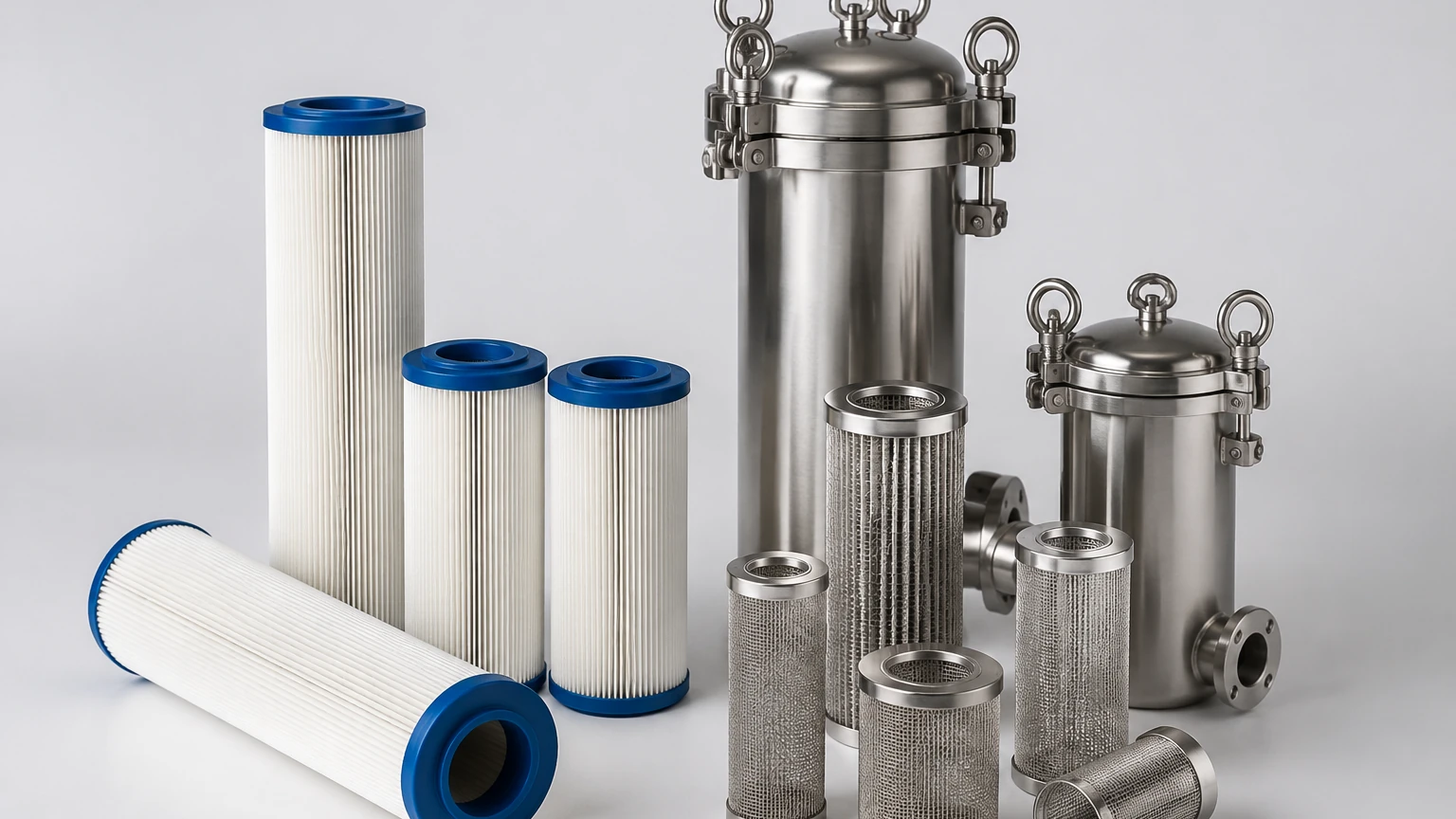
Cartridge filter housings are significantly more compact. Because stainless steel cartridges can be pleated to maximize surface area within a small volume, a cartridge housing can often handle the same flow rate as a sand filter in a fraction of the space. This modularity allows for easier integration into existing skid-mounted systems or facilities with limited floor space. For engineers designing compact hydraulic power units or mobile water treatment trailers, the space-saving nature of cartridge filters is a distinct advantage.
Material Durability and Chemical Compatibility
In demanding industrial environments, the durability of the filter materials is paramount. Sand filters are limited by the chemical and thermal resistance of the media and the vessel lining. Over time, sand grains can degrade, smooth out (reducing filtration efficiency), or even react with certain aggressive chemicals.
Stainless steel filtration solutions, such as those found on the Main Page of specialized manufacturers, offer superior resistance to high temperatures, high pressures, and corrosive environments. Using 304 or 316L stainless steel ensures that the filter element will not shed fibers or particles into the fluid—a common risk with sand or polypropylene cartridges. In applications involving steam, hot oils, or caustic cleaning solutions, the structural integrity of a metal cartridge is far more reliable than a sand bed.
Total Cost of Ownership (TCO) Analysis
When asking if a sand filter is better than a cartridge, one must look beyond the initial purchase price to the Total Cost of Ownership (TCO).
* Sand Filter TCO: Lower media cost but higher initial capital cost for large vessels and complex valving/piping for backwashing. Ongoing costs include high water usage and the eventual need to replace the entire sand bed (typically every 3–5 years).
* Cartridge Filter TCO: Lower initial capital cost for the housing. If using disposable cartridges, the recurring cost of replacements can be high. However, if using high-quality stainless steel cartridges, the TCO is optimized through long service life and the ability to clean the elements repeatedly.
For many industrial facilities, the reduction in water waste and the assurance of product quality provided by cartridge systems lead to a faster Return on Investment (ROI), despite the potentially higher cost of individual metal filter elements.
Industry-Specific Selection Criteria
To help engineers make an informed decision, here is how the comparison usually plays out across different sectors:
Water Treatment and Pre-filtration
In large-scale municipal or raw water intake systems where the goal is to remove bulk turbidity, a sand filter is often better due to its ability to handle massive solids loads. However, as a pre-filter for Reverse Osmosis (RO) membranes, cartridge filters (often 5-micron) are mandatory to protect the delicate membranes from fine particles that sand filters miss.
Chemical and Petrochemical Processing
Here, the answer is almost always cartridge filtration. The need for precise micron control and compatibility with aggressive solvents makes stainless steel wire mesh or sintered metal cartridges the industry standard. The risk of sand media contaminating a high-value chemical batch is a risk most plant managers are unwilling to take.
Food and Beverage
Hygiene is the priority in food and beverage. Sand filters can harbor bacterial growth within the media bed if not perfectly maintained. Stainless steel cartridges, which can be sterilized via SIP (Steam-in-Place) or CIP (Clean-in-Place) procedures, provide the sanitary environment required for processing juices, oils, and dairy products.
Hydraulic and Lube Oil Systems
Sand filters are virtually never used in hydraulic systems. The precision required to protect high-pressure pumps and valves necessitates the use of high-strength cartridge filters that can withstand system pressures and provide absolute filtration to prevent component wear.
Conclusion: Which Should You Choose?
Is sand filter better than cartridge? The sand filter is a workhorse for bulk water treatment where high solids loading is present and precision is secondary. However, for the majority of modern industrial processes that demand high purity, compact footprints, and chemical resilience, the cartridge filter—specifically the stainless steel variety—is the superior technical solution.
Before making a final selection, engineers should confirm the following data points:
* Fluid Characterization: Viscosity, temperature, and chemical composition.
* Contaminant Profile: Particle size distribution and concentration.
* Flow Requirements: Minimum and maximum flow rates and allowable pressure drop.
* Target Purity: The specific micron rating required for downstream protection.
For those seeking specialized advice on custom filtration hardware, reviewing technical product options and application support on the Main Page can provide the necessary engineering data to optimize your filtration system design. By focusing on the specific needs of the application rather than a generic preference, you can ensure a filtration solution that delivers both performance and value.
