


Johnson Screen
In the landscape of industrial filtration and separation, the Johnson screen—commonly referred to as a wedge wire screen—represents a pinnacle of mechanical engineering designed for durability and high-efficiency performance. Characterized by its unique V-shaped wire profile and continuous slot design, the Johnson screen has become an essential component in sectors ranging from water well development to complex petrochemical processing. For engineers and procurement specialists, understanding the technical nuances of these components is vital for optimizing system longevity and process reliability.
At Kaifil, we recognize that industrial filtration is not a one-size-fits-all discipline. The selection of a Johnson screen involves a deep dive into material science, fluid dynamics, and structural mechanics. This guide provides a comprehensive technical overview of wedge wire technology, helping technical teams navigate the complexities of selection, customization, and application integration.
Engineering Principles of the Johnson Screen Design
The fundamental advantage of a Johnson screen lies in its geometric configuration. Unlike traditional woven wire mesh or perforated plates, a Johnson screen is constructed by resistance-welding V-shaped stainless steel wires onto support rods. This method creates a structure that is both exceptionally strong and highly resistant to clogging.
The V-Shaped Profile Advantage
The "V" or wedge-shaped profile of the surface wire is the defining feature of this technology. The wire is oriented so that the widest part of the wedge faces the incoming flow. As particles pass through the slot, the opening widens inwardly. This means that any particle small enough to enter the slot will pass through without becoming wedged or trapped. This self-cleaning property is critical for applications involving high-solids loading or sticky materials where downtime for manual cleaning must be minimized.
Continuous Slot Construction
The manufacturing process allows for a continuous slot opening that wraps around the entire circumference of the screen. This design maximizes the total open area compared to other filtration media. For a given surface area, a Johnson screen typically offers a lower pressure drop and higher flow capacity, which translates to reduced energy consumption for pumps and more efficient process throughput.
Material Selection and Corrosion Resistance
Industrial environments often subject filtration components to aggressive chemical agents, high temperatures, and abrasive particles. Selecting the correct alloy is the first step in ensuring the structural integrity of a Johnson screen over its intended service life.
Stainless Steel Grades
Most industrial wedge wire screens are fabricated from austenitic stainless steels.
* Grade 304: Suitable for general-purpose applications where cost-effectiveness is balanced with moderate corrosion resistance. It is commonly used in food processing and standard water treatment.
* Grade 316L: The "L" denotes low carbon, which improves weldability and resistance to intergranular corrosion. 316L contains molybdenum, making it significantly more resistant to chlorides and pitting, which is essential for marine environments and chemical processing.
* Duplex and Super Duplex: For extreme environments involving high pressure and highly corrosive media, Duplex stainless steels offer superior yield strength and resistance to stress corrosion cracking.
Surface Treatments
To further enhance performance, various surface treatments can be applied. Passivation is standard to remove free iron and enhance the protective oxide layer. In specific high-purity applications, such as pharmaceuticals, electropolishing may be used to achieve a mirror-like finish that minimizes bacterial adhesion and facilitates easier sterilization.
Evaluating Performance Metrics: Slot Size and Flow Dynamics
When specifying a Johnson screen, engineers must balance filtration accuracy with hydraulic performance. The precision of the slot size determines the particle cut-off point, but it also dictates the mechanical limits of the screen.
Slot Size Accuracy
Slot sizes for wedge wire can range from as small as 20 microns to several millimeters. It is crucial to confirm the tolerance levels provided by the manufacturer. In high-precision applications, such as resin traps or catalyst support grids, even a slight deviation in slot width can lead to the loss of expensive media or downstream contamination.
Open Area Calculations
The percentage of open area is calculated based on the slot width relative to the wire width. A common engineering trade-off is that a larger open area improves flow but reduces the mechanical strength of the screen. Technical teams must calculate the expected velocity of the fluid through the slots to ensure it does not exceed the "critical velocity" that could cause erosion of the wire edges or pull fine solids through the filter bed.
Structural Integrity and Mechanical Load Considerations
A Johnson screen is often a structural element within a pressure vessel or a deep well. Consequently, it must withstand significant mechanical loads, including collapse pressure, burst pressure, and axial tension.
Support Rod Configuration
The strength of the screen is largely determined by the spacing and diameter of the internal support rods. For high-pressure applications, such as deep-water wells or high-head intake screens, the support rods must be engineered to prevent buckling. Engineers should request collapse strength ratings based on the specific depth or differential pressure the screen will encounter in the field.
Flow Direction: FITO vs. FOTI
The orientation of the wedge wire relative to the support rods determines the flow direction capability.
* FOTI (Flow-Out-To-In): The most common configuration for well screens and intake filters, where the smooth surface is on the outside.
* FITO (Flow-In-To-Out): Often used in centrifuge baskets or internal pipe liners, where the smooth filtration surface is on the inside of the cylinder.
Understanding the required flow direction is essential for ensuring the "V" profile performs its non-clogging function correctly.
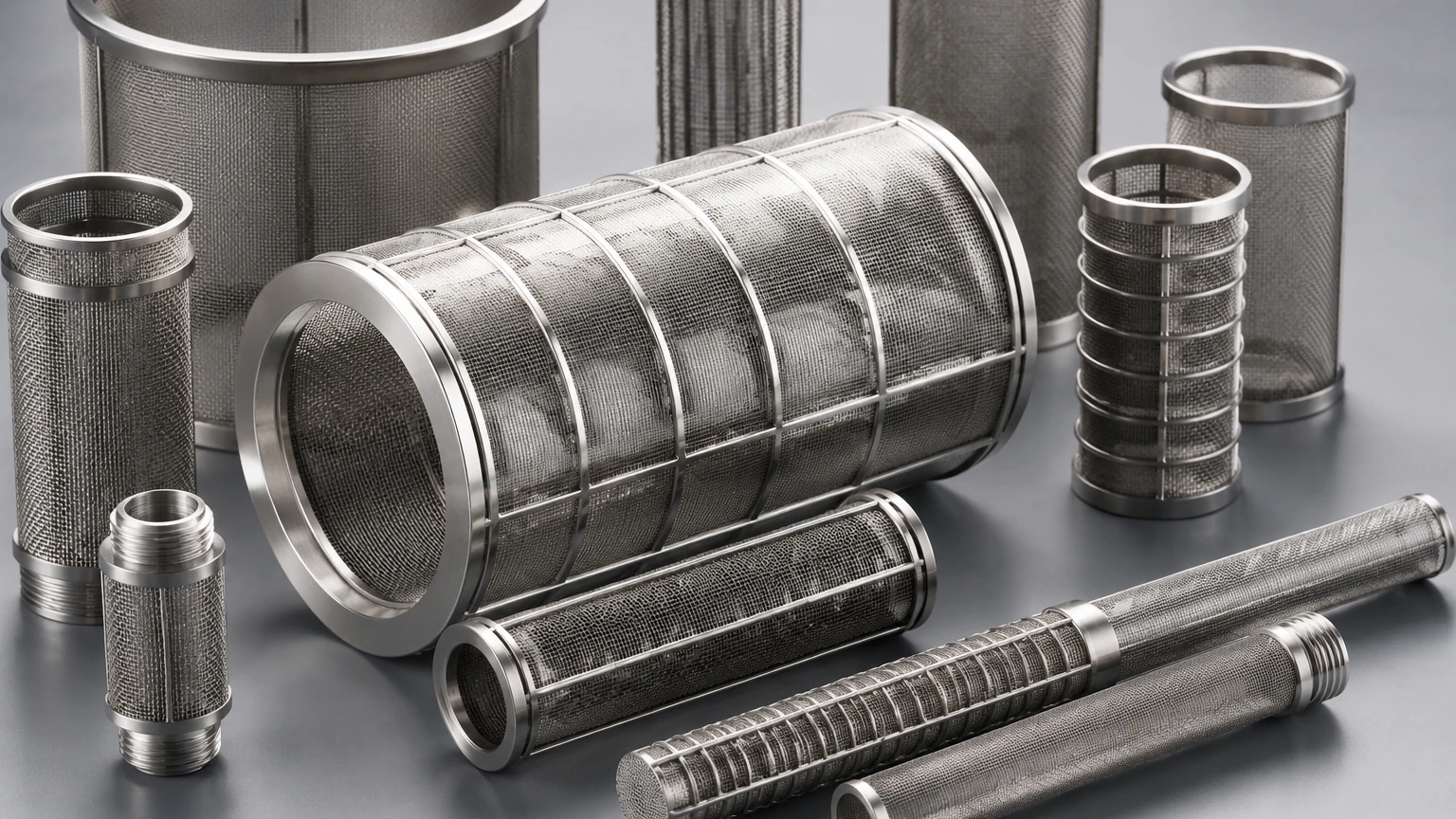
Customization and OEM Integration
One of the primary reasons engineers opt for wedge wire technology is the high degree of customization available. Because these screens are fabricated rather than woven, they can be engineered to fit precise dimensional constraints and integrated directly into existing machinery.
At Kaifil, we specialize in translating complex filtration requirements into high-performance metal components. Whether your project requires specific end fittings, reinforced housings, or non-standard diameters, our manufacturing capabilities ensure that the final product aligns with your technical specifications. To explore the full range of our custom capabilities and technical support, we invite you to visit our Main Page for detailed product options and application guidance.
End Fittings and Connections
The method of integration is as important as the filtration media itself. Common customization options include:
* Threaded Couplings: Typically used in water well and oil field applications for easy assembly of long screen strings.
* Flanges: Standard for chemical and industrial piping systems to ensure a leak-proof seal.
* Weld Rings: Used when the screen is to be permanently integrated into a larger vessel or housing.
* Reinforced Headers: For lateral screen systems used in large-scale water treatment underdrains.
Common Risks and Failure Modes
While Johnson screens are robust, they are not immune to failure if improperly specified or maintained. Identifying potential risks early in the design phase can prevent costly system outages.
1. Erosion: In high-velocity applications containing abrasive sands or minerals, the edges of the wedge wire can wear down over time. This increases the slot size and compromises filtration accuracy. Selecting hardened alloys or reducing flow velocity through larger surface areas can mitigate this risk.
2. Biofouling: In water intake applications, the growth of organic matter can block slots. While the V-wire resists mechanical clogging, it cannot entirely prevent biological growth. Engineers should consider copper-nickel alloys or integrated backwash systems for such environments.
3. Mechanical Fatigue: Vibration caused by turbulent flow or mechanical movement can lead to fatigue at the weld points. Proper structural support and flow baffling are necessary to ensure the screen remains stable under dynamic loads.
Total Cost of Ownership and Maintenance
The initial procurement cost of a Johnson screen is often higher than that of disposable cartridges or simple wire mesh. However, the total cost of ownership (TCO) is frequently lower due to the screen's longevity and cleanability.
Cleaning and Regeneration
Unlike disposable filters, wedge wire screens can be cleaned in situ using backwashing, ultrasonic cleaning, or chemical CIP (Clean-In-Place) cycles. This eliminates the recurring cost of replacement filters and reduces the environmental impact of waste disposal. When evaluating the budget, purchasing teams should account for the reduced labor and downtime associated with these durable components.
Replacement Cycles
In a well-designed system, a stainless steel Johnson screen can last for decades. Replacement is typically only necessary if the process conditions change significantly (e.g., a change in particle size distribution) or if physical damage occurs. Regular inspection of the slot widths and weld integrity during scheduled maintenance is recommended to ensure continued performance.
Procurement Checklist: What Engineers Must Confirm
Before finalizing a purchase order for a Johnson screen, technical teams should confirm the following data points with their manufacturer:
* Material Certification: Ensure the alloy meets ASTM or ISO standards for the intended environment.
* Slot Tolerance: Define the maximum allowable deviation from the nominal slot size.
* Pressure Ratings: Confirm the collapse and burst pressure limits based on the operating temperature.
* Flow Capacity: Verify that the open area is sufficient to maintain the required flow rate at an acceptable pressure drop.
* Quality Assurance: Inquire about weld integrity testing and dimensional inspection reports.
By focusing on these technical parameters, engineers can ensure that their selection of a Johnson screen provides the reliability and efficiency required for demanding industrial processes. For further technical consultation or to review specific filtration solutions, visit the Kaifil Main Page to connect with our engineering team.
