


Liquid Liquid Coalescer Separator
In industrial process engineering, the efficient separation of immiscible liquids—typically water from hydrocarbons or organic solvents from aqueous phases—is a critical requirement for maintaining product purity and protecting downstream equipment. A liquid liquid coalescer separator is a specialized filtration and separation system designed to accelerate the natural settling process of dispersed droplets within a continuous liquid phase. Unlike simple gravity settlers, which rely solely on residence time and density differences, coalescers utilize advanced media to merge sub-micron droplets into larger masses that can be easily removed.
For engineers and procurement professionals, selecting the right separation technology involves a deep understanding of fluid dynamics, interfacial tension, and material compatibility. This technical overview examines the mechanical principles, engineering considerations, and industrial applications of liquid-liquid separation systems, with a focus on the high-performance stainless steel components provided by manufacturers like Kaifil.
Fundamental Principles of Liquid-Liquid Coalescence
The operation of a liquid liquid coalescer separator is governed by the physical interaction between two immiscible liquids. In many industrial streams, one liquid (the dispersed phase) exists as tiny droplets suspended within another liquid (the continuous phase). These droplets are often too small to settle by gravity within a reasonable timeframe, especially when the density difference between the two fluids is minimal.
Stokes' Law and Droplet Growth
According to Stokes' Law, the settling velocity of a droplet is proportional to the square of its diameter. Therefore, increasing the droplet size is the most effective way to speed up separation. The coalescing media provides a high-surface-area environment where droplets are captured. As the fluid flows through the media, the dispersed droplets attach to the fibers or wires. Subsequent droplets collide with the captured ones, merging into larger globules. Once these globules reach a critical size, the drag force of the flowing liquid overcomes the adhesive force, and the enlarged droplets are released to settle or rise according to their density.
The Role of Surface Energy
Effective coalescence depends heavily on the surface properties of the media. Coalescing elements are typically designed to be "preferentially wetted" by the dispersed phase. For example, if water is being removed from oil, a hydrophilic (water-attracting) media is used to capture the water droplets. Conversely, the separator stage often utilizes hydrophobic (water-repelling) media to allow the continuous oil phase to pass while blocking the enlarged water droplets.
Engineering Design and Component Selection
Designing a liquid liquid coalescer separator requires precise calculation of flow rates, pressure drops, and vessel dimensions. A standard system usually consists of two distinct stages housed within a single pressure vessel.
Stage 1: The Coalescer Element
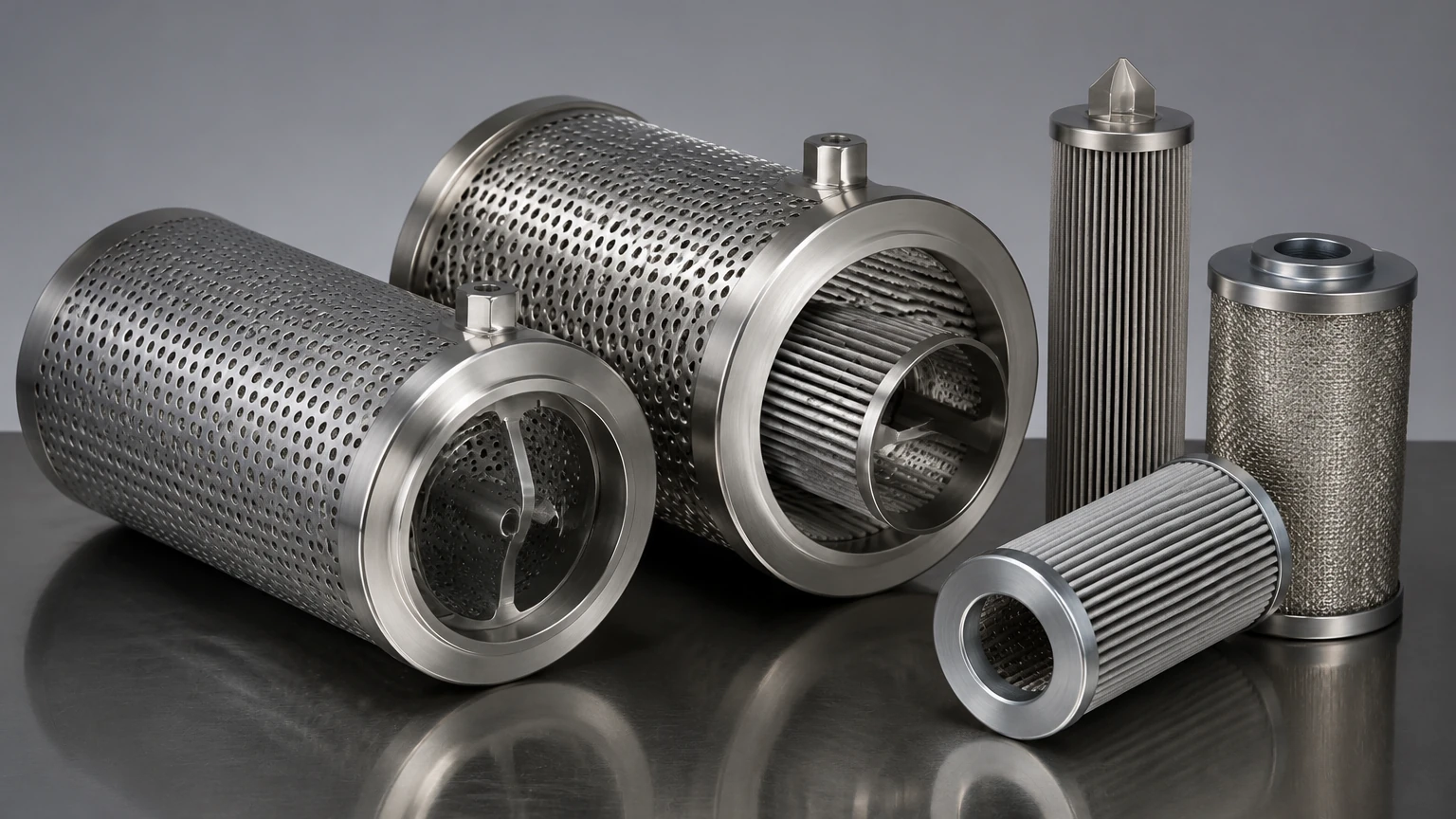
The first stage contains the coalescing cartridges. These are often constructed from multi-layered media, including stainless steel wire mesh, sintered metal fibers, or specialized glass fibers. Stainless steel is frequently preferred in harsh chemical environments due to its mechanical strength and resistance to corrosion. The pore size gradient within the element is engineered to capture droplets progressively, ensuring that the coalescence occurs throughout the depth of the media rather than just on the surface.
Stage 2: The Separator Element
After the droplets have been enlarged in the first stage, the fluid enters the separator stage. This stage employs a barrier that is chemically treated or naturally resistant to the dispersed phase. For instance, a Teflon-coated stainless steel mesh might be used to repel water. The enlarged water droplets, unable to pass through the separator mesh, fall to the bottom of the vessel (the sump) for drainage, while the clean continuous phase exits the outlet.
Vessel Configuration
Engineers must determine whether a horizontal or vertical vessel configuration is appropriate. Horizontal vessels are generally preferred for liquid-liquid separation because they provide a larger surface area for phase interface and settling, allowing for higher flow capacities in a smaller footprint compared to vertical designs.
Material Science in Coalescer Manufacturing
The choice of material for the internal filtration components is a primary factor in the system's total cost of ownership and operational reliability. While synthetic fibers are common in light-duty applications, industrial processes involving high temperatures, high pressures, or aggressive chemicals necessitate the use of metallic media.
Stainless Steel Wire Mesh
Stainless steel 304 and 316L are the industry standards for coalescer internals. These materials offer excellent resistance to oxidation and organic solvents. Precision-woven wire mesh provides a predictable and consistent pore structure, which is vital for maintaining a stable pressure drop across the system. For more information on custom metal filtration components, you can visit the Main Page of the manufacturer’s technical resource.
Sintered Metal Media
In applications requiring extreme durability, sintered metal fibers or powders are used. Sintering bonds the metal particles or fibers together at high temperatures, creating a rigid structure that can withstand significant backpressure and mechanical stress. This is particularly useful in hydraulic systems and high-pressure chemical reactors where element collapse could lead to catastrophic downstream contamination.
Industrial Applications and Performance Metrics
Liquid-liquid coalescers are utilized across a broad spectrum of industries, each with unique performance requirements and regulatory standards.
* Petrochemical and Refining: Removing water from jet fuel, diesel, and gasoline is essential to prevent engine corrosion and microbial growth. Coalescers ensure that fuel meets strict "clear and bright" standards.
* Chemical Processing: In solvent extraction processes, coalescers are used to recover expensive solvents from aqueous waste streams, improving process efficiency and reducing environmental impact.
* Pharmaceutical Manufacturing: Precision separation is required to isolate active pharmaceutical ingredients (APIs) from reaction mixtures. Stainless steel components are favored here for their ease of sterilization and lack of extractables.
* Food and Beverage: Coalescers help in the recovery of essential oils and the removal of fats or oils from process water, ensuring compliance with discharge regulations.
Evaluating Performance
When evaluating a liquid liquid coalescer separator, engineers look at several key metrics:
1. Efficiency: The ability to reduce the dispersed phase concentration (e.g., reducing water in oil from 5,000 ppm to less than 10 ppm).
2. Pressure Drop ($ΔP$): The resistance to flow. A high initial pressure drop indicates an undersized system, while a rapid increase in pressure drop suggests premature fouling.
3. Flux Rate: The volume of fluid passing through a unit area of media. Optimizing flux is essential to prevent droplet shearing, which occurs when high velocities break apart droplets before they can coalesce.
Maintenance, Cleaning, and Operational Longevity
One of the primary advantages of using stainless steel filtration components in a liquid liquid coalescer separator is the ability to clean and reuse the elements. Unlike disposable cartridges made of fiberglass or paper, metal mesh elements can often be restored through ultrasonic cleaning, chemical soaking, or backwashing.
Monitoring and Replacement Cycles
Operational monitoring typically involves tracking the differential pressure across the coalescer and separator stages. An unexpected rise in $ΔP$ usually indicates the accumulation of solid contaminants (particulates) rather than liquid saturation. In many systems, a pre-filter is installed upstream of the coalescer to remove solids, thereby extending the life of the more expensive coalescing elements.
Total Cost of Ownership (TCO)
While the initial capital expenditure for a system with stainless steel internals may be higher than for disposable alternatives, the TCO is often lower. Reduced waste disposal costs, fewer shutdowns for element replacement, and the long-term durability of metal components provide a significant return on investment for high-capacity industrial plants.
Customization and OEM Integration for Specialized Systems
Standard off-the-shelf coalescers often fail to meet the specific needs of complex industrial processes. Factors such as varying fluid viscosities, fluctuating flow rates, and the presence of surfactants can interfere with the coalescence process. Surfactants, in particular, lower the interfacial tension between liquids, making it much harder for droplets to merge.
Tailored Filtration Solutions
Manufacturers like Kaifil work closely with engineering teams to develop customized filtration solutions. This includes selecting specific mesh weaves, adjusting the number of media layers, and designing custom cartridge dimensions to fit existing vessel housings. Customization ensures that the liquid liquid coalescer separator is optimized for the specific chemical and physical properties of the process stream.
Technical Confirmation for Procurement
Before finalizing a purchase, purchasing teams should confirm the following with the manufacturer:
* Chemical Compatibility: Ensure all gaskets, seals, and metal alloys are compatible with the process fluids.
* Filtration Rating: Define the required micron rating for both solid removal and liquid droplet capture.
* Certification Requirements: Confirm if the vessel and internals need to meet specific codes, such as ASME Section VIII or PED standards.
* Scalability: Ensure the design can handle peak flow conditions without bypassing or losing efficiency.
By focusing on high-quality materials and precise engineering, industrial facilities can achieve reliable, long-term liquid-liquid separation. Whether the goal is to protect sensitive equipment, meet environmental standards, or improve product quality, the integration of a well-designed liquid liquid coalescer separator is a vital component of modern industrial infrastructure.
