


Liquid-liquid Coalescers
In industrial processing, the separation of two immiscible liquids is a critical requirement across the chemical, petrochemical, pharmaceutical, and food and beverage sectors. Whether the goal is to remove water from fuel, recover valuable organic solvents from aqueous streams, or purify oil in hydraulic systems, the efficiency of the separation process directly impacts product quality and equipment longevity. Liquid-liquid coalescers represent a sophisticated mechanical solution designed to accelerate the separation of stable emulsions that would otherwise take an impractical amount of time to settle by gravity alone.
For engineers and procurement teams, understanding the technical nuances of coalescer design—from media selection to fluid dynamics—is essential for optimizing system performance. As a specialist in custom stainless steel filtration solutions, Kaifil provides the precision-engineered components necessary to facilitate these complex separation tasks. Navigating the options available on our Main Page allows technical professionals to identify the specific materials and configurations required for demanding industrial environments.
Understanding Liquid-Liquid Coalescence Principles
Liquid-liquid coalescers operate on the principle of merging small, dispersed droplets of a discontinuous phase into larger droplets. In a typical emulsion, droplets may be so small (often in the sub-micron to 10-micron range) that Brownian motion and fluid viscosity prevent them from settling. Coalescence overcomes this by providing a high-surface-area medium that intercepts these droplets.
The process generally follows three distinct stages:
1. Interception and Attachment: As the emulsion passes through the coalescing media, the dispersed droplets come into contact with the fibers or mesh. The media must be "preferentially wetted" by the dispersed phase. For example, to remove water from oil, a hydrophilic medium is used to attract the water droplets.
2. Coalescence: Once attached to the media, the droplets move along the fibers and collide with other captured droplets. These collisions cause the droplets to merge, growing in size. The physical structure of the media—such as the pore size and fiber density of stainless steel wire mesh—plays a vital role in how effectively these droplets can combine.
3. Release and Separation: When the merged droplets reach a sufficient size, the drag force of the continuous phase flow overcomes the attachment force, and the enlarged droplets are released. Due to the density difference between the two liquids, these larger droplets then rapidly rise or sink (according to Stokes' Law) in a downstream settling zone, where they can be decanted.
Engineering Considerations for Coalescer Media Selection
The heart of any liquid-liquid coalescer is the media. Selecting the right material is not merely a matter of filtration accuracy but involves a deep understanding of surface chemistry and fluid properties. Engineers must evaluate several factors to ensure the long-term viability of the separation system.
Surface Tension and Interfacial Tension
Interfacial tension (IFT) is a measure of the force holding the two liquids together at their boundary. High IFT emulsions are relatively easy to break, whereas low IFT emulsions (often caused by the presence of surfactants) require much finer, high-surface-energy media. Stainless steel components are often preferred in these applications because their surface properties can be precisely controlled through various finishing techniques.
Viscosity and Density
The viscosity of the continuous phase affects the velocity at which droplets can move through the media and eventually settle. High-viscosity fluids require larger coalescer vessels and slower flow velocities to prevent the "re-entrainment" of coalesced droplets. Similarly, the density difference between the two liquids dictates the settling speed; the closer the densities, the more critical the coalescing stage becomes.
Chemical Compatibility
Industrial fluids can be highly corrosive or operate at extreme temperatures. While polymer-based media are common in light-duty applications, industrial-grade liquid-liquid coalescers frequently utilize stainless steel (such as 304 or 316L) or specialized alloys. These materials ensure that the media does not degrade, swell, or shed fibers into the process stream, which is particularly vital in pharmaceutical and food-grade applications.
The Role of Stainless Steel in High-Performance Coalescers
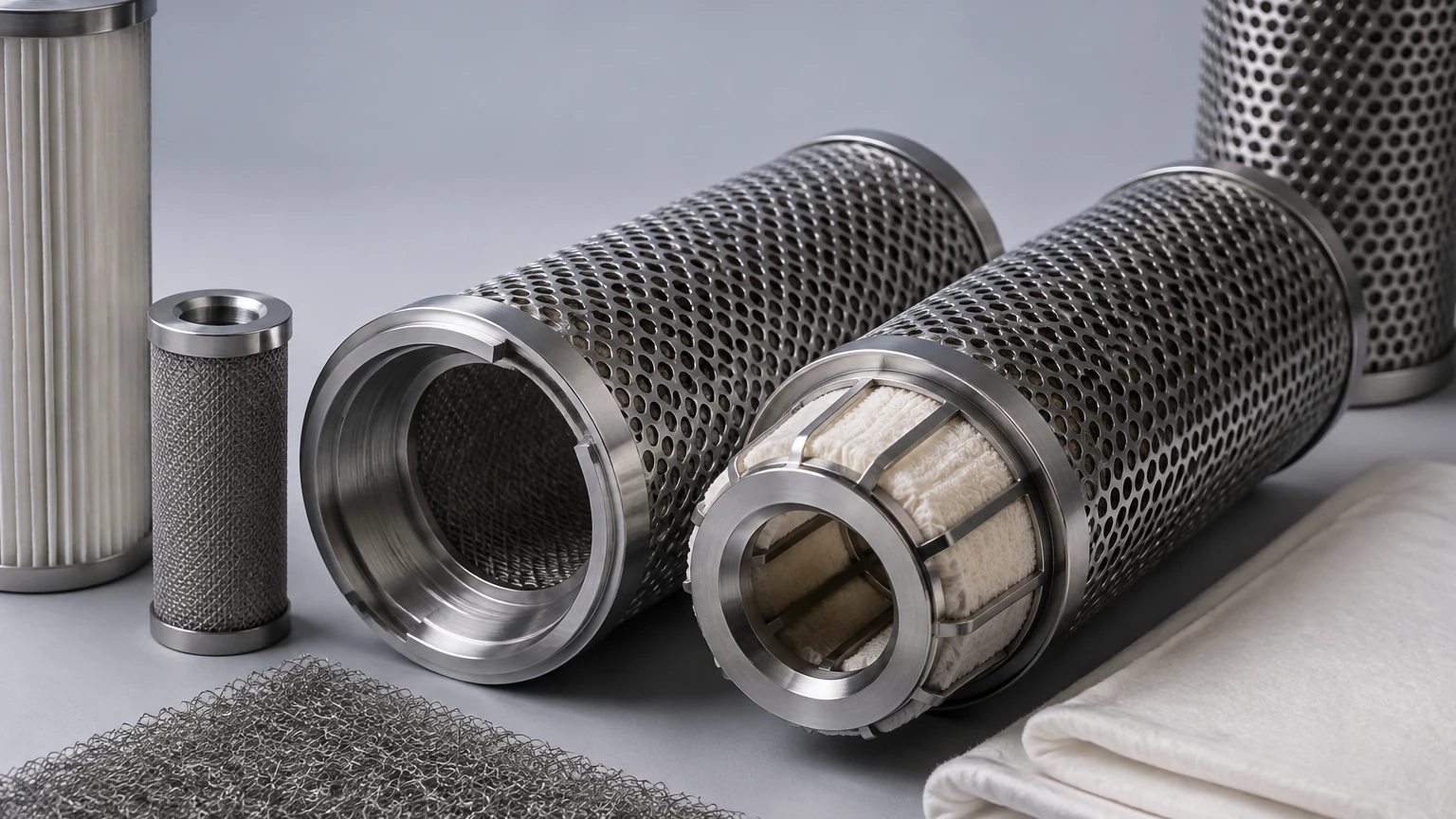
In many heavy-duty industrial applications, stainless steel is the material of choice for coalescing elements. Kaifil specializes in manufacturing stainless steel wire mesh and sintered metal components that serve as the primary media or the structural support for coalescer cartridges.
Using stainless steel offers several engineering advantages:
* Structural Integrity: Unlike synthetic fibers, stainless steel mesh does not collapse under high differential pressure. This maintains a consistent pore structure and ensures predictable separation efficiency throughout the service life of the element.
* Thermal Stability: Many chemical processes occur at elevated temperatures where polymers would lose their mechanical properties. Stainless steel remains stable, allowing for effective coalescence in steam-stripped systems or hot oil recovery.
* Cleanability and Longevity: Stainless steel coalescer elements can often be cleaned and reused, depending on the nature of the contaminants. This significantly reduces the total cost of ownership compared to disposable cartridges.
* Precision Manufacturing: Advanced weaving and sintering techniques allow for the creation of multi-layered media. By combining different mesh counts, engineers can create a gradient pore structure that captures solids in the outer layers while facilitating coalescence in the inner layers.
For those seeking detailed specifications on material grades and mesh configurations, the Main Page provides a comprehensive overview of the manufacturing capabilities available for custom filtration projects.
Application-Specific Challenges in Industrial Separation
Liquid-liquid coalescers are utilized in diverse environments, each presenting unique challenges that must be addressed during the design phase.
Oil and Gas Refineries
In refinery operations, removing water from hydrocarbons (such as diesel, jet fuel, or LPG) is essential to prevent corrosion in downstream equipment and to meet strict fuel quality standards. The presence of naphthenic acids or other natural surfactants can lower interfacial tension, making separation difficult. In these cases, high-efficiency coalescers with multi-stage separation are required.
Chemical Processing and Solvent Recovery
Chemical plants often use liquid-liquid extraction (LLE) to separate products. After the extraction stage, the two phases must be separated completely to ensure product purity and to recycle solvents. Coalescers are used here to remove the "haze"—the fine mist of one liquid suspended in another—which gravity alone cannot resolve.
Hydraulic and Lube Oil Systems
Water contamination in hydraulic fluid leads to oil oxidation, additive depletion, and component wear. Industrial coalescers integrated into bypass loops or kidney-loop systems continuously remove water ingress, extending the life of both the oil and the machinery. Stainless steel cartridges are frequently used here due to their compatibility with various synthetic and mineral oils.
Evaluating Coalescer Performance and Maintenance Cycles
To maintain optimal efficiency, engineers must monitor the performance of liquid-liquid coalescers through quantitative metrics. The most common indicator of performance is the effluent quality, measured in parts per million (ppm) of the dispersed phase remaining in the continuous phase.
Pressure Drop Monitoring
As the coalescer media captures solid particulates along with liquid droplets, the differential pressure ($ΔP$) across the element will increase. While liquid-liquid coalescers are primarily designed for separation, they inevitably act as filters. A sudden rise in $ΔP$ usually indicates solids loading, whereas a decrease in separation efficiency without a change in pressure might indicate media fouling by surfactants or "disarming" of the media surface.
Replacement and Cleaning Cycles
The life cycle of a coalescer element depends on the fluid cleanliness and the presence of chemical contaminants. In many B2B industrial settings, pre-filtration is recommended to remove solids larger than 5-10 microns before the fluid reaches the coalescer. This protects the fine coalescing media and extends the time between maintenance intervals. When using stainless steel components from Kaifil, the durability of the material allows for more rigorous operating conditions compared to standard fiberglass elements.
Customization and OEM Solutions for Filtration Systems
No two industrial separation problems are identical. Factors such as flow rate fluctuations, varying contaminant concentrations, and space constraints in existing plants necessitate customized solutions. Working with an OEM manufacturer allows for the development of coalescer elements that fit specific vessel geometries and meet exact performance targets.
When specifying a custom liquid-liquid coalescer, engineers should be prepared to confirm the following data:
* Fluid Properties: Density, viscosity, and interfacial tension of both phases at operating temperature.
* Flow Rates: Minimum, normal, and maximum flow conditions.
* Concentration Levels: The inlet concentration of the dispersed phase and the required outlet purity.
* Materials of Construction: Compatibility requirements for the media, end caps, and seals.
By focusing on these technical parameters, purchasing teams can ensure they receive a solution that balances initial capital expenditure with long-term operational reliability. Kaifil’s expertise in precision metal filtration ensures that every component is manufactured to the highest standards of industrial accuracy.
For further technical resources, application guides, and to explore our full range of stainless steel filtration products, please visit our Main Page. Our team is dedicated to supporting engineers in achieving efficient, durable, and cost-effective filtration performance across all industrial sectors.
