


Stainless Steel Screen Filter
In the landscape of industrial processing, the selection of a filtration medium is a critical engineering decision that impacts product purity, equipment longevity, and operational efficiency. The stainless steel screen filter represents a versatile and robust solution for separating solids from liquids or gases across a wide spectrum of demanding environments. Unlike disposable synthetic filters, stainless steel components offer a unique combination of thermal stability, chemical resistance, and mechanical strength, making them indispensable in sectors ranging from petrochemical processing to food and beverage production.
As a specialized manufacturer, Kaifil provides precision-engineered filtration solutions designed to meet the rigorous standards of global industrial applications. Understanding the technical nuances of stainless steel screen filters—from mesh geometry to metallurgical properties—is essential for engineers and procurement professionals tasked with optimizing filtration systems. This guide examines the engineering principles, material considerations, and selection criteria necessary for implementing effective stainless steel filtration.
1. Engineering Principles of Stainless Steel Screen Filters
The performance of a stainless steel screen filter is primarily determined by its weave pattern and the physical characteristics of the wire mesh. Unlike depth filters, which trap particles within a thick matrix, a screen filter operates primarily on the principle of surface filtration. This means that particles larger than the pore size are retained on the upstream surface of the mesh, allowing for predictable performance and easier cleaning.
Weave Patterns and Pore Geometry
The method by which stainless steel wires are interlaced dictates the filter's micron rating, flow capacity, and structural integrity. Common weave patterns include:
* Plain Weave: The most straightforward construction where each warp wire crosses over and under each shute wire. This provides high flow rates and is ideal for general-purpose filtration where lower pressure drops are required.
* Twill Weave: Each warp wire passes over and under two shute wires. This allows for the use of heavier wires in a given mesh count, increasing the mechanical strength and durability of the screen.
* Dutch Weave (Plain and Twill): This pattern utilizes a larger diameter warp wire and a smaller diameter shute wire, woven closely together. The result is a dense, strong mesh with very fine pore sizes, often used in high-pressure applications or where precise micron ratings are required.
* Reverse Dutch Weave: In this configuration, the positions of the warp and shute wires are swapped compared to standard Dutch weave. This provides exceptional mechanical strength and is frequently used in continuous filtration systems like polymer melt filtration.
Micron Rating vs. Mesh Count
It is vital to distinguish between mesh count (the number of openings per linear inch) and the micron rating (the actual size of the opening). For industrial applications, the micron rating is the more critical metric, as it defines the filtration efficiency. Engineers must also consider the difference between "absolute" and "nominal" ratings. An absolute rating indicates the largest particle that can pass through the mesh, whereas a nominal rating represents an average retention efficiency.
2. Material Selection: Metallurgy and Chemical Compatibility
One of the primary advantages of utilizing a stainless steel screen filter is the ability to withstand corrosive environments and extreme temperatures. However, not all stainless steels are created equal. The choice of alloy must be aligned with the chemical composition of the process fluid and the operating temperature.
Grade 304 Stainless Steel
Grade 304 is the most common austenitic stainless steel used in filtration. It offers excellent corrosion resistance in a wide range of atmospheric environments and many corrosive media. It is often the preferred choice for food processing and general industrial water treatment due to its cost-effectiveness and durability. However, it is susceptible to pitting and crevice corrosion in warm chloride environments.
Grade 316L Stainless Steel
For more demanding applications, Grade 316L is the industry standard. The addition of molybdenum enhances its resistance to chlorides and acids. The "L" designation stands for low carbon, which minimizes carbide precipitation during welding, ensuring that the filter maintains its corrosion resistance at the joints and seams. This grade is essential for marine environments, pharmaceutical manufacturing, and chemical processing where aggressive solvents are present.
High-Temperature Performance
Stainless steel screen filters maintain their structural integrity at temperatures far exceeding the limits of polymer-based filters. In high-heat applications, such as steam filtration or hot gas exhaust, stainless steel prevents the risk of media migration or thermal degradation, which could otherwise contaminate the process stream.
3. Structural Design and Reinforcement
In many industrial settings, the filtration media is subjected to high differential pressures. A standalone thin wire mesh may lack the necessary rigidity to withstand these forces without deforming. Therefore, the structural design of the filter assembly is as important as the mesh itself.
Pleated vs. Cylindrical Designs
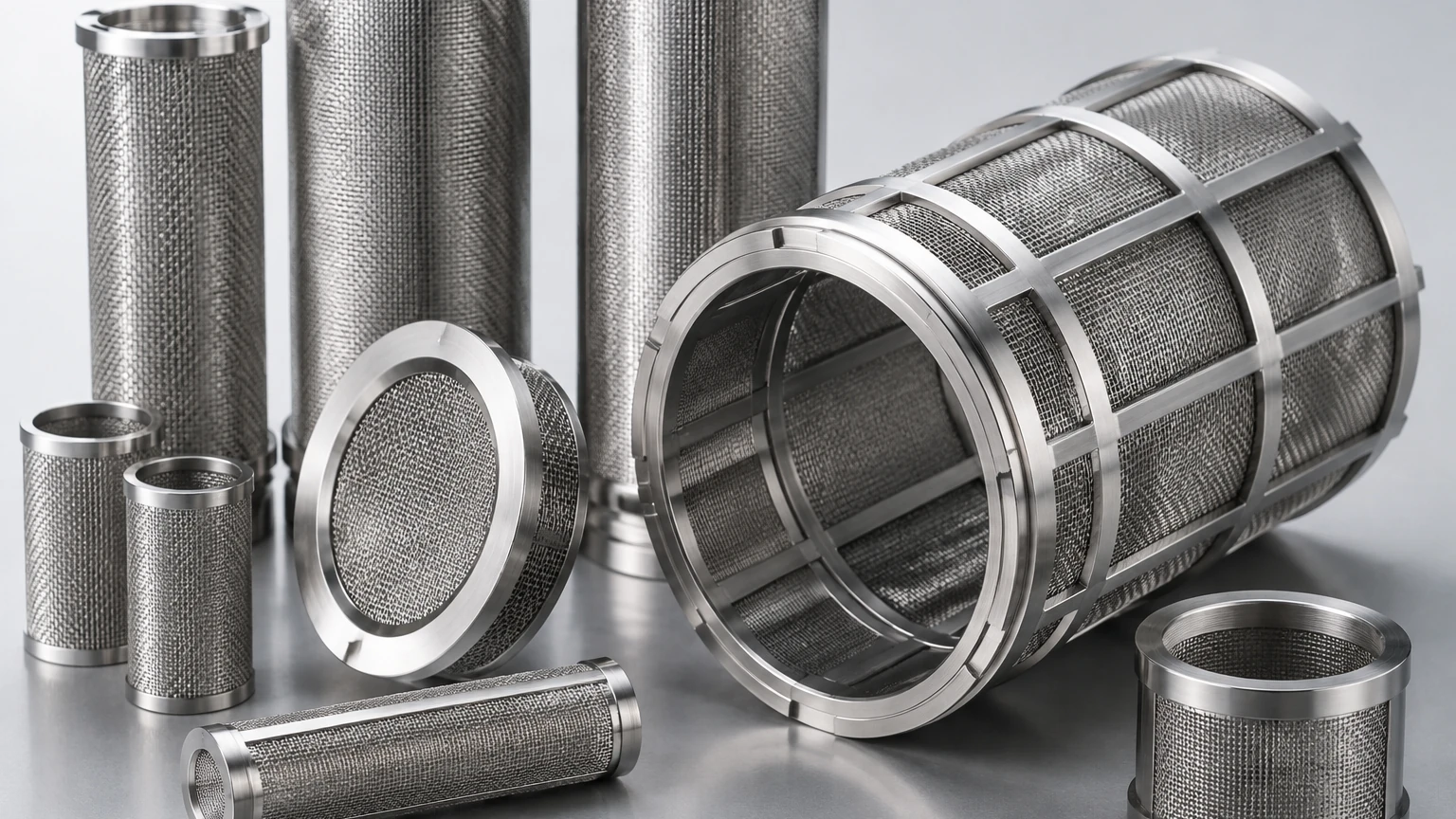
* Cylindrical Filters: These are simple and robust, consisting of a single or multi-layer mesh wrapped around a perforated core. They are easy to clean and maintain but offer limited surface area.
* Pleated Filters: By pleating the stainless steel mesh, the effective surface area is significantly increased within the same footprint. This results in lower face velocities, reduced pressure drops, and longer service life between cleaning cycles. Pleating requires precision manufacturing to ensure the mesh is not compromised at the folds.
Sintered Multi-Layer Mesh
For the most demanding high-pressure applications, Kaifil offers sintered stainless steel mesh. This process involves bonding multiple layers of wire mesh together through heat and pressure without the use of binders. A typical sintered laminate might include a fine filtration layer, a distribution layer, and several heavy-duty support layers. This creates a monolithic structure that is exceptionally strong, dimensionally stable, and capable of withstanding intense backwashing pressures.
4. Performance Metrics and Selection Criteria
When evaluating a stainless steel screen filter for a specific project, engineers should focus on several key performance indicators to ensure the system meets the intended specifications. You can Review product options and application support on our Main Page to see how these metrics are applied to custom designs.
Pressure Drop (ΔP)
The differential pressure across the filter is a function of the fluid's viscosity, flow rate, and the filter's open area. A high initial pressure drop reduces the available energy for the process and shortens the time until the filter reaches its terminal pressure drop (the point at which it must be cleaned or replaced). Selecting a mesh with a high percentage of open area while maintaining the required micron rating is a delicate balance in filtration engineering.
Dirt Holding Capacity
This refers to the amount of contaminant the filter can retain before the pressure drop exceeds the allowable limit. In surface filtration, dirt holding capacity is directly related to the total surface area. This is why pleated designs are often favored in systems with high particulate loading.
Mechanical Integrity and Fatigue
In systems with pulsating flows or frequent backwashing, the filter media is subject to mechanical fatigue. The choice of wire diameter and the quality of the welds in the filter housing are critical. Engineers must confirm that the filter can withstand the maximum system pressure and any potential pressure spikes without catastrophic failure.
5. Maintenance, Cleaning, and Total Cost of Ownership
One of the most compelling arguments for the use of stainless steel screen filters in a B2B context is the total cost of ownership (TCO). While the initial capital expenditure is higher than that of disposable cartridges, the ability to clean and reuse stainless steel filters provides significant long-term savings.
Cleaning Methodologies
Stainless steel filters can be restored to near-original performance levels through various cleaning methods:
* Backwashing: Reversing the flow of the process fluid to dislodge particles from the surface of the mesh. This is often automated in continuous process systems.
* Ultrasonic Cleaning: Using high-frequency sound waves in a cleaning solvent to remove fine particulates trapped deep within the mesh pores. This is highly effective for Dutch weave and sintered media.
* Chemical Cleaning: Utilizing acids, alkalis, or solvents to dissolve organic or inorganic fouling. The chemical compatibility of the stainless steel grade (e.g., 316L) ensures the filter is not damaged during this process.
* Burn-off/Pyrolysis: In applications like polymer filtration, the filter may be heated to high temperatures to carbonize and remove organic residues.
Environmental Impact
By eliminating the need for frequent disposal of spent filter cartridges, stainless steel solutions contribute to corporate sustainability goals. This reduces waste streams and the logistical costs associated with purchasing and storing large volumes of disposable media.
6. Industry Applications and Case Studies
The versatility of the stainless steel screen filter allows it to serve as a primary filtration stage or a secondary safety filter in various industries.
Chemical and Petrochemical Processing
In these environments, filters must handle aggressive solvents and high temperatures. Stainless steel screens are used for catalyst recovery, monomer filtration, and the removal of impurities from corrosive acids. The mechanical strength of the mesh prevents media migration, which is critical for protecting downstream sensitive equipment like high-pressure pumps and valves.
Food and Beverage Industry
Hygiene and cleanability are paramount in food production. Stainless steel filters are used for straining juices, filtering edible oils, and protecting bottling lines from particulates. Because stainless steel is non-leaching and can withstand steam sterilization (SIP), it meets the stringent regulatory requirements for food contact materials.
Pharmaceutical and Biotechnology
Precision is the hallmark of pharmaceutical filtration. Sintered stainless steel screen filters are often used for gas sparging, solvent filtration, and as vent filters for storage tanks. The ability to verify the integrity of the filter through bubble point testing ensures that the filtration process remains within validated parameters.
Hydraulic and Lube Oil Systems
In hydraulic systems, even microscopic metal shavings can cause catastrophic component failure. Stainless steel screen filters provide a high-strength barrier that can handle the high-viscosity and high-pressure conditions typical of industrial hydraulics, ensuring the longevity of cylinders and motors.
7. Confirming Specifications Before Procurement
To ensure the successful implementation of a stainless steel screen filter, the intended project audience should confirm several technical details before finalizing a purchase order. At Kaifil, we work closely with engineering teams to define these parameters:
1. Fluid Characteristics: Confirm the viscosity, density, and chemical composition of the fluid, including any trace contaminants that might affect corrosion resistance.
2. Operating Conditions: Define the normal and maximum operating temperatures and pressures, as well as the expected flow rate.
3. Contaminant Profile: Understand the particle size distribution and the nature of the solids (e.g., hard, abrasive, or soft and deformable).
4. Cleaning Requirements: Determine if the filter will be cleaned in-situ (backwashing) or removed for external cleaning (ultrasonic), as this influences the structural design.
5. Regulatory Compliance: Identify if the application requires specific certifications, such as FDA compliance for food contact or ISO standards for quality management.
By addressing these factors, engineers can select a stainless steel screen filter that not only meets the immediate filtration needs but also provides a durable, cost-effective solution for years of reliable operation. For more information on custom manufacturing capabilities and technical support, visit the Kaifil Main Page.
