


Maple Syrup Filtration
In the production of high-quality maple syrup, filtration is a critical stage that determines the final product's clarity, grade, and shelf stability. For industrial producers and food processing engineers, maple syrup filtration involves more than just removing visible debris; it requires the precise management of suspended solids, specifically "sugar sand" or nitre, while maintaining the organoleptic properties of the syrup. Achieving the desired transparency and consistency necessitates a deep understanding of fluid dynamics, material science, and the specific thermal requirements of the maple industry.
As a technical process, the efficiency of filtration directly impacts the commercial value of the syrup. Cloudiness or sediment in a finished bottle can lead to product rejection or downgrading. Therefore, selecting the appropriate filtration hardware—ranging from stainless steel wire mesh to pressurized cartridge systems—is essential for optimizing yield and ensuring food safety compliance.
The Role of Filtration in Maple Syrup Quality
The primary objective of maple syrup filtration is the removal of nitre, also known as sugar sand. Nitre is a collection of concentrated minerals, primarily calcium malate and potassium, that precipitate out of the sap as it is boiled down into syrup. Because maple sap is concentrated by a factor of approximately 40:1 to 60:1, these minerals become highly concentrated. If left in the syrup, nitre creates a cloudy appearance, imparts a gritty texture, and can even affect the flavor profile by introducing a slight bitterness.
Beyond aesthetics, effective filtration ensures that the syrup meets regulatory standards for clarity. Maple syrup is graded based on its color and light transmission. Any suspended particles interfere with spectrophotometer readings, potentially resulting in an inaccurate grade. Furthermore, residual nitre can act as a nucleation point for sugar crystallization during storage, leading to "rock candy" formation at the bottom of containers, which is undesirable for retail consumers.
Industrial maple syrup filtration must be performed while the syrup is hot, typically between 180°F and 190°F (82°C to 88°C). At these temperatures, the viscosity of the syrup is significantly lower, allowing it to pass through fine filter media with less resistance. If the temperature drops too low, the syrup thickens, the pressure drop across the filter increases, and the risk of clogging rises exponentially.
Technical Challenges: Viscosity and Mineral Loading
Engineers designing or managing maple syrup filtration systems face two primary technical hurdles: the non-Newtonian behavior of concentrated sugar solutions and the high volume of mineral loading. Maple syrup at the standard 66.0 to 68.0 Brix is significantly more viscous than water. This viscosity is highly temperature-dependent. A 10-degree drop in temperature can result in a substantial increase in the force required to push the fluid through a micron-rated mesh.
Handling Sugar Sand (Nitre)
The volume of nitre produced varies depending on the soil chemistry where the maple trees are located and the specific timing of the harvest. In some seasons, "heavy sand" years require more frequent filter changes or larger surface areas to prevent rapid blinding of the filter media. Blinding occurs when the particles completely cover the openings of the filter, halting the flow.
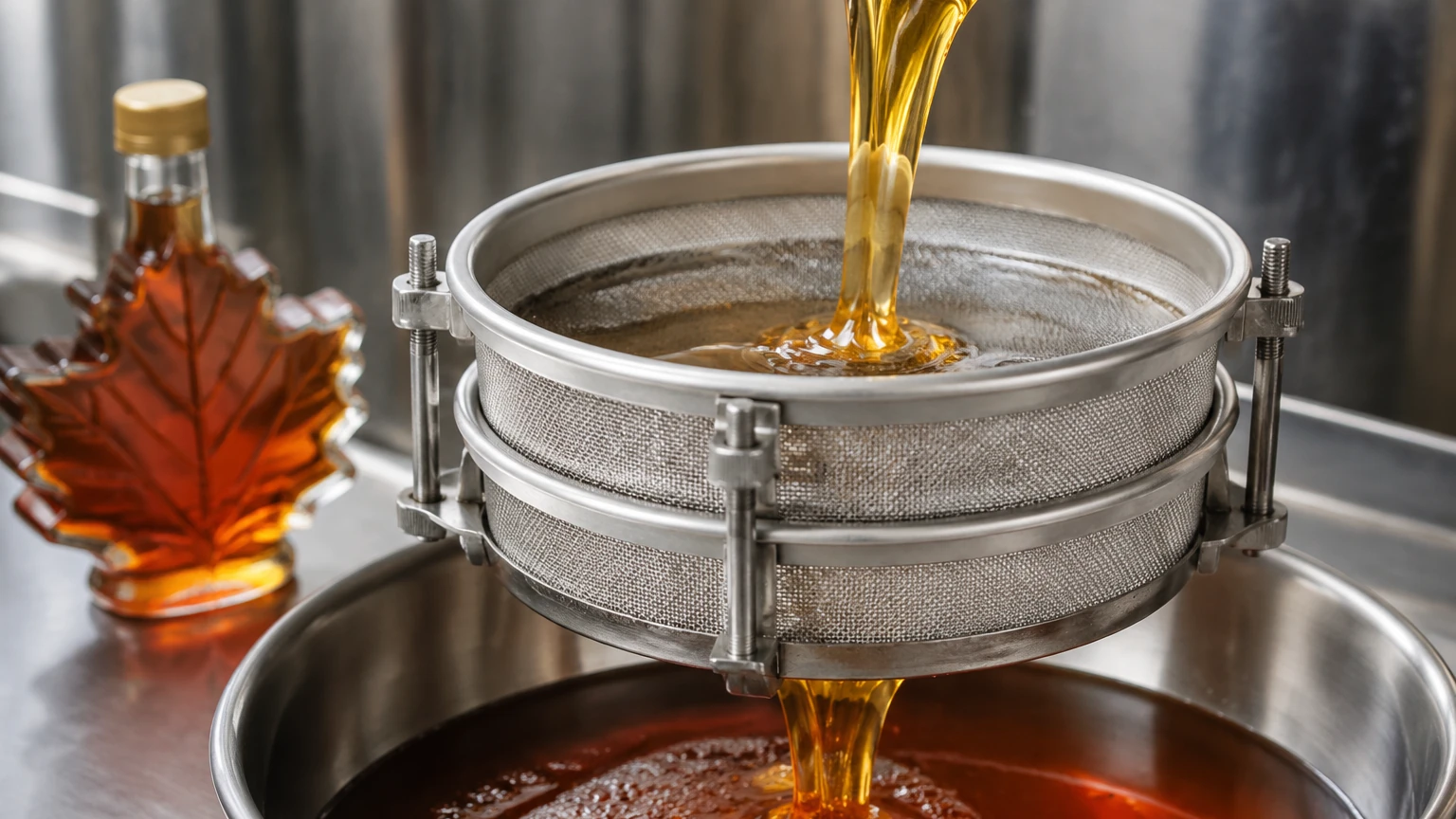
To combat this, industrial systems often utilize a multi-stage approach. A coarse pre-filter removes larger particulates, while a secondary fine filter—often a stainless steel cartridge or a specialized wire mesh assembly—performs the final polishing. This staged approach protects the more expensive fine-filtration components and extends the overall service life of the system.
Engineering Considerations for Filter Media Selection
When selecting hardware for maple syrup filtration, material compatibility and durability are paramount. In an industrial B2B context, the move away from traditional felt bags toward stainless steel filtration solutions is driven by the need for consistency, ease of cleaning, and long-term cost-efficiency.
Stainless Steel Wire Mesh
Stainless steel wire mesh is an ideal medium for maple syrup because of its structural integrity at high temperatures. Unlike synthetic fibers, stainless steel does not stretch or deform under pressure. This ensures that the micron rating remains constant throughout the filtration cycle. For maple applications, Type 304 or 316L stainless steel is preferred due to its corrosion resistance and food-grade status.
Key advantages of using stainless steel mesh include:
- Heat Resistance: Capable of withstanding continuous exposure to boiling syrup without degradation.
- Cleanability: Stainless steel components can be subjected to Clean-in-Place (CIP) procedures, using hot water or food-safe caustic cleaners to dissolve trapped sugars and minerals.
- Sustainability: Unlike disposable paper or felt filters, metal mesh can be reused for many seasons, reducing the total cost of ownership.
Micron Ratings and Flow Rates
The selection of the micron rating is a balance between clarity and throughput. If the mesh is too fine, the filter will clog almost immediately; if it is too coarse, the syrup will remain cloudy. Most industrial maple syrup filtration systems target a range between 1 micron and 25 microns for final polishing, depending on the specific grade of syrup and the presence of diatomaceous earth (DE) as a filter aid.
Gravity vs. Pressure Filtration Systems
There are two primary methods for executing maple syrup filtration: gravity-fed systems and pressurized systems.
Gravity Filtration
Gravity filtration is the traditional method, often using cone filters or flat-bed screens. While simple and low-cost, it is generally too slow for high-volume industrial operations. The flow rate is limited by the head pressure of the fluid, and as nitre builds up, the flow slows to a trickle. This method is also prone to heat loss, which further complicates the process as the syrup cools and thickens.
Pressure Filtration (Filter Presses and Cartridges)
Most modern B2B maple operations utilize pressure filtration. By using a pump to force the hot syrup through a filter press or a stainless steel filter housing, producers can achieve much higher throughput.
1. Filter Presses: These use a series of plates and frames with filter paper or cloth, often supplemented with diatomaceous earth. While effective, they are labor-intensive to set up and clean.
2. Stainless Steel Filter Cartridges: These represent a more modern, streamlined approach. High-precision metal filter components can be housed in a pressure vessel. This setup allows for rapid processing and can be easily integrated into automated production lines. Engineers often prefer these for their predictable performance and reduced labor requirements.
For those looking to optimize their equipment, reviewing technical specifications on a manufacturer's Main Page can provide insights into the flow capacities and pressure ratings of various stainless steel filter configurations.
Maintenance and Cleaning Cycles
In a professional maple syrup production environment, downtime is costly. The filtration system must be designed for rapid maintenance. Stainless steel filters are particularly advantageous here because they can be backwashed or ultrasonically cleaned.
Nitre is essentially a mineral scale. While hot water will dissolve the sugar components of the residue, a mild acid wash (such as citric acid) may occasionally be required to dissolve the calcium-based mineral buildup on the metal mesh. Ensuring that the filter design allows for easy disassembly is a key requirement that engineers should confirm during the procurement phase.
Furthermore, the durability of the filter medium is a factor in the replacement cycle. While a stainless steel filter cartridge has a higher upfront cost than a felt bag, its ability to withstand hundreds of cleaning cycles without losing its filtration accuracy makes it the more economical choice for large-scale operations.
Customization and OEM Solutions
Every maple syrup operation has unique parameters, including different pump pressures, pipe diameters, and batch sizes. Off-the-shelf filtration solutions may not always provide the optimal balance of flow rate and filtration precision. This is where custom-engineered filtration components become valuable.
OEM manufacturers can provide customized wire mesh filters tailored to specific housing dimensions or flow requirements. For example, a producer might require a reinforced mesh to handle higher-than-standard pump pressures, or a specialized pleating pattern to increase the surface area within a compact footprint. Increasing the surface area is one of the most effective ways to extend the time between cleaning cycles, as it lowers the flux (flow per unit area) and slows the accumulation of nitre on the mesh surface.
Conclusion: Making Informed Purchasing Decisions
For engineers and purchasing teams, the goal of implementing a maple syrup filtration system is to achieve a consistent, high-clarity product with minimal operational overhead. When evaluating potential filtration solutions, it is important to look beyond the initial purchase price and consider the total cost of ownership, including labor, replacement parts, and the impact on product quality.
Before finalizing a filtration strategy, technical professionals should confirm the following:
- Material Certification: Ensure all components are food-grade (304 or 316L stainless steel).
- Pressure Ratings: Verify that the filter housing and the internal mesh can handle the operating pressures of the syrup pumps at 190°F.
- Micron Accuracy: Confirm that the micron rating is absolute rather than nominal to ensure consistent clarity.
- Scalability: Determine if the system can handle peak-season mineral loads without excessive downtime.
By focusing on high-performance metal filtration components, maple syrup producers can ensure their process is robust enough to handle the rigors of the season while maintaining the highest standards of product excellence. For more detailed technical data on custom filtration components, engineers are encouraged to visit the Main Page to review product options and application support.
