


Melt Blown Filters
In the landscape of industrial liquid and gas processing, melt blown filters represent a fundamental category of depth filtration media. These components are widely utilized across industries ranging from chemical processing and water treatment to the production of food and beverages. Characterized by their complex, multi-layered fiber structure, melt blown filters provide a cost-effective solution for removing a broad spectrum of particulate contaminants. For engineers and procurement professionals, understanding the technical nuances of these filters is essential for optimizing process efficiency and ensuring the longevity of downstream equipment.
As a manufacturer specializing in high-performance filtration solutions, Kaifil recognizes that the selection of filtration media depends heavily on the specific demands of the application, including chemical compatibility, temperature requirements, and the desired level of filtration precision. While melt blown filters are often the first line of defense, they are frequently integrated into systems alongside more robust components found on our Main Page, such as stainless steel wire mesh and precision metal filter cartridges.
Understanding the Structure and Function of Melt Blown Filters
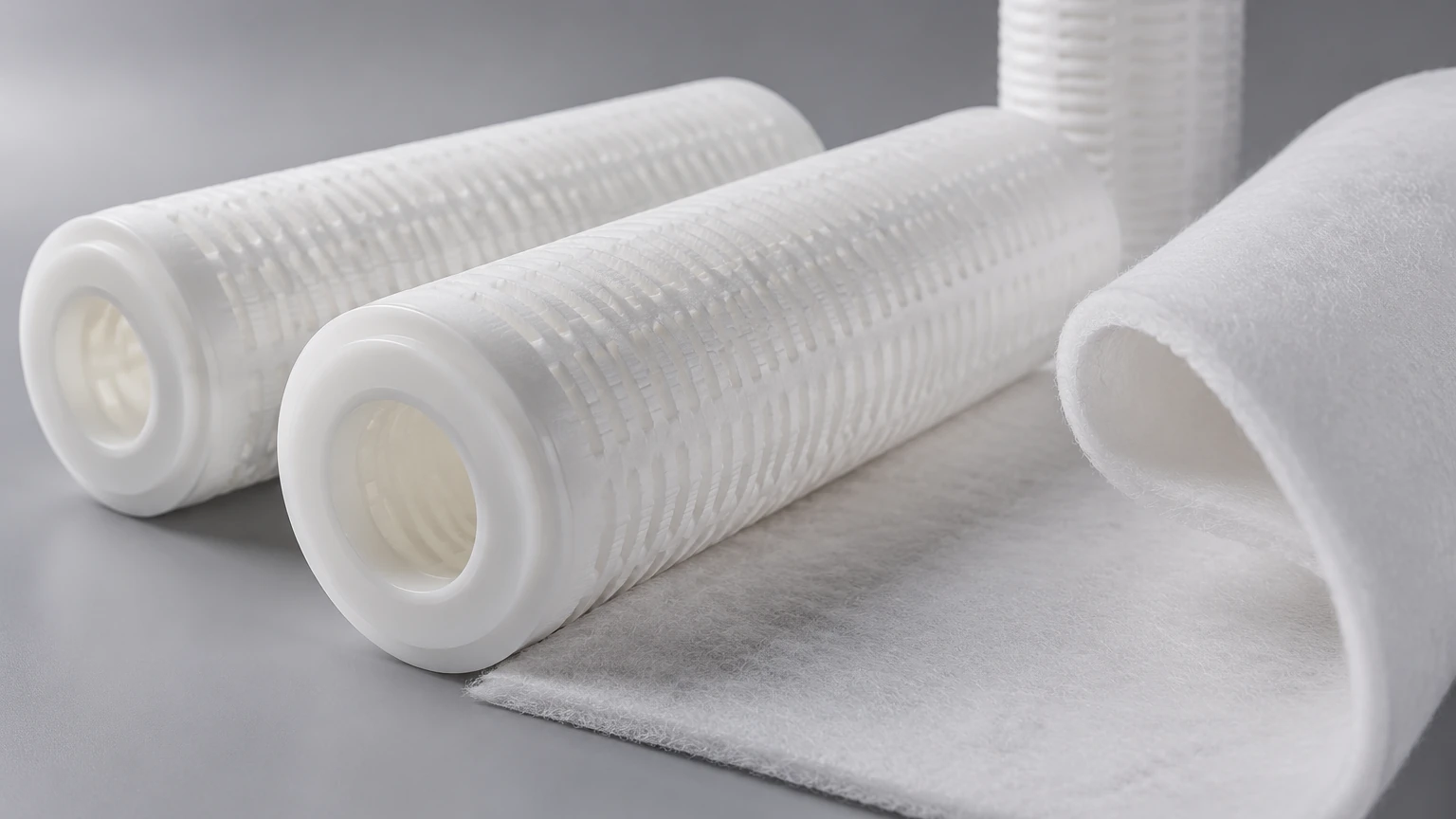
The performance of melt blown filters is derived from their unique manufacturing process. These filters are produced by extruding a thermoplastic polymer—most commonly polypropylene—through a series of small nozzles. As the molten polymer emerges, it is hit by high-velocity hot air streams that attenuate the filaments into extremely fine fibers. These fibers are then collected on a rotating mandrel, where they thermally bond to form a cohesive, self-supporting tubular structure.
Graded Density Architecture
One of the most significant technical advantages of melt blown filters is their graded density structure. During the production process, the density of the fiber packing is varied. The outer layers of the filter are typically constructed with larger fibers and a more open pore structure, while the inner layers become progressively denser with finer fibers.
This design allows for true depth filtration. Larger particles are trapped in the outer sections, while finer particles penetrate deeper into the media before being captured. This prevents "surface blinding," a phenomenon where the outer surface of a filter becomes prematurely clogged, and significantly increases the dirt-holding capacity (DHC) of the cartridge compared to surface-style filters.
Core vs. Coreless Designs
Melt blown filters are available in both cored and coreless configurations. Coreless filters rely entirely on the thermal bonding of the fibers for structural integrity. They are often preferred for their ease of disposal, as they can be incinerated or crushed more easily. However, in high-pressure or high-viscosity applications, a central core—often made of reinforced polypropylene or stainless steel—is necessary to prevent the filter from collapsing under high differential pressure ($ΔP$).
Key Performance Indicators in Industrial Depth Filtration
When evaluating melt blown filters for industrial use, several technical metrics must be considered to ensure the product meets the process requirements. Engineers typically focus on filtration efficiency, pressure drop, and the total volume of fluid processed before replacement is required.
Nominal vs. Absolute Filtration Ratings
It is critical to distinguish between nominal and absolute ratings. Most standard melt blown filters are nominally rated, meaning they are designed to retain a high percentage (typically 80% to 90%) of particles at a specific micron size. For applications requiring higher precision, such as the protection of sensitive membranes or high-purity chemical processing, absolute-rated melt blown filters are used. These filters employ more rigorous manufacturing controls to ensure a Beta ratio ($β$) of 5000 or higher, indicating 99.9% efficiency at the stated micron rating.
Differential Pressure and Flow Rates
The initial pressure drop across a clean filter is a function of the media density and the fluid's flow rate and viscosity. As the filter accumulates contaminants, the differential pressure increases. In industrial settings, it is standard practice to monitor this $ΔP$. Most polypropylene melt blown filters have a recommended change-out differential pressure of approximately 2.0 to 2.5 bar (30-35 psi). Exceeding these limits can lead to bypass, where contaminants are forced through the media, or structural failure of the filter element.
Material Science and Chemical Compatibility
The vast majority of melt blown filters are manufactured from polypropylene (PP) due to its excellent chemical resistance and low cost. However, the material properties of the polymer define the operational boundaries of the filter.
Chemical Resistance
Polypropylene is highly resistant to a wide range of acids, bases, and many organic solvents. This makes melt blown filters suitable for pre-filtration in deionized water systems, plating baths, and various chemical processing streams. However, PP is susceptible to degradation by strong oxidizing agents and certain aromatic or chlorinated hydrocarbons. In such cases, alternative materials or specialized stainless steel filtration components may be required to maintain system integrity.
Temperature Constraints
Thermoplastic filters have inherent temperature limitations. Standard polypropylene melt blown filters are generally rated for continuous operation up to 60°C (140°F), with some high-temperature variants capable of reaching 80°C (176°F). Beyond these temperatures, the structural integrity of the fibers may soften, leading to pore migration or the release of fibers into the filtrate (media migration). For high-temperature applications exceeding 100°C, engineers typically transition to metallic filtration solutions, such as those offered by Kaifil, which provide the necessary thermal stability.
Comparing Melt Blown Filters with Stainless Steel Alternatives
In the B2B industrial sector, the choice between disposable melt blown filters and reusable stainless steel filters is often a matter of balancing initial capital expenditure against long-term operational costs.
| Feature | Melt Blown Filters (PP) | Stainless Steel Filters |
| :— | :— | :— |
| Type | Disposable / Depth | Reusable / Surface or Depth |
| Temperature Limit | Low (up to 80°C) | High (up to 500°C+) |
| Chemical Resistance | Good (limited by polymer) | Excellent (304/316L) |
| Cleanability | None (Single-use) | High (Ultrasonic/Backwash) |
| Initial Cost | Low | High |
| Waste Generation | High (Disposal required) | Low (Long service life) |
Melt blown filters are ideal for applications with high contaminant loads where the cost of cleaning a permanent filter would be prohibitive. Conversely, stainless steel filters are preferred in high-pressure, high-temperature, or highly corrosive environments where polymer filters would fail. Many industrial systems utilize a hybrid approach: using inexpensive melt blown filters as sacrificial pre-filters to protect more expensive, high-precision stainless steel or membrane filters downstream.
Selection Criteria for Industrial Purchasing and Engineering
To select the correct melt blown filters, technical teams should confirm the following parameters before procurement:
1. Micron Requirement: Determine if the application requires nominal protection or absolute retention.
2. Fluid Compatibility: Verify that the fluid and any trace chemicals are compatible with polypropylene and the gasket/O-ring materials (e.g., EPDM, Viton, or Buna-N).
3. Flow Rate and Housing Size: Ensure the filter housing can accommodate the required number of cartridges to maintain a low face velocity, which improves filtration efficiency and extends filter life.
4. End-Cap Configuration: Identify the necessary seal style, such as Double Open End (DOE) with gaskets or Single Open End (SOE) with code 7 or code 3 fin/O-ring configurations to ensure a bypass-free fit in the housing.
5. Compliance Standards: For food and beverage or pharmaceutical applications, ensure the filters are manufactured from FDA-compliant materials and meet USP Class VI plastics testing if required.
Optimizing Filtration Systems for Longevity and Efficiency
The effective use of melt blown filters involves more than just selecting the right micron rating; it requires a holistic view of the filtration system. One common mistake in industrial operations is selecting a micron rating that is too fine for the initial stage of filtration. This leads to rapid clogging and frequent downtime. By employing a multi-stage approach—using a 20-micron melt blown filter followed by a 5-micron element—operators can often achieve better fluid clarity with a lower total cost of ownership.
Furthermore, monitoring the "Total Cost of Filtration" is essential. This includes the purchase price of the filters, the labor costs associated with change-outs, the cost of fluid lost during filter changes, and the disposal fees for used cartridges. In high-volume processes, moving to a larger format, such as High-Flow melt blown cartridges, can reduce the number of elements required and simplify maintenance procedures.
At Kaifil, we understand that filtration is a critical component of industrial reliability. Whether you are utilizing disposable melt blown filters for general pre-filtration or require customized stainless steel components for demanding environments, our engineering expertise ensures that your filtration system performs to its highest potential. By aligning material selection with process conditions, industrial facilities can achieve the precise balance of performance, durability, and cost-effectiveness.
