


Mesh Filter Water
In industrial liquid processing, the implementation of a mesh filter water system is a critical requirement for protecting downstream equipment, ensuring product purity, and maintaining operational efficiency. Unlike depth filtration media, which trap particles within a thick matrix, mesh filters provide surface filtration. This mechanism relies on a precise geometric arrangement of metallic wires to create specific aperture sizes, allowing for predictable and repeatable solids separation.
For engineers and procurement professionals, selecting the appropriate mesh filter for water applications involves a complex evaluation of fluid dynamics, material science, and mechanical design. Whether the application involves pre-filtration for reverse osmosis (RO) systems, cooling water loops, or process water in food and beverage production, the choice of mesh directly impacts the system's total cost of ownership and reliability.
Understanding the Mechanics of Mesh Filtration in Water Systems
Mesh filtration operates primarily through mechanical straining. When water passes through the stainless steel mesh, particles larger than the pore size are retained on the upstream surface. Because this is a surface-based process, mesh filters are particularly effective for removing rigid, non-deformable contaminants such as sand, scale, and metallic debris.
One of the primary advantages of using a mesh filter for water is its cleanability. Unlike disposable polymer cartridges, stainless steel mesh can be cleaned via backwashing, ultrasonic baths, or chemical cleaning (CIP), making it a sustainable choice for high-volume industrial processes. The efficiency of this process is governed by the "open area" of the mesh—the ratio of the total area of the apertures to the total area of the mesh. A higher open area results in lower initial pressure drop and higher flow capacity, which are essential parameters in large-scale water treatment.
Material Science: Selecting Stainless Steel for Water Applications
Material selection is the most significant factor in determining the lifespan of a mesh filter in water environments. Industrial water is rarely pure; it often contains dissolved salts, gases, and chemicals that can lead to various forms of corrosion.
Type 304 Stainless Steel
Type 304 is the standard grade for many general-purpose water filtration tasks. It offers good corrosion resistance in most freshwater applications and is cost-effective. However, it is susceptible to pitting and crevice corrosion in environments with high chloride concentrations.
Type 316L Stainless Steel
For more demanding environments, such as brackish water, seawater intake, or chemical process water, Type 316L is the preferred material. The addition of molybdenum enhances its resistance to chloride-induced pitting. The "L" designation stands for low carbon, which is crucial for components that require welding, as it prevents carbide precipitation and ensures the integrity of the filter's structural joints.
Specialty Alloys
In extreme cases involving high temperatures or highly acidic/alkaline water, specialty alloys like 904L or Duplex stainless steel may be required. These materials provide superior mechanical strength and chemical stability, ensuring that the mesh does not fail prematurely under stress or corrosive attack.
Technical Specifications: Micron Ratings and Mesh Counts
When specifying a mesh filter for water, engineers must distinguish between mesh count and micron rating. These two terms are related but describe different physical characteristics of the filter media.
1. Mesh Count: This refers to the number of wires per linear inch. For example, a 100-mesh screen has 100 wires per inch in both the warp and weft directions. As the mesh count increases, the aperture size decreases.
2. Micron Rating: This indicates the size of the smallest particle the mesh is designed to retain. In the context of wire mesh, this is usually a "nominal" rating, though high-precision Dutch weave meshes can provide "absolute" ratings where 99% or more of particles at a specific size are captured.
For industrial water filtration, typical micron ratings range from 5 microns for fine polishing to 500 microns or more for coarse straining. It is vital to balance the required filtration fineness with the resulting pressure drop. Over-specifying (choosing a finer mesh than necessary) leads to rapid clogging and increased maintenance frequency.
Structural Integrity and Filter Design Variations
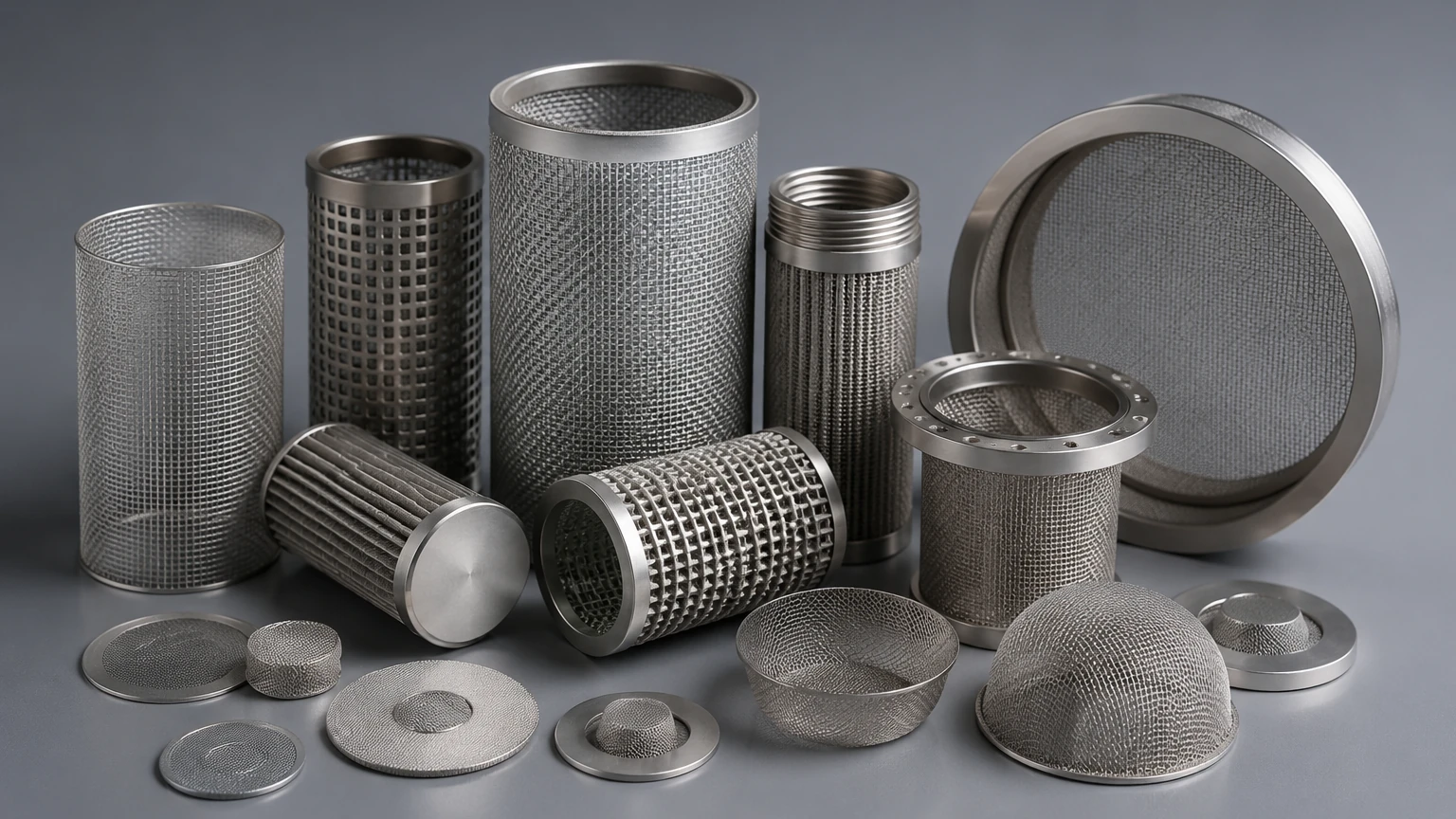
A mesh filter water component is rarely just a piece of cloth; it is an engineered assembly designed to withstand hydraulic surges and mechanical stress. Common designs include:
* Cylindrical Filter Cartridges: These are often used in housing units. They can be single-layered or multi-layered. Multi-layered designs often incorporate a fine filtration mesh sandwiched between coarser support meshes to provide mechanical rigidity.
* Pleated Mesh Elements: By pleating the stainless steel mesh, the effective filtration surface area is significantly increased within the same footprint. This design is ideal for high-flow applications where space is limited, as it reduces the flux (flow per unit area) and extends the interval between cleanings.
* Basket Strainers: Used for high-solids loading, these allow for easy manual removal and cleaning of large debris.
* Custom Precision Components: For OEM applications, mesh filters can be formed into cones, discs, or custom shapes to fit specific equipment geometries.
Operational Efficiency: Flow Rates and Differential Pressure
The performance of a mesh filter in a water system is monitored through differential pressure ($ΔP$)—the difference in pressure between the inlet and the outlet. A clean mesh filter will have a specific "clean pressure drop" based on the flow rate and fluid viscosity.
As the mesh captures debris, the available open area decreases, causing the $ΔP$ to rise. Industrial systems are typically designed with a maximum allowable $ΔP$ (often 10-15 psi) before cleaning or replacement is required. To optimize efficiency, engineers should consider the following:
* Velocity: High water velocity can cause particles to be forced through the mesh or lead to impingement erosion of the wires. Keeping face velocity within recommended limits (typically 0.5 to 2.0 ft/s for fine mesh) extends the filter's life.
* Structural Support: In high-pressure systems, the mesh must be supported by a perforated metal core or an external cage to prevent collapsing or "bursting" under high differential pressure.
Maintenance Strategies for Industrial Mesh Filters
One of the primary reasons engineers choose stainless steel mesh for water filtration is the ability to restore the filter to its original state through cleaning. Effective maintenance strategies include:
* Backwashing: Reversing the flow of water to dislodge particles from the surface. This can be automated using differential pressure sensors to trigger a backwash cycle.
* Ultrasonic Cleaning: For fine meshes where particles may become wedged in the apertures, ultrasonic energy can be used to vibrate the contaminants loose without damaging the delicate wire structure.
* Chemical Cleaning: If the water contains organic matter or mineral scale, soaking the filter in a compatible acid or alkaline solution can dissolve the buildup.
It is important to establish a regular maintenance schedule. Allowing a filter to operate at excessively high differential pressures can lead to permanent deformation of the mesh, rendering it ineffective.
Industry-Specific Implementation of Mesh Water Filters
Different industries have unique requirements for water filtration that dictate the design of the mesh filter.
Chemical Processing
In chemical plants, water is used for cooling, steam generation, and as a solvent. Mesh filters must be compatible with a wide range of pH levels and temperatures. Precision stainless steel filters prevent contaminants from fouling heat exchangers and sensitive instrumentation.
Food and Beverage
In this sector, hygiene is paramount. Mesh filters used for process water must be made from FDA-compliant materials and designed without dead zones where bacteria could proliferate. Smooth surface finishes and high-quality welds are essential for sanitary performance.
Pharmaceutical and Biotech
Water for Injection (WFI) and purified water systems require stringent pre-filtration. Mesh filters serve as the first line of defense, protecting expensive membrane filters and UV sterilization units from particulate damage.
Hydraulic and Cooling Systems
Water-based hydraulic fluids and cooling tower water often contain rust particles and scale. Durable mesh filters ensure that these particles do not cause abrasive wear on pump seals or clog narrow cooling channels.
Critical Selection Criteria for Engineering Teams
When sourcing a mesh filter for water, providing the manufacturer with comprehensive data ensures the final product meets the application's demands. Technical professionals should confirm the following parameters:
1. Fluid Characteristics: Temperature, pH, and chemical composition (especially chloride levels).
2. Contaminant Profile: The type of solids (organic vs. inorganic), particle size distribution, and concentration.
3. Operational Parameters: Normal and maximum flow rates, operating pressure, and maximum allowable pressure drop.
4. Connection Requirements: Flange types, thread specifications, or custom housing interfaces.
5. Compliance Standards: Requirements for ISO, FDA, or specific industry certifications.
By focusing on these technical details, purchasing teams can avoid the common pitfalls of selecting under-performing components. For a comprehensive overview of available technologies and customized engineering support, technical teams are encouraged to visit the Main Page to review product options and application support.
Conclusion
Mesh filter water solutions represent a fundamental technology in modern industrial infrastructure. By leveraging the durability and precision of stainless steel wire mesh, facilities can achieve reliable particulate removal while minimizing waste and operational downtime. The success of a filtration system depends on a deep understanding of the relationship between mesh geometry, material integrity, and fluid dynamics. When these factors are aligned, mesh filters provide a cost-effective and high-performance solution for the most demanding water treatment challenges.
