


Microsparger vs Ring Sparger
In industrial gas-liquid mixing processes, the efficiency of mass transfer is often the primary bottleneck for productivity. Whether in a bioreactor for pharmaceutical production or a large-scale chemical vessel for oxidation, the method used to introduce gas into the liquid phase—sparging—is a critical engineering decision. When evaluating the best equipment for these applications, the debate often centers on microsparger vs ring sparger configurations.
Both technologies serve the same fundamental purpose: dispersing gas into a liquid. However, their mechanical designs, bubble dynamics, and resulting mass transfer rates differ significantly. Selecting the wrong sparger can lead to insufficient oxygen levels, wasted gas, or excessive energy consumption. This article provides a technical comparison to help engineers and purchasing teams determine which solution aligns with their specific process requirements.
Understanding the Fundamental Mechanics
To compare a microsparger vs ring sparger effectively, one must first understand the physics of gas dispersion. The goal of any sparger is to maximize the interfacial area between the gas and the liquid. This is governed by the total surface area of the bubbles produced.
Ring Spargers: The Macro-Bubble Approach
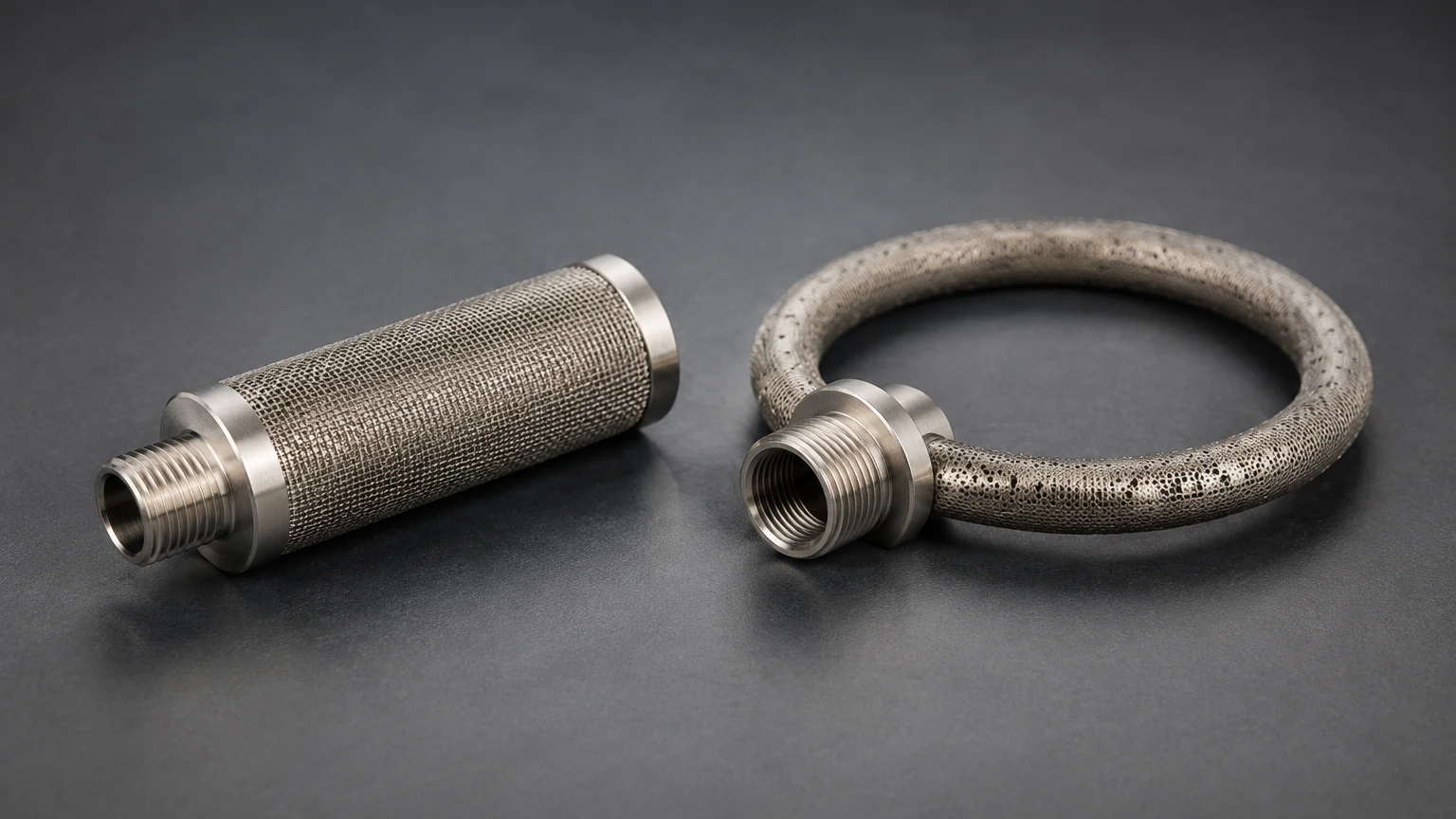
A ring sparger typically consists of a stainless steel pipe formed into a circular loop, with a series of drilled holes (or orifices) positioned along the ring. Gas is pumped through the pipe and exits through these holes.
Because the holes are mechanically drilled, they are relatively large—usually ranging from 0.5 mm to 3 mm in diameter. Consequently, the bubbles produced are "macro-bubbles." These bubbles have a high buoyancy and rise quickly through the liquid column. While ring spargers are excellent for high gas flow rates and providing some degree of agitation, their efficiency in dissolving gas into the liquid is limited by the relatively low surface-area-to-volume ratio of the large bubbles.
Microspargers: The Sintered Metal Advantage
Microspargers utilize porous materials, most commonly sintered stainless steel, to disperse gas. Instead of a few dozen drilled holes, a microsparger features millions of microscopic pores. These pores are typically rated between 0.5 and 10 microns.
When gas is forced through these tiny channels, it emerges as a dense cloud of "micro-bubbles." These bubbles are orders of magnitude smaller than those from a ring sparger. Because smaller bubbles rise more slowly and provide a much larger total surface area for a given volume of gas, the mass transfer efficiency is drastically higher. This makes microspargers the preferred choice for applications where rapid gas dissolution is required.
Technical Comparison: Microsparger vs Ring Sparger
When conducting a technical evaluation, engineers must look beyond the basic design and consider performance metrics such as the volumetric mass transfer coefficient ($k_La$), pressure drop, and gas utilization.
1. Mass Transfer Efficiency ($k_La$)
The $k_La$ value is the standard measure of how effectively oxygen or other gases are transferred into a liquid. In a microsparger vs ring sparger comparison, the microsparger consistently delivers higher $k_La$ values.
Research in bioreactor design indicates that microspargers can increase oxygen transfer rates by 100% to 400% compared to traditional ring spargers at the same gas flow rate. This is due to the exponential increase in interfacial area. For processes like aerobic fermentation, where cell density is limited by oxygen availability, the microsparger is often the only way to achieve high-yield production.
2. Gas Flow Rates and Velocity
Ring spargers are designed for volume. They can handle significantly higher superficial gas velocities without the risk of clogging or excessive backpressure. If a process requires a massive volume of gas to be moved through a liquid—perhaps for stripping volatile organic compounds (VOCs) where the volume of gas matters more than the dissolution rate—the ring sparger is the more robust choice.
Microspargers, conversely, are limited by the permeability of the sintered metal. If the gas flow rate is pushed too high, the micro-bubbles may coalesce (merge) into larger bubbles near the surface of the sparger, negating the benefits of the fine pore structure. Therefore, microspargers are typically sized based on specific flux limits to maintain bubble integrity.
3. Pressure Drop and Energy Considerations
Operating a microsparger requires overcoming the resistance of the sintered metal media. This results in a higher pressure drop across the sparger compared to the open orifices of a ring sparger.
* Ring Sparger: Low pressure drop; requires less compressor energy to push gas into the vessel.
* Microsparger: Higher pressure drop; requires higher inlet gas pressure. However, because the gas is used much more efficiently, the total volume of gas required is often lower, which can result in overall energy savings in the long run.
Application-Specific Selection Criteria
Choosing between a microsparger and a ring sparger depends heavily on the industry and the specific goals of the process. As a manufacturer of custom filtration and sparging components, Kaifil often assists clients in matching sparger geometry to vessel dynamics. You can Review product options and application support on our Main Page to see how custom-engineered solutions fit into these categories.
Bioprocessing and Pharmaceuticals
In the pharmaceutical industry, particularly in mammalian cell culture, shear sensitivity is a major concern. Large bubbles from ring spargers can cause significant cell damage when they burst at the liquid surface. Microspargers produce a gentler gas dispersion, and because they are more efficient, lower total gas flow rates are needed, reducing the overall turbulence and shear stress on delicate cells.
Chemical Processing and Oxidation
For chemical reactions where gas is a reactant (such as hydrogenation or oxidation), the speed of the reaction is often limited by how fast the gas can reach the catalyst or the liquid reactant. In these scenarios, the microsparger’s ability to maximize the $k_La$ directly translates to shorter batch times and higher throughput.
Wastewater Treatment and Large-Scale Aeration
In large-scale water treatment, where the goal is simple aeration or grit removal, the cost of high-pressure compressors and the risk of fouling make the ring sparger a more practical choice. Ring spargers are easier to clean and can handle the lower-purity air often used in these environments without the risk of internal clogging.
Material Integrity and Customization
Whether selecting a microsparger or a ring sparger, the material of construction is paramount. In most industrial settings, 316L stainless steel is the standard due to its corrosion resistance and ability to withstand high temperatures.
The Importance of Sintered Quality
For microspargers, the quality of the sintered metal is the determining factor in performance. Inconsistent pore size distribution can lead to "channeling," where gas exits only through the largest pores, resulting in uneven bubble distribution. High-quality manufacturing ensures a uniform pore structure, which is essential for predictable $k_La$ performance.
Customization is also a key factor. Many industrial vessels are not standard shapes. Engineers must consider:
* Sparger Geometry: Should it be a flat disc, a cylindrical probe, or a custom-contoured ring?
* Connection Types: NPT, flange, or quick-connect fittings for easy removal during maintenance.
* Surface Finish: In food and pharma, a high-polish or electro-polished finish is required to prevent bacterial growth.
Maintenance and Longevity
A common concern when comparing microsparger vs ring sparger options is the maintenance cycle.
* Ring Spargers are relatively immune to clogging from the gas side. However, if the liquid contains solids, they can settle into the orifices when the gas flow is turned off. Cleaning is usually straightforward, often involving simple mechanical brushing or chemical flushing.
* Microspargers are more sensitive. The microscopic pores can become fouled by mineral scale, biological growth, or fine particulates in the gas stream. To maintain performance, microspargers often require Clean-in-Place (CIP) protocols using acid or caustic washes. In some cases, ultrasonic cleaning is necessary to restore full permeability. Using high-purity gas and maintaining a positive pressure during shutdown can significantly extend the life of a microsparger.
Conclusion: Making the Final Decision
The choice between a microsparger and a ring sparger is a balance of efficiency versus flow capacity.
* Choose a Microsparger if: Your process is mass-transfer limited, you are working with shear-sensitive cells, or you need to minimize gas consumption and batch time.
* Choose a Ring Sparger if: You require very high gas throughput, the liquid has a high solids content that would clog fine pores, or the dissolution rate of the gas is not a critical factor in your process.
At Kaifil, we specialize in the engineering and production of precision stainless steel filtration and sparging components. By focusing on the technical requirements of each application, we ensure that our customers achieve optimal gas-liquid interface performance. For more information on our custom manufacturing capabilities and to explore our full range of stainless steel solutions, visit our Main Page.
