


Oil and Gas Filtration Companies
In the oil and gas industry, the integrity of downstream equipment and the purity of final products depend heavily on the efficiency of filtration systems. From the extraction of crude oil and natural gas to the refining and distribution stages, filtration acts as a critical barrier against contaminants that cause equipment wear, process inefficiencies, and costly downtime. For engineers and procurement specialists, selecting the right partner among various oil and gas filtration companies is a strategic decision that impacts the entire lifecycle of a facility. This article explores the technical requirements, material considerations, and evaluation criteria necessary for selecting high-performance filtration solutions in this demanding sector.
The Strategic Importance of Filtration in Oil and Gas Operations
Filtration in the oil and gas sector is not a monolithic process; it is a series of specialized interventions designed to protect specific assets. In upstream operations, filtration is vital for produced water treatment and water injection systems. If solids are not effectively removed, they can plug the formation, reducing the injectivity of the well and necessitating expensive workovers.
In midstream and downstream processing, the focus shifts to protecting compressors, turbines, and heat exchangers. For instance, in amine sweetening and glycol dehydration units, the presence of solid particulates can lead to foaming, which significantly reduces the efficiency of the chemical process. High-quality filtration ensures that these solvents remain clean, extending their service life and maintaining the throughput of the plant.
Furthermore, fuel gas conditioning requires precise filtration to remove liquids and solids before the gas enters high-precision gas turbines. Any failure here can lead to blade erosion or nozzle plugging, resulting in catastrophic engine failure. Consequently, the role of oil and gas filtration companies is to provide engineered solutions that can withstand high pressures, corrosive fluids, and extreme temperatures while maintaining consistent filtration accuracy.
Engineering Specifications: Beyond Micron Ratings
When evaluating filtration components, engineers must look beyond simple nominal micron ratings. In industrial oil and gas applications, the distinction between nominal and absolute filtration is paramount. A nominal rating refers to the filter's ability to retain a major weight percentage of particles of a certain size, whereas an absolute rating indicates the diameter of the largest hard spherical particle that will pass through the filter under specified test conditions.
Understanding the Beta Ratio
The performance of a filter is more accurately described by its Beta Ratio (β). This ratio compares the number of particles of a given size in the upstream fluid to the number of particles in the downstream fluid. For example, a Beta Ratio of 1000 (βx = 1000) means that for every 1000 particles of size 'x' entering the filter, only one passes through, representing 99.9% efficiency. Professional oil and gas filtration companies should provide detailed Beta Ratio data to help engineers predict performance in real-world conditions.
Pressure Drop and Collapse Pressure
Another critical engineering consideration is the clean pressure drop (ΔP) and the maximum allowable differential pressure. A filter with a high initial pressure drop will reach its terminal differential pressure faster, leading to shorter service intervals. Furthermore, the structural integrity of the filter element—its collapse pressure—must exceed the maximum possible differential pressure the system can generate. In high-pressure hydraulic or gas injection systems, using a filter with insufficient collapse strength can lead to the media rupturing, which releases all captured contaminants into the downstream system at once.
Material Science in Petrochemical Environments
The choice of material for filter elements is dictated by the chemical composition of the process fluid and the environmental conditions. Stainless steel is the standard for most industrial filtration due to its mechanical strength and resistance to temperature. However, the specific grade of stainless steel is critical.
* 304/304L Stainless Steel: Suitable for basic industrial applications where corrosion risks are minimal.
* 316/316L Stainless Steel: The industry standard for oil and gas due to the addition of molybdenum, which provides better resistance to pitting and crevice corrosion in chloride-rich environments.
* Duplex and Super Duplex Stainless Steel: Required for highly aggressive environments, such as offshore platforms or sour gas processing, where high levels of hydrogen sulfide (H2S) and chlorides are present. These materials offer superior yield strength and resistance to stress corrosion cracking.
* Specialty Alloys: In extreme cases involving high-temperature acids or specialized chemical injections, alloys like Monel, Inconel, or Hastelloy may be required to ensure the filter does not degrade during service.
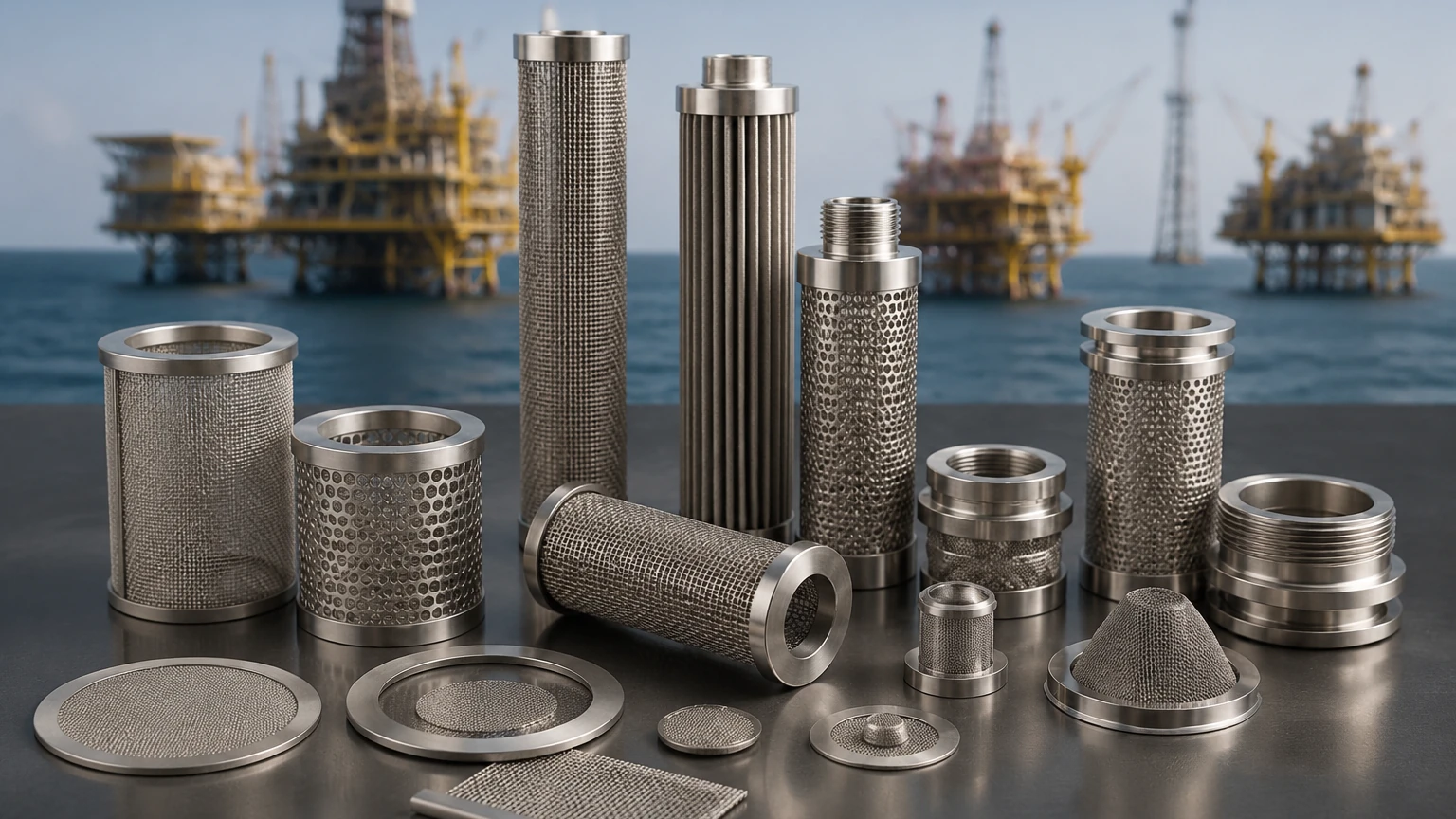
Oil and gas filtration companies specializing in metal mesh and sintered components often utilize these advanced materials to create reusable filter elements that can be cleaned and returned to service, offering a lower total cost of ownership compared to disposable polymer-based cartridges.
Evaluating Oil and Gas Filtration Companies: Key Selection Criteria
Choosing a filtration partner requires a thorough assessment of their manufacturing capabilities and technical support. A reliable manufacturer does more than supply parts; they act as an engineering resource. When vetting oil and gas filtration companies, consider the following factors:
OEM and Customization Capabilities
Many oil and gas applications involve legacy equipment or unique process constraints where standard, off-the-shelf filters are inadequate. A manufacturer with strong OEM capabilities can design custom filter cartridges, strainers, or lateral assemblies that fit existing housings while improving filtration efficiency or flow rates. This includes the ability to customize the weave pattern of wire mesh, the number of layers in a sintered laminate, and the overall dimensions of the element.
Quality Management and Standards
Compliance with international standards is non-negotiable in the energy sector. Verify that the company adheres to ISO 9001 quality management systems. Furthermore, depending on the application, filters may need to meet specific industry standards such as ASME Section VIII for pressure vessels or API (American Petroleum Institute) standards for specific equipment types. Technical documentation, including material test reports (MTRs) and pressure test certifications, should be readily available.
Technical Support and Problem Solving
An ideal partner helps engineers troubleshoot issues such as premature clogging or fluid bypass. They should be able to perform fluid analysis and forensic examination of used filter elements to determine the nature of the contaminants and suggest improvements in media selection or system design. For detailed technical specifications and to explore various filtration configurations, engineers can refer to the Main Page of a specialized manufacturer to understand the breadth of available solutions.
Operational Maintenance and Filter Longevity
The total cost of ownership (TCO) for a filtration system is heavily influenced by maintenance requirements. While disposable filters may have a lower initial purchase price, the costs associated with replacement labor, disposal of contaminated media, and procurement lead times can be significant.
Cleanable vs. Disposable Media
In many oil and gas processes, stainless steel wire mesh or sintered metal filters are preferred because they are cleanable. Methods such as backwashing, ultrasonic cleaning, or chemical cleaning can restore the filter to near-original differential pressure levels. This is particularly advantageous in remote locations, such as offshore rigs, where the logistics of transporting and storing large quantities of disposable filters are challenging.
Monitoring and Predictive Maintenance
Modern filtration systems often incorporate differential pressure sensors linked to a control system. By monitoring the rate of ΔP increase, operators can predict when a filter will reach its terminal pressure. This allows for scheduled maintenance during planned outages rather than reacting to emergency shutdowns. Oil and gas filtration companies that provide guidance on proper installation and monitoring help their clients maximize the service life of every element.
Custom Filtration Solutions for Specialized Equipment
Beyond standard pipeline filtration, the industry requires highly specialized components for complex machinery. For example:
1. Hydraulic System Protection: High-pressure stainless steel filters are essential for protecting the sensitive valves and actuators in subsea control modules and hydraulic power units (HPUs).
2. Catalyst Recovery: In refinery processes like Fluid Catalytic Cracking (FCC), high-temperature sintered metal filters are used to recover expensive catalyst fines from gas streams, preventing environmental discharge and reducing operational costs.
3. Sand Control: In upstream well completions, specialized wire-wrapped screens and premium mesh filters are used to prevent formation sand from entering the wellbore, which would otherwise erode pumps and surface equipment.
Manufacturers like Kaifil specialize in these precision metal filtration components, providing the durability needed for demanding industrial environments. By focusing on the specific pore structure and mechanical strength of the filter media, these companies ensure that the filtration system can handle the rigorous demands of continuous oil and gas production.
Conclusion
The selection of oil and gas filtration companies is a critical factor in maintaining the operational integrity of energy infrastructure. By focusing on technical parameters such as Beta Ratios, material compatibility, and structural collapse pressure, engineers can ensure they select filtration solutions that protect valuable assets and optimize process efficiency. Whether the requirement is for standard stainless steel filter cartridges or highly customized OEM components, the right filtration partner provides the technical expertise and manufacturing quality necessary to thrive in the challenging environments of the oil and gas industry. For those seeking reliable, high-performance metal filtration solutions, reviewing product options and application support on a manufacturer's Main Page is the first step toward achieving long-term filtration success.
