


Petrochemical Filtration Systems
In the petrochemical industry, the integrity of process fluids is fundamental to operational efficiency, equipment longevity, and product purity. Petrochemical filtration systems serve as the primary defense against particulate contamination that can compromise downstream processes, damage sensitive machinery, and lead to costly unscheduled downtime. Given the extreme environments characterized by high pressures, fluctuating temperatures, and corrosive chemical compositions, the selection of filtration components requires a rigorous engineering approach.
As a specialized manufacturer of stainless steel filtration solutions, Kaifil provides the technical expertise and manufacturing precision necessary to meet these demanding requirements. This guide explores the engineering considerations, material science, and performance metrics essential for optimizing petrochemical filtration systems.
The Critical Role of Filtration in Petrochemical Processing
Petrochemical facilities operate through a series of complex chemical reactions and physical separations. Throughout these stages, various contaminants—ranging from catalyst fines and pipe scale to carbonaceous deposits and organic polymers—can enter the fluid stream. Without effective petrochemical filtration systems, these particulates pose several risks:
1. Catalyst Protection and Recovery: Many petrochemical reactions rely on expensive catalysts. Filtration systems prevent contaminants from poisoning catalyst beds and are also used to recover catalyst fines from the product stream to minimize material loss.
2. Equipment Longevity: High-speed rotating equipment, such as centrifugal pumps and compressors, is highly sensitive to abrasive particles. Precision filtration ensures that seals and bearings are protected from premature wear.
3. Heat Exchanger Efficiency: Particulate buildup on heat exchanger surfaces (fouling) reduces thermal transfer efficiency and increases energy consumption. Consistent filtration maintains clean surfaces and extends the intervals between manual cleanings.
4. Product Specification Compliance: Final products, whether fuels, lubricants, or chemical intermediates, must meet strict purity standards. Filtration ensures that the end product is free of visible particulates and meets microscopic cleanliness levels.
Engineering Challenges: Material Selection and Durability
The harsh nature of petrochemical environments dictates that filtration media must be exceptionally robust. Unlike standard industrial applications, petrochemical filtration systems often encounter aggressive solvents, acidic or alkaline process streams, and temperatures that exceed the limits of polymer-based filters.
Stainless Steel as the Standard
Stainless steel is the preferred material for these applications due to its mechanical strength and chemical resistance. Specifically, AISI 304 and 316L grades are commonly utilized. 316L, containing molybdenum, offers superior resistance to pitting and crevice corrosion in chloride-rich environments, making it a staple for offshore and coastal petrochemical facilities.
For engineers, the choice of material involves evaluating the pH of the fluid, the presence of corrosive agents like hydrogen sulfide (H2S), and the potential for thermal expansion. Metal filters maintain their structural integrity under high differential pressures, where disposable cartridges might collapse or bypass.
Core Components of Petrochemical Filtration Systems
Effective filtration is rarely achieved through a single component. Instead, it involves a combination of media types designed to handle specific particulate loads and sizes.
Wire Mesh Filters
Stainless steel wire mesh is a versatile medium used in both coarse and fine filtration. By varying the weave pattern—such as plain weave, twill weave, or Dutch weave—manufacturers can control the pore size and flow characteristics. In petrochemical filtration systems, wire mesh is often used in strainers and basket filters for primary separation, removing larger debris before the fluid reaches more sensitive stages.
Sintered Metal Filter Cartridges
For high-precision applications, sintered metal media provide exceptional performance. Sintering involves bonding multiple layers of wire mesh or metallic fibers through a thermal process without the use of binders. This creates a porous, rigid structure with a fixed pore size. Sintered cartridges offer several advantages:
* High Porosity: Allows for high flow rates with minimal initial pressure drop.
* Mechanical Stability: The bonded structure prevents media migration, ensuring that the filter itself does not become a source of contamination.
* Backwash Capability: Sintered metal can withstand the reverse flow pressures required for in-situ cleaning, extending the service life of the component.
Custom Precision Components
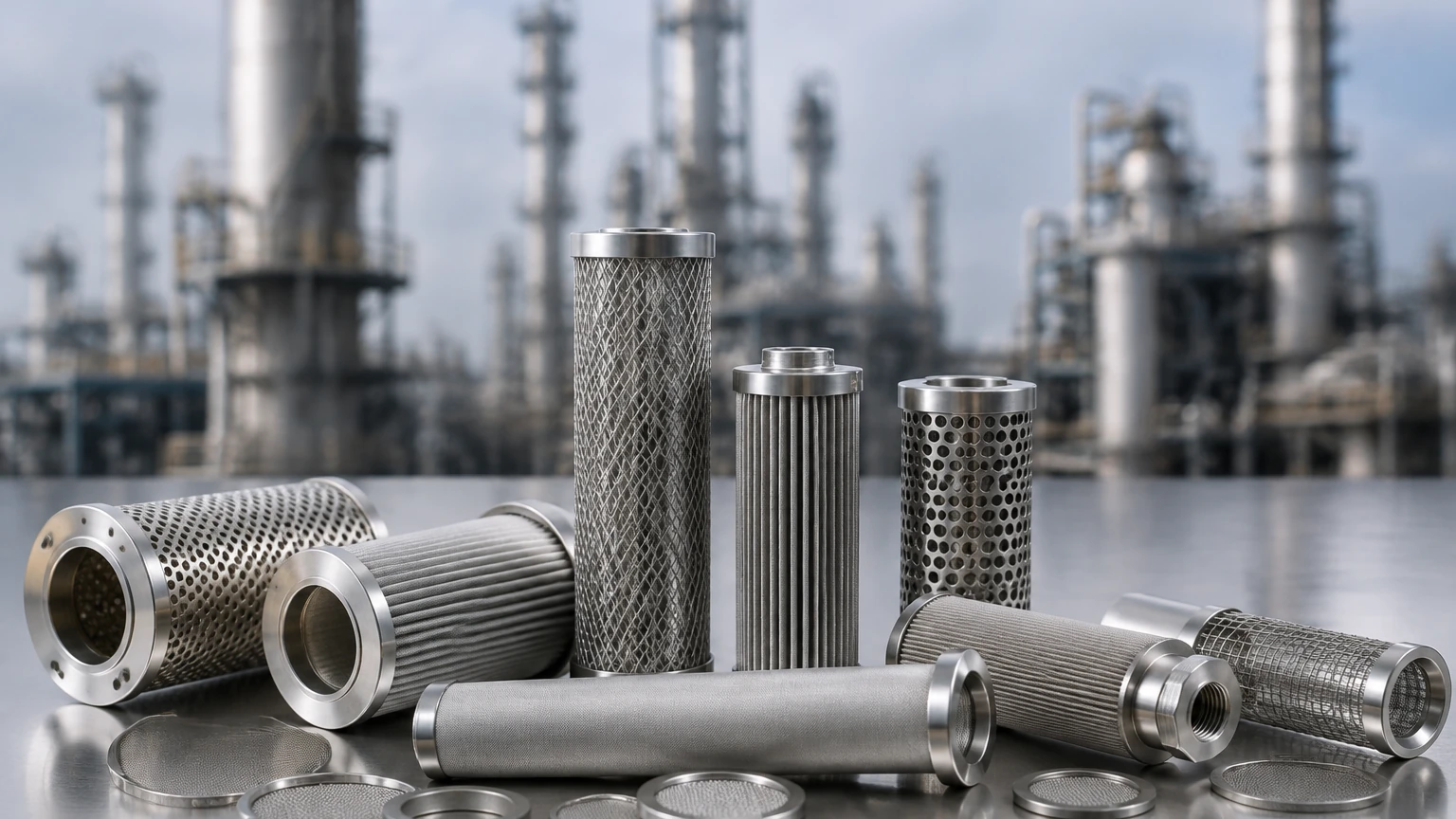
Many petrochemical processes utilize proprietary reactor designs or specialized piping configurations. This necessitates customized filtration components, such as pleated cartridges that maximize surface area or reinforced filter elements designed for extreme pressure differentials. Engineering teams often work directly with manufacturers like Kaifil to develop bespoke solutions that fit existing housing dimensions while improving filtration efficiency.
Performance Metrics: Efficiency, Flow Rate, and Pressure Drop
When evaluating petrochemical filtration systems, engineers must balance three primary variables: filtration accuracy (micron rating), flow capacity, and the allowable pressure drop ($Δ$P).
Micron Rating and Efficiency
The micron rating indicates the size of particles the filter is designed to remove. It is important to distinguish between "nominal" and "absolute" ratings. A nominal rating refers to a filter's ability to retain a majority of particles of a certain size, whereas an absolute rating indicates the size at which 99.9% or more of the particles are captured. In critical petrochemical processes, absolute-rated filters are typically required to ensure consistent downstream quality.
Managing Pressure Drop
Every filter introduces a degree of resistance to the fluid flow. As the filter captures contaminants, the pressure drop increases. Petrochemical filtration systems must be sized correctly to ensure that the initial $Δ$P is low enough to allow for a practical service life before the terminal $Δ$P is reached. Excessive pressure drop can lead to reduced flow rates, increased pump energy consumption, and potential structural failure of the filter element.
Customization and OEM Integration for Specialized Applications
Standard off-the-shelf filters often fail to meet the specific nuances of a complex petrochemical plant. Customization is a key factor in optimizing system performance. This includes:
* End-Cap Configurations: Ensuring compatibility with various housing types, such as DOE (Double Open End), SOE (Single Open End) with 222 or 226 O-rings, or threaded connections.
* Reinforcement Layers: Adding internal or external support cores to withstand high-viscosity fluids or rapid pressure surges.
* Surface Treatments: Applying specialized coatings or finishes to enhance corrosion resistance or reduce the adhesion of sticky contaminants.
By leveraging OEM capabilities, purchasing teams can procure components that are exact replacements for original equipment or upgraded versions designed to solve specific operational issues. You can Review product options and application support on our Main Page to see how customized designs can be integrated into your existing infrastructure.
Maintenance, Cleaning, and Lifecycle Management
The total cost of ownership (TCO) for petrochemical filtration systems is heavily influenced by the maintenance strategy. While disposable filters may have a lower initial purchase price, the ongoing costs of replacement, disposal, and labor can be significant.
Cleanable vs. Disposable
Stainless steel filters are inherently cleanable, which provides a major advantage in petrochemical applications. Techniques such as ultrasonic cleaning, chemical steeping, or high-pressure backwashing can restore the filter's permeability. This not only reduces waste but also ensures that the high-quality filtration media can be reused over multiple cycles.
Monitoring and Replacement Cycles
Automated monitoring of differential pressure is the standard method for determining when a filter requires cleaning or replacement. Engineers should establish baseline $Δ$P values for clean filters and define the critical threshold for intervention. Regular inspection of the filter media during cleaning cycles can also reveal insights into the process, such as the presence of unexpected corrosion products or changes in the nature of the contaminants.
Selecting a Filtration Partner for Petrochemical Success
Choosing a supplier for petrochemical filtration systems goes beyond simply comparing prices. It requires a partner who understands the technical rigors of the industry and can provide documented quality assurance. Key factors to confirm before procurement include:
* Material Certification: Verification that the stainless steel used meets the specified AISI or international standards.
* Manufacturing Precision: Consistency in weave patterns, welding quality, and pore size distribution.
* Technical Support: The ability of the manufacturer to assist in troubleshooting filtration issues and recommending the optimal media for a specific fluid chemistry.
Kaifil's commitment to quality and durability makes it a reliable resource for engineers and purchasing teams worldwide. By focusing on precision-engineered stainless steel components, we help ensure that petrochemical processes remain efficient, safe, and productive. For more information on our full range of industrial filtration solutions, visit our Main Page.
In conclusion, the optimization of petrochemical filtration systems is a continuous process of matching the right materials and designs to the specific challenges of the application. Through careful engineering and the selection of high-performance stainless steel media, facilities can achieve superior filtration performance while minimizing operational risks and costs.
