


Pg25 Liquid Cooling
In high-performance thermal management, liquid cooling has transitioned from a niche solution to a fundamental requirement for data centers, power electronics, and industrial processing equipment. Among the various coolant formulations, PG25—a mixture containing 25% propylene glycol and 75% deionized water—is widely utilized for its balance of thermal conductivity, freeze protection, and corrosion inhibition. However, the efficiency of a pg25 liquid cooling system is heavily dependent on the purity of the circulating fluid.
For engineers and system designers, maintaining fluid integrity through precision filtration is not merely a maintenance task but a critical design parameter. Particulate contamination within a cooling loop can lead to catastrophic component failure, reduced heat transfer efficiency, and increased pumping power requirements. This article examines the technical requirements for filtering PG25 coolants and the engineering considerations for selecting robust stainless steel filtration components.
The Fundamentals of PG25 Liquid Cooling Systems
PG25 liquid cooling systems are designed to move heat away from concentrated sources more effectively than air-cooled alternatives. The "PG25" designation typically refers to the volumetric concentration of propylene glycol. At a 25% concentration, the fluid provides a freeze point of approximately -10°C (14°F), which is sufficient for most indoor industrial environments and many outdoor applications in temperate climates.
From a thermal engineering perspective, the addition of glycol increases the viscosity of the fluid compared to pure water. This change in viscosity affects the Reynolds number and, consequently, the flow regime within the cooling channels. Because PG25 is more viscous than water, the pressure drop across the system—including the filtration stage—is higher. Engineers must account for this when sizing pumps and selecting filter media to ensure that the system maintains the required flow rate for optimal heat dissipation.
Furthermore, PG25 mixtures often include chemical inhibitors to prevent corrosion and biological growth. These additives must remain in suspension to be effective. Filtration systems used in these loops must be chemically compatible with both the glycol and the inhibitors to prevent degradation of the filter media or the leaching of contaminants into the coolant stream.
Particulate Contamination Risks in Cooling Loops
Despite being "closed-loop," liquid cooling systems are susceptible to various forms of contamination. If left unfiltered, these particles can cause significant operational issues:
1. Micro-channel Clogging: Modern cold plates often utilize micro-channels with widths measured in hundreds of microns to maximize surface area. Even microscopic debris can lodge in these channels, creating hot spots and reducing the cooling capacity of the module.
2. Erosion-Corrosion: High-velocity fluid carrying abrasive particles can physically erode the internal surfaces of copper or aluminum heat exchangers. This erosion removes protective oxide layers, accelerating chemical corrosion.
3. Pump Wear: Particulates can act as abrasives within the pump housing, damaging seals and impellers. This leads to internal leakage, reduced head pressure, and eventual pump failure.
4. Reduced Heat Transfer: A layer of fine silt or biological film (bio-fouling) on heat exchanger surfaces acts as an insulator, significantly increasing the thermal resistance of the system.
To mitigate these risks, a dedicated filtration strategy is required. For more information on high-performance filtration components suitable for these applications, visit the Main Page of our technical resource center.
Filtration Requirements for High-Performance Thermal Management
When designing a filtration solution for pg25 liquid cooling, several technical parameters must be evaluated to ensure long-term system reliability.
Micron Rating and Efficiency
The selection of a micron rating is a trade-off between fluid purity and pressure drop. For most industrial liquid cooling loops, a nominal filtration rating between 10 and 50 microns is standard. However, in systems utilizing high-density micro-channel cold plates, absolute filtration at the 5-micron level may be necessary. It is essential to distinguish between nominal ratings (which indicate a general range) and absolute ratings (which guarantee the capture of a specific particle size at a defined efficiency, typically Beta 1000).
Pressure Drop ($ΔP$)
The pressure drop across a filter is a function of the media's pore size, the total filtration area, and the fluid's viscosity. Because PG25 is more viscous than pure water, the clean pressure drop will be higher. Engineers must calculate the "terminal pressure drop"—the point at which the filter is considered fouled and requires cleaning or replacement—to ensure the pump can still provide adequate flow at that stage.
Structural Integrity
In industrial environments, cooling loops may experience pressure surges or flow fluctuations. The filter element must possess high collapse strength to prevent the media from rupturing or bypassing under stress. Stainless steel wire mesh and sintered metal components are preferred in these scenarios due to their inherent structural rigidity compared to polymer-based depth filters.
Engineering Filter Selection: Material and Micron Considerations
For pg25 liquid cooling applications, stainless steel is the material of choice for filtration components. Specifically, Type 304 and Type 316L stainless steel offer the chemical resistance required to withstand long-term exposure to glycol mixtures and corrosion inhibitors.
Sintered Wire Mesh vs. Single-Layer Mesh
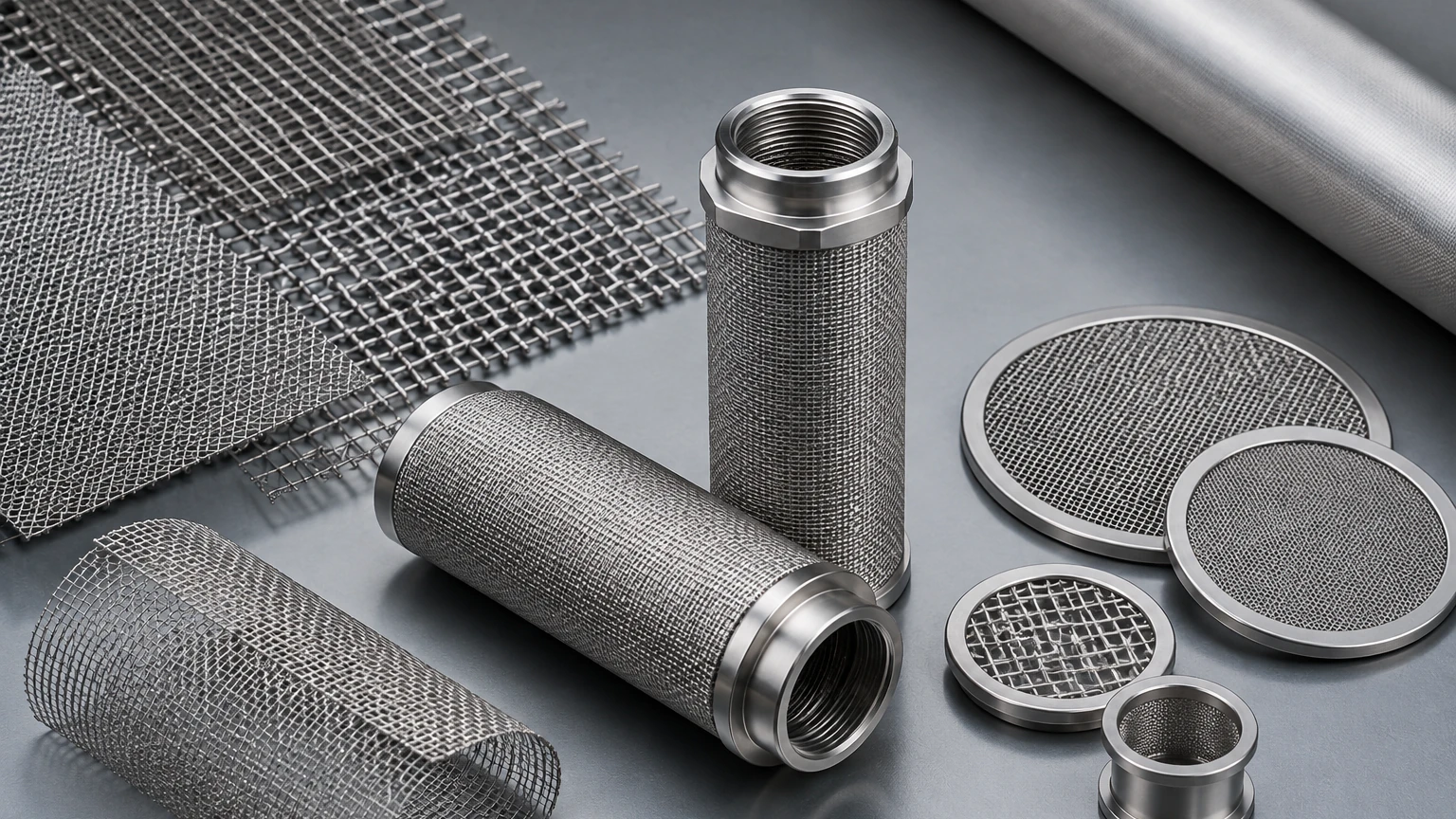
Kaifil specializes in various configurations of stainless steel media. For liquid cooling, sintered wire mesh is often the superior choice. This material consists of multiple layers of stainless steel wire cloth that are bonded together through a high-temperature vacuum sintering process. This creates a porous metal laminate with precise pore sizes, excellent mechanical strength, and the ability to be cleaned and reused multiple times.
In contrast, single-layer wire mesh may be sufficient for coarse straining (e.g., 100 microns and above) but lacks the depth and structural support required for the fine filtration necessary in high-performance cooling loops. Sintered laminates allow for a thin, high-precision filtration layer to be supported by coarser, stronger layers, providing a low-profile element with high flow capacity.
Compatibility with Cooling System Metals
It is vital to ensure that the filter housing and element do not contribute to galvanic corrosion. In a system containing mixed metals (e.g., copper cold plates and aluminum radiators), the filtration unit should be integrated with appropriate dielectric fittings or constructed from materials that remain passive within the PG25 environment. Stainless steel’s passivity makes it an ideal candidate for these multi-metal loops.
Integration and Maintenance of Filtration Components
The placement of the filter within the pg25 liquid cooling loop is a strategic decision. Typically, filters are placed in one of two locations:
* Full-Flow Filtration: The filter is placed in the main loop, usually immediately after the pump or before the most sensitive components (the cold plates). This ensures that 100% of the fluid is filtered on every pass, providing the highest level of protection.
* Side-Stream (Kidney Loop) Filtration: A portion of the flow (typically 5-10%) is diverted through a high-efficiency filter and then returned to the main reservoir. While this does not protect components from a single-pass contamination event, it effectively maintains overall fluid clarity over time with a much lower impact on the main loop's pressure budget.
Monitoring and Replacement Cycles
To avoid unexpected downtime, filtration systems should be equipped with differential pressure $(ΔP)$ sensors. By monitoring the pressure increase across the filter, maintenance teams can transition from schedule-based maintenance to condition-based maintenance.
For stainless steel filters, the total cost of ownership (TCO) is often lower than disposable options. While the initial investment is higher, the ability to ultrasonically clean or backflush the elements allows them to remain in service for years. In a pg25 liquid cooling system, where fluid loss and air ingress during filter changes must be minimized, the longevity of stainless steel elements is a significant operational advantage.
Custom OEM Solutions for Industrial Cooling
Every industrial cooling application has unique constraints regarding space, flow rate, and allowable pressure drop. Off-the-shelf filtration solutions often fail to meet the specific geometric or performance requirements of specialized cooling modules.
Kaifil provides custom engineering support to develop tailored filtration components for PG25 systems. This includes:
* Custom Geometry: Designing filter cartridges or discs that fit within existing manifold structures or compact pump-reservoir combos.
* Optimized Pleating: Increasing the surface area through precision pleating of stainless steel mesh to reduce the frequency of cleaning cycles without increasing the filter's footprint.
* Material Selection: Advising on the use of 316L for high-salinity environments or specific grades of sintered metal for ultra-fine particulate capture.
When evaluating a provider for cooling system filtration, engineers should confirm the manufacturer's ability to provide technical documentation, including pressure drop curves for PG25 at various temperatures and verified micron retention ratings. For a comprehensive overview of available filtration technologies and engineering support, Review product options and application support.
Conclusion
The reliability of a pg25 liquid cooling system is inextricably linked to the quality of its filtration. As thermal loads increase and cooling architectures become more complex, the margin for error regarding fluid contamination decreases. By selecting high-quality stainless steel filtration components, engineers can protect sensitive heat transfer surfaces, extend the life of pumps and seals, and ensure the long-term thermal stability of their systems. Investing in robust, cleanable filtration is a critical step in optimizing the performance and reducing the lifetime maintenance costs of modern industrial cooling solutions.
