


Plate Fin Exchanger
In the landscape of industrial thermal management, the plate fin exchanger (PFE) represents a pinnacle of compact, high-efficiency heat transfer technology. Characterized by its ability to provide a large heat transfer surface area relative to its volume, the plate fin exchanger is indispensable in applications ranging from cryogenic air separation and natural gas processing to aerospace environmental control systems. However, the very design features that make these units efficient—narrow flow passages and complex internal geometries—also make them exceptionally sensitive to fluid contaminants.
For engineers and procurement professionals, understanding the mechanical nuances of the plate fin exchanger is only half the battle. Ensuring long-term operational integrity requires a rigorous approach to upstream filtration. As a manufacturer specializing in precision stainless steel filtration, Kaifil provides the critical components necessary to protect these sophisticated thermal assets from fouling, erosion, and catastrophic blockage.
Technical Architecture of the Plate Fin Exchanger
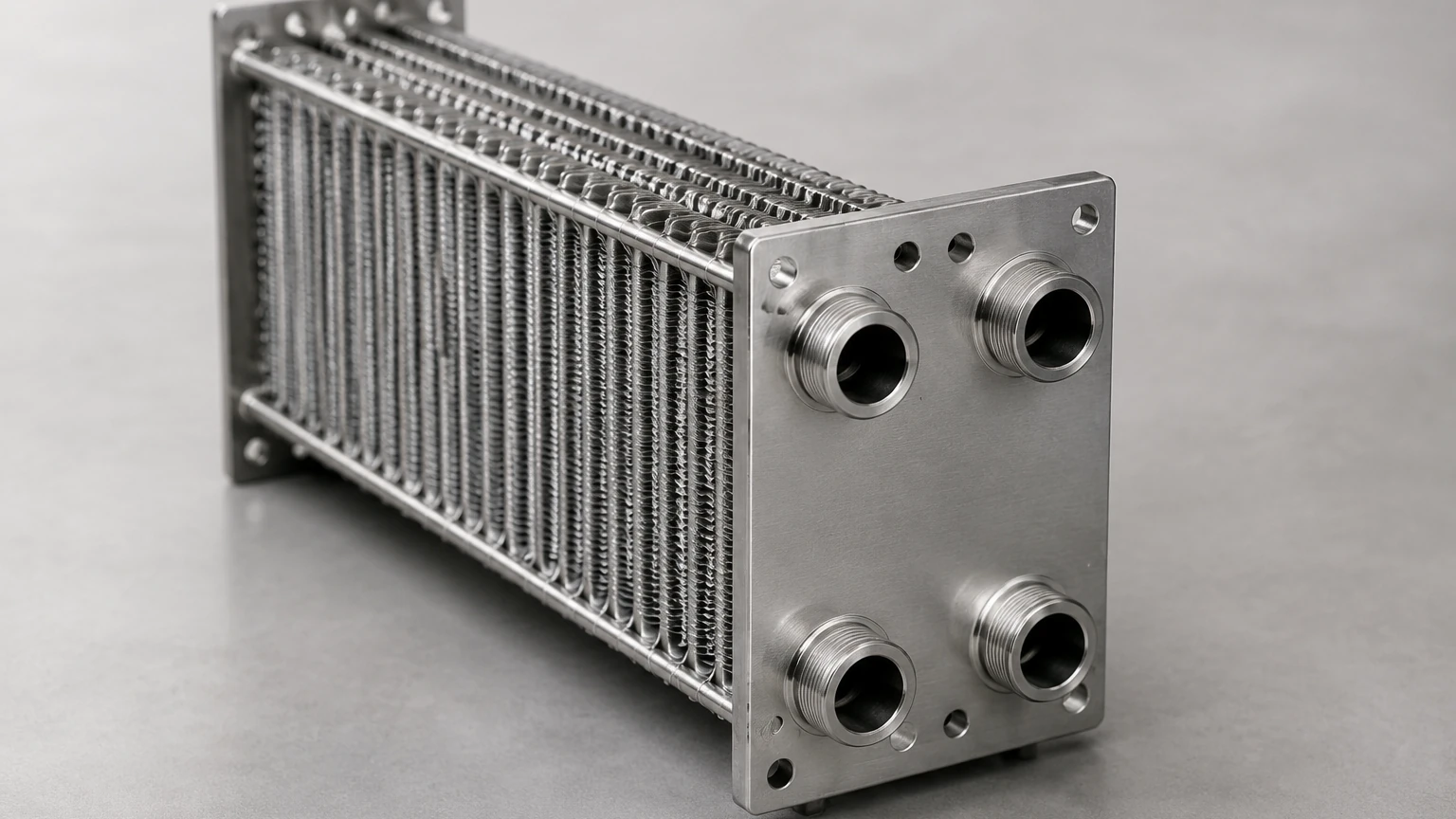
A plate fin exchanger is a type of compact heat exchanger consisting of a stack of alternating layers of corrugated fins and flat parting sheets (also known as separator plates). These components are brazed together to form a monolithic block. The side bars seal the edges of the finned passages, and headers are welded to the block to distribute the process fluids into the appropriate layers.
Fin Geometries and Their Functions
The fins are the primary heat transfer surfaces. Their geometry is selected based on the required heat transfer coefficient, allowable pressure drop, and the nature of the fluid. Common fin types include:
* Plain Fins: Straight, continuous channels that offer the lowest pressure drop but relatively lower heat transfer enhancement. These are typically used in applications where low pumping power is a priority.
* Serrated (Offset Strip) Fins: These fins are cut and offset at regular intervals. This design constantly restarts the boundary layer, significantly increasing the heat transfer coefficient through induced turbulence, albeit at the cost of a higher pressure drop.
* Herringbone (Wavy) Fins: These provide a tortuous path for the fluid, promoting mixing and increasing surface area without the sharp edges found in serrated designs, which can be beneficial in reducing certain types of mechanical stress.
* Perforated Fins: Small holes in the fins allow for cross-flow between channels, which can help equalize pressure and improve performance in multi-phase flow applications.
Material Selection: Aluminum vs. Stainless Steel
Historically, aluminum has been the material of choice for plate fin exchangers due to its high thermal conductivity, low weight, and excellent ductility at cryogenic temperatures. Vacuum-brazed aluminum plate fin exchangers (BAHX) are the industry standard in the industrial gas sector.
However, in high-temperature or highly corrosive environments—such as chemical processing or high-pressure hydraulic systems—stainless steel plate fin exchangers are required. Stainless steel offers superior mechanical strength and resistance to oxidation. When utilizing stainless steel exchangers, it is imperative that the upstream filtration components, such as those found on the Main Page, match the metallurgical integrity of the system to prevent galvanic corrosion or material incompatibility.
The Critical Role of Filtration in PFE Protection
The efficiency of a plate fin exchanger is derived from its high "area density," often exceeding 1,000 m²/m³. This is achieved by creating flow channels that are frequently less than 2.0 mm in height. While this maximizes thermal performance, it creates a significant risk: fouling.
Mechanisms of Fouling
Fouling in a plate fin exchanger can lead to increased pressure drop, decreased thermal efficiency, and eventually, total blockage of specific layers. In multi-stream exchangers, a blockage in one layer can lead to thermal maldistribution, causing internal stresses that may result in mechanical failure.
1. Particulate Fouling: Solid particles, such as pipe scale, sand, or weld slag, can easily bridge the narrow gaps between fins. Once a bridge is formed, it acts as a secondary filter, trapping smaller particles and rapidly increasing the blockage.
2. Biological Fouling: In water-cooled systems, algae and bacterial growth can coat the fin surfaces, creating an insulating layer that destroys the heat transfer coefficient.
3. Chemical Scaling: Precipitation of minerals (like calcium carbonate) occurs when fluid temperatures change, leading to hard deposits that are difficult to remove without chemical cleaning.
Utilizing Stainless Steel Filter Cartridges
To mitigate these risks, high-precision stainless steel filter cartridges are employed at the inlet of the plate fin exchanger. Unlike disposable polymer filters, stainless steel wire mesh filters offer the mechanical strength to withstand high differential pressures and the thermal stability to operate at the same temperatures as the exchanger.
When selecting a filter for a plate fin exchanger, the micron rating must be significantly smaller than the narrowest passage in the fin geometry. A common engineering rule of thumb is to utilize a filter with a rating of 1/3 to 1/5 the size of the smallest flow opening. For a fin gap of 1.5 mm, a filter with a 300 to 500-micron rating might be the absolute maximum, though precision applications often require filtration down to 10 or 25 microns to prevent the accumulation of micro-particulates on the fin surfaces.
Key Evaluation Criteria for Plate Fin Exchangers
When evaluating a plate fin exchanger for a specific industrial process, engineers must look beyond the initial thermal duty. The following criteria are essential for ensuring the long-term viability of the system:
Thermal Performance and UA Value
The UA value (the product of the overall heat transfer coefficient and the surface area) is the primary metric of performance. In a plate fin exchanger, the UA value can be precisely tuned by adjusting fin density (fins per inch) and fin height. However, increasing the UA value through higher fin density inherently increases the risk of fouling, requiring more robust filtration solutions.
Pressure Drop Constraints
In many processes, such as gas liquefaction, the allowable pressure drop is extremely tight. Because plate fin exchangers rely on narrow channels to induce turbulence, the pressure drop must be carefully balanced against the heat transfer gain. Engineers must account for the pressure drop across both the exchanger and the protective filter housing to ensure the system's total head loss remains within the pump or compressor's capabilities.
Mechanical Integrity and Fatigue
Plate fin exchangers are subject to thermal cycling, which can induce significant stress at the brazed joints between the fins and the parting sheets. In applications with frequent start-stop cycles or rapid temperature changes, the fatigue life of the exchanger is a critical concern. Specifying the correct material and ensuring the brazing quality is paramount. Furthermore, the use of precision metal filter components ensures that no foreign debris enters the unit to cause localized erosion or stress risers.
Common Risks and Mitigation Strategies
Operating a plate fin exchanger involves navigating several operational risks. Identifying these early in the design phase can prevent costly downtime.
Thermal Stress and Maldistribution
If the fluid is not distributed evenly across all parallel channels, some layers may experience higher temperatures than others. This maldistribution can be caused by poor header design or by partial blockage due to inadequate filtration. The resulting temperature gradients cause differential expansion, which can lead to cracking of the brazed seams. To prevent this, engineers should confirm that the upstream filtration system is capable of removing 100% of particles above a specific threshold to maintain uniform flow.
Corrosion and Erosion
High-velocity fluids, especially those containing abrasive particles, can erode the leading edges of the fins. Over time, this erosion reduces the heat transfer surface and can eventually breach the parting sheets, leading to cross-contamination between fluid streams. Utilizing stainless steel wire mesh filters with high dirt-holding capacity ensures that abrasive contaminants are captured before they reach the high-velocity zones of the exchanger.
Maintenance Challenges
Unlike shell and tube exchangers, the core of a plate fin exchanger is generally non-cleanable by mechanical means. Once a PFE is severely fouled, the only options are chemical cleaning (which may not reach the center of a blocked passage) or replacement of the entire unit. This makes the "Total Cost of Ownership" heavily dependent on the quality of the filtration system. Investing in high-quality, cleanable stainless steel filter cartridges from a reliable manufacturer can extend the life of a plate fin exchanger by years.
Procurement and Engineering Coordination
Before finalizing the specification for a plate fin exchanger, the intended audience—technical professionals and purchasing teams—should confirm several critical data points with their suppliers:
1. Fluid Compatibility: Ensure that all materials, including the brazing alloy (often nickel-based for stainless steel units), are compatible with the process fluids.
2. Filtration Specification: Define the required micron rating based on the specific fin geometry of the exchanger. Do not rely on "standard" filtration; customize the filter to the exchanger's needs.
3. Design Codes: Confirm that the unit is designed and manufactured to relevant standards, such as ASME Section VIII or PED, and that the manufacturer has experience with the specific brazing requirements of the chosen material.
4. OEM Customization: For integrated equipment manufacturers, sourcing custom filtration components that fit within the footprint of the heat exchanger assembly can save significant space and reduce installation costs.
Conclusion
The plate fin exchanger is a marvel of thermal engineering, offering unparalleled efficiency in a compact package. However, its sophisticated design demands a disciplined approach to system purity. By integrating high-performance stainless steel filtration solutions, such as those provided by Kaifil, engineers can protect these vital components from the devastating effects of fouling and erosion.
Whether you are designing a new cryogenic system or upgrading a chemical processing line, prioritizing the synergy between heat transfer and filtration is the key to operational excellence. For more information on custom filtration solutions tailored for high-performance industrial equipment, Review product options and application support to see how precision engineering can optimize your thermal management systems.
