


Plate-fin Heat Exchanger
In the landscape of industrial thermal management, the plate-fin heat exchanger (PFHE) stands out as a pinnacle of compact, high-efficiency design. Primarily utilized in applications where space is at a premium and high thermal performance is mandatory—such as cryogenic air separation, aerospace, and petrochemical processing—the PFHE offers a significantly higher surface area-to-volume ratio than traditional shell-and-tube designs. However, the very features that make these units efficient also make them exceptionally sensitive to fluid purity. For engineers and procurement teams, understanding the mechanics of a plate-fin heat exchanger is only half the battle; the other half involves implementing robust filtration strategies to protect these precision-engineered components.
To ensure the longevity and efficiency of these systems, sourcing high-quality components is essential. For more information on specialized filtration components that support industrial thermal systems, visit the Main Page of Kaifil.
Understanding Plate-fin Heat Exchanger Design and Mechanics
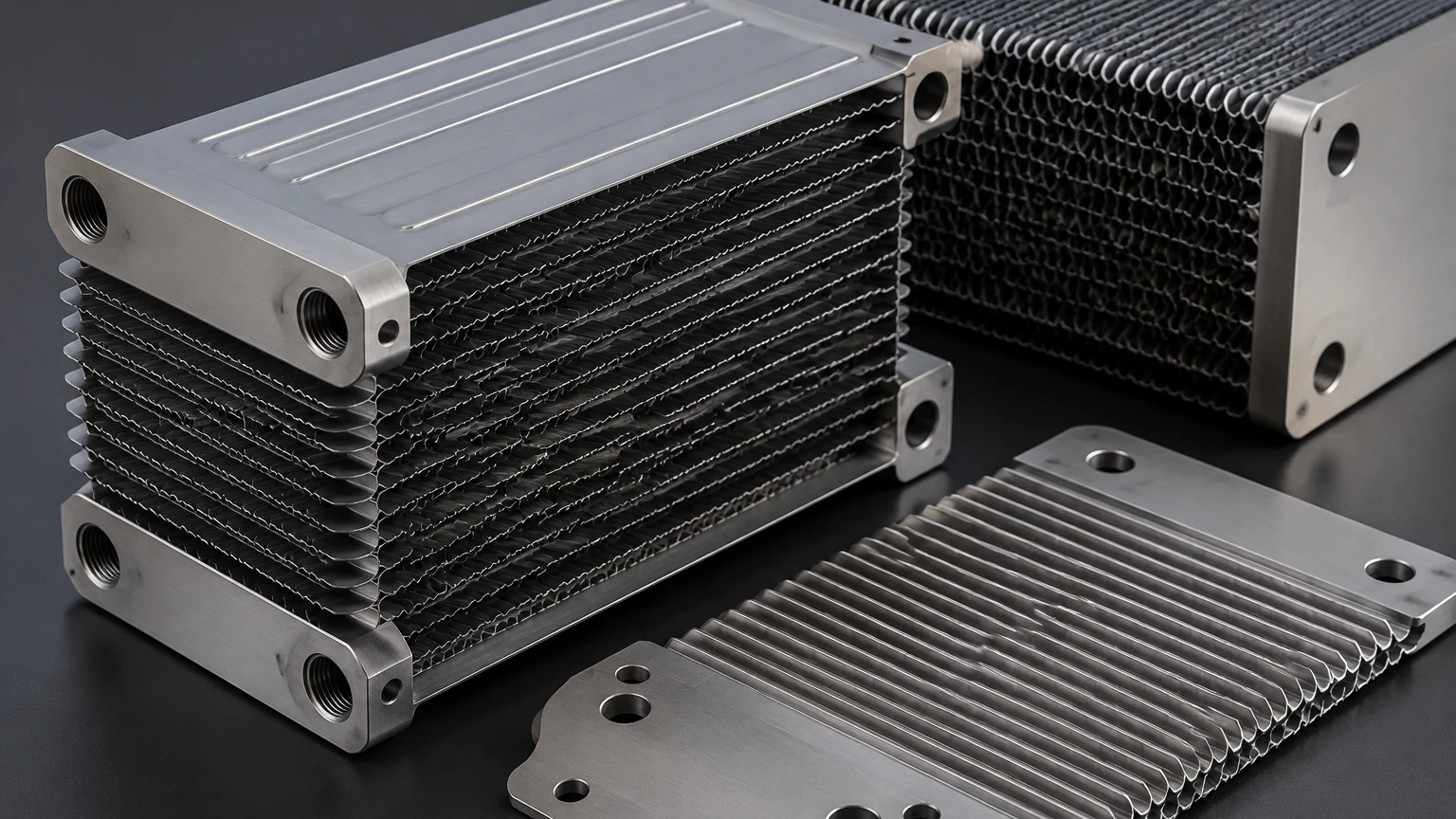
A plate-fin heat exchanger is a type of compact heat exchanger consisting of a series of stacked layers, each containing a corrugated fin between flat metal plates (parting sheets). These layers are brazed together to form a monolithic block. The fluids flow through the passages created by the fins, and heat is transferred through the fin surface and the parting sheet to the adjacent fluid stream.
Core Components of the PFHE
1. Fins: These are the primary heat transfer surfaces. They come in various geometries, including plain, perforated, serrated (lanced), and wavy. The choice of fin geometry affects both the heat transfer coefficient and the pressure drop.
2. Parting Sheets: These flat plates separate the different fluid streams and provide the primary structural integrity of the unit.
3. Side Bars: These seal the edges of the fin layers, ensuring that the fluids remain within their designated channels and do not leak to the environment or cross-contaminate.
4. Headers and Manifolds: These components distribute the incoming fluid into the various layers and collect the outgoing fluid.
Because the fins are typically very thin (0.2 mm to 0.6 mm) and the spacing between them is narrow, the hydraulic diameter of the flow passages is small. While this maximizes heat transfer, it creates a significant engineering challenge: the system is highly susceptible to particulate fouling.
The Critical Role of Upstream Filtration
The efficiency of a plate-fin heat exchanger is directly tied to the cleanliness of the fluids passing through it. In industrial environments, fluids often carry suspended solids, scale, or debris from upstream piping. In a shell-and-tube exchanger, small amounts of debris might simply pass through or settle in areas that are easily cleaned. In a PFHE, even minor particulate matter can lodge in the narrow fin passages.
The Consequences of Fouling
* Thermal Resistance: As particles accumulate on the fin surfaces, they create an insulating layer that reduces the heat transfer coefficient, forcing the system to work harder to achieve the same thermal output.
* Pressure Drop Escalation: Clogged passages restrict flow, leading to a sharp increase in pressure drop. This increases the energy consumption of pumps or compressors and can eventually lead to system-wide performance degradation.
* Flow Malidistribution: If some channels become blocked while others remain open, the fluid flow becomes uneven. This can cause localized temperature stresses, potentially leading to mechanical failure of the brazed joints over time.
* Cleaning Difficulties: Unlike shell-and-tube heat exchangers, which can often be mechanically cleaned, a brazed plate-fin heat exchanger is a sealed unit. If it becomes severely fouled, chemical cleaning is the only option, and in cases of solid particulate blockage, the unit may need to be replaced entirely.
To prevent these issues, engineers must specify high-precision filtration solutions. Utilizing stainless steel wire mesh filters or custom filter cartridges at the inlet of the heat exchanger is a standard industry practice to ensure that no particles larger than a fraction of the fin spacing enter the unit.
Engineering Filtration Solutions for PFHE Protection
When selecting filtration for a plate-fin heat exchanger, the material and the structure of the filter media are paramount. Stainless steel is the material of choice for industrial filtration due to its thermal stability, chemical resistance, and mechanical strength.
Material Selection: 304 vs. 316L Stainless Steel
For most industrial applications, Type 304 stainless steel provides adequate corrosion resistance. However, in environments involving chlorides, acids, or high-temperature chemical processing, Type 316L is preferred due to its molybdenum content, which offers superior resistance to pitting and crevice corrosion. For cryogenic applications—common for PFHEs—stainless steel maintains its ductility and strength at extremely low temperatures, unlike many carbon steels or polymers.
Filter Media Structures
1. Woven Wire Mesh: This is the most common media for protecting heat exchangers. It provides a precise pore size and a high open area, which minimizes the initial pressure drop across the filter. Different weave types, such as Plain Dutch Weave or Twilled Dutch Weave, offer varying levels of filtration fineness and mechanical strength.
2. Sintered Metal Mesh: For high-pressure applications, multiple layers of wire mesh are sintered (diffusion bonded) together. This creates a robust, rigid filter element that can withstand significant differential pressure without deforming, ensuring that the filtration rating remains constant even under surge conditions.
3. Perforated Metal Support: In high-flow scenarios, the fine wire mesh is often supported by a heavier perforated metal core or outer shroud to prevent the mesh from collapsing or tearing.
Selection Criteria: Micron Ratings and Flow Dynamics
Determining the correct micron rating for a filter protecting a plate-fin heat exchanger is a critical engineering decision. A common rule of thumb in the industry is that the filter should remove all particles larger than 1/3 to 1/5 of the narrowest dimension of the heat exchanger flow passage.
Key Evaluation Factors
* Micron Rating: If the fin spacing is 2.0 mm, the filter should typically be rated at 400 to 600 microns. However, for high-precision applications like aerospace or semiconductor cooling, much finer filtration (down to 10-50 microns) may be required to prevent the buildup of microscopic films.
* Flow Rate and Velocity: The filter must be sized to handle the maximum system flow rate without exceeding a specific clean pressure drop (usually less than 0.1 to 0.2 bar). High fluid velocities can also cause erosion of the filter media if not properly managed.
* Dirt Holding Capacity: A filter that is too small will clog quickly, requiring frequent maintenance. Engineers must balance the physical size of the filter housing with the expected particulate load of the process fluid to ensure an acceptable service interval.
* Compatibility: Ensure that the gaskets and seals used in the filter housing are compatible with the process fluid and the operating temperature range of the heat exchanger system.
For customized filtration components tailored to specific industrial requirements, engineers often turn to manufacturers like Kaifil to develop bespoke solutions that fit within existing piping constraints while meeting strict performance metrics.
Maintenance and Total Cost of Ownership (TCO)
In a B2B procurement context, the initial cost of a high-quality stainless steel filter is often a small fraction of the total cost of ownership of a plate-fin heat exchanger. A well-designed filtration system reduces the frequency of expensive chemical cleanings and extends the operational lifespan of the heat exchanger.
Monitoring and Replacement Cycles
Industrial filtration systems should always be equipped with differential pressure (DP) gauges. A rising DP indicates that the filter is doing its job by capturing contaminants.
* Scheduled Cleaning: Stainless steel mesh filters are typically cleanable and reusable. Methods such as ultrasonic cleaning, backwashing, or chemical soaking can restore the filter to near-original condition.
* Redundancy: In continuous process industries, duplex filter systems are often employed. This allows one filter to be cleaned while the other remains in service, preventing system downtime.
Risk Mitigation
The primary risk in PFHE operation is "bypass." If a low-quality filter element fails or if the seals are bypassed, the heat exchanger is immediately at risk. Investing in precision-manufactured, quality-tested filter cartridges is a necessary safeguard against the catastrophic costs associated with a blocked heat exchanger.
Conclusion
The plate-fin heat exchanger is an essential component for modern high-efficiency thermal processes. Its ability to manage complex multi-stream heat transfer in a compact footprint is unmatched. However, this performance is contingent upon the purity of the fluids involved. By implementing high-quality, stainless steel filtration solutions, engineers can protect these sensitive units from fouling, maintain optimal thermal efficiency, and significantly reduce long-term operational costs.
When specifying components for your next thermal management project, consider the filtration requirements as early as the heat exchanger design phase. For technical support and a wide range of industrial filtration products, please refer to the Main Page to explore how custom-engineered solutions can support your specific application needs.
