


Pneumatic Muffler Symbol
In the field of industrial automation and fluid power, clear communication through standardized technical drawings is essential for safety, maintenance, and system efficiency. One of the most common yet critical components in a pneumatic circuit is the silencer, represented by the pneumatic muffler symbol. This symbol provides engineers and technicians with immediate information regarding how compressed air is exhausted into the atmosphere and how noise is mitigated within a system.
For manufacturers like Kaifil, which specializes in high-performance stainless steel filtration and silencing solutions, understanding the nuances of these symbols is the first step in translating a theoretical design into a functional, durable industrial application. This article explores the technical details of the pneumatic muffler symbol, the engineering considerations behind silencer selection, and the role of specialized materials in demanding environments.
The Role of Symbols in Pneumatic Circuit Design
Pneumatic systems operate by using compressed air to perform mechanical work. When this air has completed its task—such as extending a cylinder or powering an air motor—it must be exhausted. Without a muffler, the rapid expansion of compressed air into the atmosphere creates significant high-frequency noise, which can exceed safe decibel levels for personnel and lead to mechanical vibration.
Engineers use standardized symbols, primarily governed by ISO 1219-1, to represent these components in a schematic. The pneumatic muffler symbol indicates that an exhaust port is equipped with a device designed to reduce noise and, in many cases, filter out particulate matter or oil mist before the air reaches the ambient environment. In complex industrial layouts, these symbols ensure that every exhaust point is accounted for, preventing the accidental omission of noise-control measures during the assembly phase.
Decoding the Pneumatic Muffler Symbol
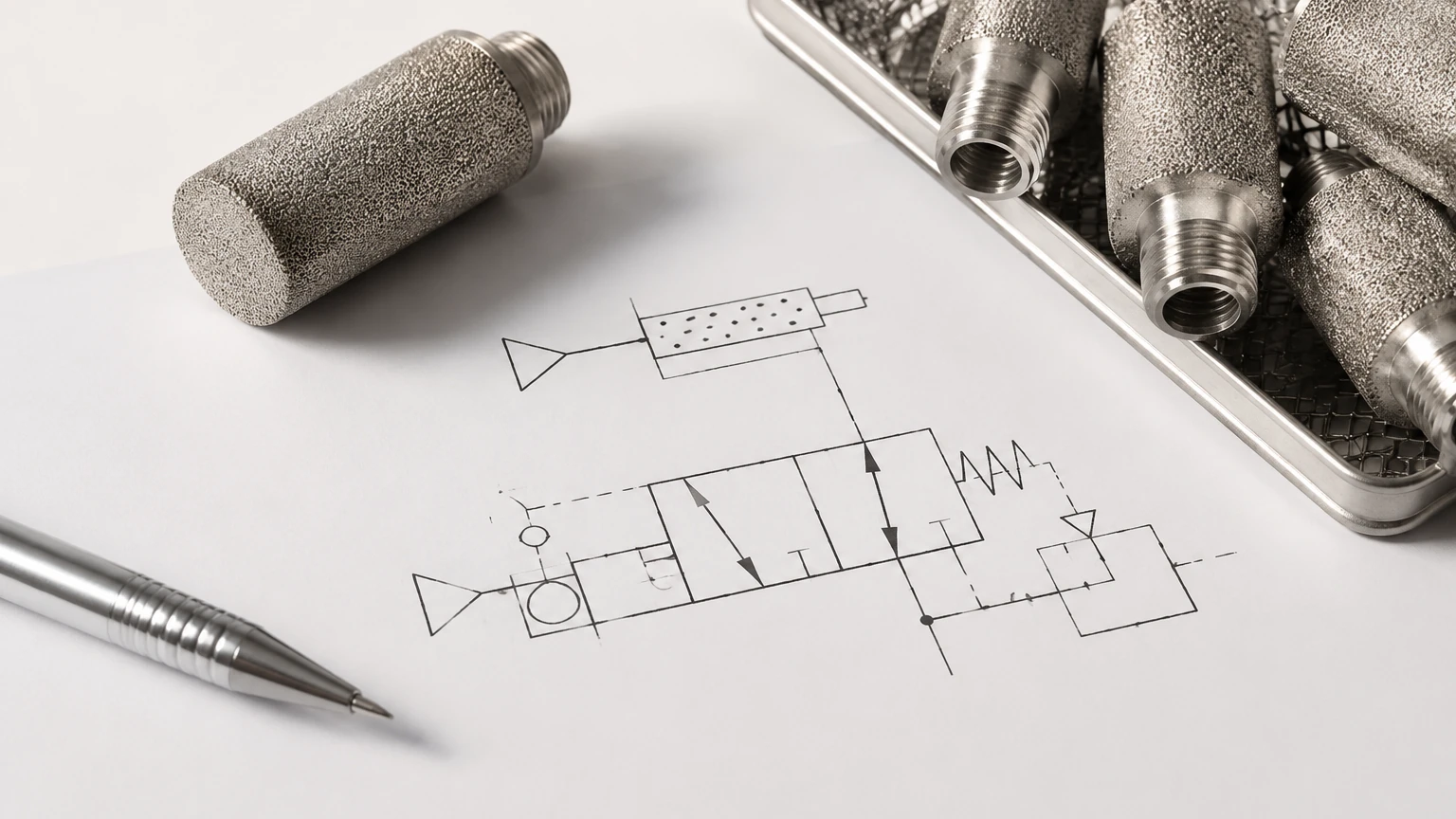
The standard pneumatic muffler symbol is relatively simple but contains specific geometric cues that define its function. In most ISO-compliant diagrams, the symbol is depicted as a triangle or a trapezoidal shape attached to the exhaust line of a valve.
1. The Basic Exhaust Symbol
A simple triangle pointing away from the component represents an exhaust to the atmosphere. This indicates that the air is released directly. However, when a silencing element is added, the symbol is modified to show the presence of a porous medium.
2. The Standard Muffler Symbol
The most common pneumatic muffler symbol consists of a rectangle or a trapezoid with a series of diagonal lines or a shaded area, representing the porous material (such as sintered bronze or stainless steel wire mesh) through which the air must pass. This symbol is typically placed at the exhaust ports (ports 3 and 5) of a 5/2 or 5/3-way directional control valve.
3. The Combined Filter-Muffler Symbol
In many high-precision applications, a muffler also serves as a filter to prevent contaminants from entering the valve when the system is not under pressure (ingression). The symbol for a filter-muffler often combines the standard muffler trapezoid with a dashed line or a diamond shape, indicating that the component provides both noise attenuation and particulate filtration.
4. Adjustable Silencer Symbols
Some silencers allow for the adjustment of the exhaust flow rate, which in turn controls the speed of the pneumatic actuator. The symbol for an adjustable muffler includes an arrow drawn diagonally through the muffler icon, indicating that the orifice or the restriction of the silencing element can be manually tuned by the operator.
Technical Performance: Noise vs. Back Pressure
When an engineer identifies a pneumatic muffler symbol on a schematic, they must then determine the physical specifications required for that component. Two primary metrics dominate this selection process: noise attenuation and back pressure.
Noise Attenuation (dB)
The primary function of a silencer is to reduce the sound pressure level (SPL). High-quality stainless steel wire mesh mufflers can reduce noise levels by 20 to 35 dB(A). This is achieved by breaking up the turbulent airflow into smaller, laminar streams and absorbing the energy of the sound waves within the porous structure of the filter media.
Back Pressure and Flow Capacity (Cv)
Every muffler introduces a degree of restriction to the airflow. This is known as back pressure. If a silencer is too restrictive, it will increase the time required for the air to exhaust from a cylinder, thereby slowing down the cycle time of the machine. Engineers must look for the flow coefficient (Cv) or the effective sectional area of the muffler to ensure it matches the flow requirements of the valve. A mismatch here can lead to sluggish performance or even system failure if the back pressure prevents a valve from fully shifting.
Material Selection: Sintered vs. Stainless Steel Wire Mesh
While the pneumatic muffler symbol remains the same regardless of the material, the actual performance in an industrial setting depends heavily on the construction of the silencer. Kaifil provides a range of custom stainless steel filtration solutions that are often utilized as high-end silencing components.
* Sintered Bronze: These are common in general-purpose industrial applications. They are cost-effective but can be brittle and are prone to corrosion in humid or acidic environments.
* Sintered Stainless Steel: Offers better corrosion resistance than bronze and can withstand higher temperatures. However, it can be difficult to clean once clogged with oil or particulate.
* Stainless Steel Wire Mesh: This is often the preferred choice for demanding B2B applications. Wire mesh mufflers offer excellent flow characteristics and are highly resistant to mechanical shock. Because they are made from woven or knitted wire, they provide a larger surface area for noise dissipation while maintaining a lower profile of back pressure. Furthermore, they are highly compatible with the rigorous cleaning protocols found in the food, beverage, and pharmaceutical industries.
For technical teams evaluating their options, visiting the Main Page provides a comprehensive overview of how different material structures impact filtration and silencing efficiency.
Application Specifics: Why Material Matters
The choice of muffler represented by the pneumatic muffler symbol is often dictated by the industry in which the system operates. A symbol on a diagram for a pharmaceutical packaging line implies different material requirements than a symbol on a heavy-duty hydraulic press.
Food and Beverage Industry
In these environments, equipment is frequently subjected to wash-down procedures involving caustic chemicals. A standard plastic or bronze muffler would degrade quickly. Here, the pneumatic muffler symbol represents a stainless steel component that is FDA-compliant and resistant to oxidation.
Chemical Processing
Exhaust air in chemical plants may contain corrosive vapors. Stainless steel wire mesh silencers are essential in these settings because they maintain their structural integrity and noise-reduction capabilities even when exposed to aggressive chemical agents.
High-Pressure Hydraulics and Pneumatics
In high-pressure systems, the physical force of the exhaust can be substantial. Sintered materials may crack under the pressure spikes, whereas wire mesh components, backed by robust internal supports, offer the durability needed to prevent component fragmentation, which could otherwise lead to downstream contamination.
Installation and Maintenance Best Practices
Identifying the pneumatic muffler symbol is only the beginning; proper installation and maintenance are required to ensure the system remains within its design parameters.
Clogging and Performance Degradation
Over time, silencers act as filters, trapping oil mist from the compressor and particulate matter from the wear of internal valve seals. As the muffler clogs, the back pressure increases. This is often a hidden cause of decreased machine productivity. In many industrial maintenance schedules, mufflers are treated as consumables, but using high-quality stainless steel mesh can extend the replacement cycle significantly, as these components can often be cleaned using ultrasonic baths or solvent rinsing.
Orientation and Environment
While a muffler can theoretically be installed in any orientation, it is best practice to point exhaust ports away from operators and sensitive electronic sensors. In dusty environments, a silencer with a built-in filter (often indicated by a specific variation of the pneumatic muffler symbol) is necessary to prevent the ingression of ambient dust into the valve's internal galleries during the return stroke of a cylinder.
Engineering Selection Criteria
When moving from a schematic containing a pneumatic muffler symbol to a procurement phase, purchasing teams and engineers should confirm the following data points:
1. Connection Type: Most mufflers use NPT, BSPP, or BSPT threads. Ensuring compatibility with the valve port is fundamental.
2. Maximum Operating Pressure: The silencer must be rated for the maximum system pressure to prevent the element from blowing out.
3. Temperature Range: In applications near furnaces or in cryogenic cooling systems, the material must remain stable.
4. Filtration Rating: If the muffler is also acting as a secondary filter, the micron rating (e.g., 5μm, 10μm, 40μm) must be specified to protect the valve internals.
5. Total Cost of Ownership: While plastic mufflers are cheaper upfront, the durability and cleanability of stainless steel wire mesh solutions from manufacturers like Kaifil often result in a lower total cost over the life of the machine.
Conclusion
The pneumatic muffler symbol is a small but vital part of technical communication in industrial engineering. It signals the necessity for noise control, safety, and environmental protection within a pneumatic circuit. By understanding the different variations of this symbol and the technical implications of material choice—specifically the advantages of stainless steel wire mesh in harsh environments—engineers can design systems that are not only quieter but also more reliable and easier to maintain.
As industrial standards continue to evolve toward higher efficiency and stricter noise regulations, the selection of precision-engineered silencing components becomes a competitive advantage. For those looking to integrate high-performance filtration and noise reduction into their next project, exploring the specialized solutions available on the Main Page is an excellent starting point for achieving optimized system performance.
