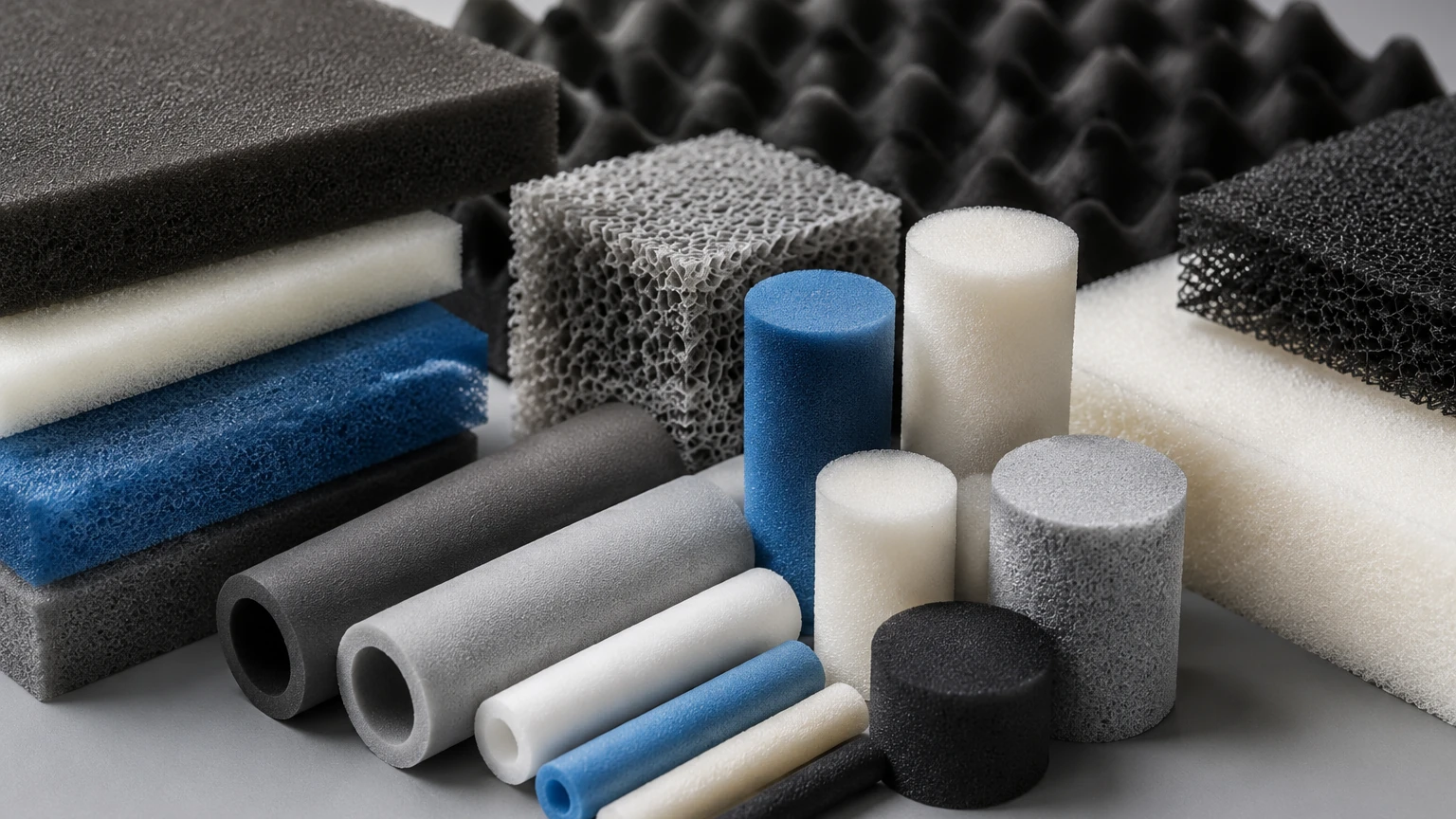
Polyester Foams
In the landscape of industrial filtration and material science, polyester foams—specifically reticulated polyester-based polyurethane foams—represent a critical category of porous media. These materials are engineered to provide high permeability, consistent pore structures, and a specific balance of physical properties that make them suitable for air filtration, fluid management, and acoustic applications. For engineers and procurement specialists, understanding the technical nuances of polyester foams is essential for determining when they are the optimal choice and when more robust alternatives, such as stainless steel wire mesh or sintered metal components, are required for demanding industrial environments.
The Fundamentals of Reticulated Polyester Foams
Polyester foams used in industrial filtration are typically "reticulated." Reticulation is a post-processing manufacturing step that involves removing the thin cell membranes (windows) within the foam structure, leaving only the dodecahedron-shaped skeletal strands. This process transforms a standard closed-cell or semi-open-cell foam into a highly porous, three-dimensional network.
The chemical composition of these foams involves the reaction of a polyester polyol with an isocyanate. Unlike polyether-based foams, polyester foams offer superior mechanical strength, higher tensile properties, and significantly better resistance to hydrocarbons, oils, and non-polar solvents. However, they are inherently more susceptible to hydrolysis—the chemical breakdown of the polymer in the presence of moisture and heat—which is a primary engineering consideration when selecting filtration media for humid or aqueous environments.
Technical Specifications and Performance Metrics
When evaluating polyester foams for industrial use, several key metrics define their performance and suitability for specific filtration tasks. Engineers must look beyond basic density to understand the functional characteristics of the media.
Pores Per Inch (PPI)
The most common metric for classifying reticulated polyester foams is PPI. This value indicates the number of pores along a linear inch. Standard industrial grades typically range from 10 PPI (very coarse) to 100 PPI (very fine).
* 10–30 PPI: Used for high-velocity air filtration, pre-filtration for larger particles, and applications requiring minimal pressure drop.
* 45–60 PPI: Common in small engine air filters and general-purpose industrial dust collection.
* 80–100 PPI: Employed for fine particle capture, oil mist separation, and medical-grade filtration where high surface area is required.
Porosity and Void Volume
Reticulated polyester foams often boast a void volume of 95% to 98%. This high porosity allows for exceptional dust-holding capacity and low initial pressure drop. In depth filtration, the tortuous path created by the skeletal strands forces air or fluid to change direction repeatedly, increasing the probability of particle impingement and entrapment within the foam structure.
Tensile Strength and Elongation
Polyester-based foams generally exhibit higher tensile strength (often between 15 and 35 psi) and greater elongation at break compared to ether-based foams. This makes them more resilient during mechanical handling, installation, and cleaning cycles. However, these properties diminish rapidly if the material is exposed to steam or prolonged high-humidity conditions above 60°C.
Industrial Applications of Polyester Foam Filtration
Polyester foams are ubiquitous in several industrial sectors due to their versatility and cost-effectiveness. Their primary role is often as a secondary or sacrificial filter designed to protect more expensive downstream components.
HVAC and Air Handling
In large-scale HVAC systems, polyester foam pads are frequently used as pre-filters. Their ability to capture large particulates—such as lint, hair, and coarse dust—prevents the premature clogging of high-efficiency HEPA or ULPA filters. Because they can be manufactured in various thicknesses and PPI ratings, they allow for precise control over the system's static pressure.
Automotive and Small Engines
The automotive industry utilizes polyester foams for air intake filtration in lawnmowers, motorcycles, and industrial compressors. In these applications, the foam is often "wetted" with a specialized filter oil. The oil coats the skeletal strands, significantly increasing the filter's efficiency by trapping fine dust that might otherwise pass through the open pores.
Ceramic Foam Precursors
A specialized industrial use of reticulated polyester foam is as a template for ceramic filters used in metal casting. The foam is impregnated with a ceramic slurry and then fired in a kiln. During the firing process, the polyester foam burns away, leaving behind a ceramic structure that perfectly replicates the original foam's pore geometry. This is critical for filtering molten aluminum and steel alloys.
Polyester Foam vs. Stainless Steel Filtration: A Comparative Analysis
While polyester foams are excellent for many applications, industrial engineers must recognize their limitations, particularly when compared to metal filtration solutions. As a manufacturer specializing in high-performance filtration, Kaifil provides technical insights into when a transition from polymer-based foams to stainless steel components is necessary. You can explore our full range of metal solutions on our Main Page.
Thermal Stability
Polyester foams have a relatively narrow operating temperature range, typically losing structural integrity above 100°C to 120°C. In contrast, stainless steel filters (such as 304 or 316L grades) can operate at temperatures exceeding 400°C to 800°C depending on the configuration. For high-temperature exhaust gas filtration or steam processing, polyester is unsuitable.
Chemical Compatibility and Hydrolysis
As previously noted, polyester foams excel in oil and fuel environments but fail in the presence of water, acids, and strong alkalis. Stainless steel wire mesh and sintered metal filters offer near-universal chemical resistance, making them the standard for chemical processing and pharmaceutical manufacturing where polyester would degrade and contaminate the process stream.
Structural Integrity and Pressure Differential
Under high differential pressure, polyester foams can compress or "blind," leading to a rapid increase in pressure drop and potential media migration (where bits of the foam break off into the filtrate). Stainless steel filter cartridges and wire mesh screens are rigid and can withstand significant pressure spikes without deformation, ensuring consistent filtration accuracy.
Engineering Considerations for Material Selection
Choosing the right grade of polyester foam or deciding to upgrade to a metal filter requires a systematic evaluation of the operating environment. Engineers should confirm the following parameters before finalizing a specification:
1. Fluid/Gas Composition: Are there trace amounts of water or steam? If so, polyester foam will suffer from hydrolysis. Are there hydrocarbons? If so, polyester is superior to polyether foams.
2. Particle Size Distribution: What is the target micron rating? While PPI gives a general idea, it does not provide an absolute micron cutoff like a woven wire mesh. For precise absolute filtration, metal media is often preferred.
3. Cleaning and Reuse: Polyester foams are often considered semi-disposable. While they can be washed a limited number of times, they eventually lose their elasticity and pore structure. Stainless steel filters are designed for long-term service and can be cleaned via ultrasonic baths, back-pulsing, or chemical cleaning, offering a lower total cost of ownership in permanent installations.
4. Flow Velocity: High-velocity streams can cause vibration in foam media, leading to mechanical fatigue. Rigid metal structures are required for high-flow industrial applications to prevent bypass or structural failure.
Maintenance, Durability, and Total Cost of Ownership
In a B2B procurement context, the initial purchase price of polyester foams is significantly lower than that of custom-engineered stainless steel filters. However, the total cost of ownership (TCO) must be calculated over the equipment's lifecycle.
Polyester foams require frequent monitoring. As they load with particulate, the pressure drop increases, which can strain blowers and pumps, leading to higher energy costs. Furthermore, the labor costs associated with frequent filter replacements can quickly surpass the one-time investment in a permanent stainless steel filtration system.
In applications where the filter is difficult to access or where process downtime is extremely expensive (such as in continuous chemical reactors or offshore oil rigs), the durability of metal filtration is indispensable. Conversely, in light-duty air handling or consumer-facing products where cost-per-unit is the primary driver, polyester foams remain a dominant and effective material choice.
Customization and OEM Integration
Both polyester foams and metal filters offer significant customization options. Polyester can be die-cut, CNC-profiled, and even laminated with other materials like activated carbon or non-woven fabrics to add functional layers.
For industrial OEMs, integrating the right filtration component often involves a collaborative design process. Whether you require the high-volume throughput of reticulated foams or the precision and durability of custom stainless steel wire mesh, selecting the right partner is crucial. At Kaifil, we focus on providing the engineering expertise needed to navigate these material choices, ensuring that the filtration solution matches the specific rigors of your industrial application.
By understanding the strengths and weaknesses of polyester foams—from their excellent oil resistance and high void volume to their vulnerability to heat and moisture—engineers can make informed decisions that optimize system performance and reliability. When the limits of polymer foams are reached, transitioning to precision-engineered metal components ensures that industrial processes remain efficient, clean, and cost-effective over the long term.