


Beer Filters
In the industrial brewing process, filtration is a critical downstream operation that directly influences the clarity, biological stability, and shelf life of the final product. While the primary goal of using beer filters is often perceived as achieving visual brilliance, the technical requirements extend far beyond aesthetics. Industrial-scale filtration must balance the removal of yeast cells, proteins, and polyphenols with the preservation of essential flavor compounds and mouthfeel. For engineers and procurement teams, selecting the appropriate filtration system requires a deep understanding of fluid dynamics, material science, and sanitary design.
As a specialized manufacturer of stainless steel filtration solutions, Kaifil provides high-performance components designed to meet the rigorous demands of modern breweries. This guide explores the technical considerations, material requirements, and engineering principles essential for optimizing beer filtration processes.
Technical Objectives of Beer Filtration
Filtration in a brewery serves multiple functions, typically categorized into primary filtration, secondary (fine) filtration, and sterile filtration. Each stage addresses specific particulates and biological loads.
1. Clarification (Primary Filtration): This stage focuses on the removal of the bulk of yeast and larger suspended solids following fermentation and maturation. The objective is to reduce turbidity to a level suitable for subsequent fine filtration. In many industrial setups, this involves the use of coarse stainless steel mesh or centrifugal separators.
2. Polishing (Secondary Filtration): This phase targets finer haze-forming proteins and smaller yeast cells. Achieving a "bright beer" status requires filtration media capable of capturing particles in the 1.0 to 5.0-micron range. Stainless steel filter cartridges are frequently employed here due to their precise pore structures and resistance to pressure fluctuations.
3. Microbial Stabilization (Sterile Filtration): To ensure a shelf-stable product without the need for flash pasteurization, breweries utilize sterile filtration. This requires absolute-rated media, typically in the 0.45 to 0.65-micron range, to effectively remove spoilage bacteria (such as *Lactobacillus* and *Pediococcus*) and wild yeasts.
Stainless Steel Filtration Media in Brewing
While polymer-based disposable filters are common in some applications, stainless steel beer filters offer distinct advantages in industrial B2B environments, particularly regarding durability, cleanability, and long-term cost-efficiency.
Sintered Wire Mesh
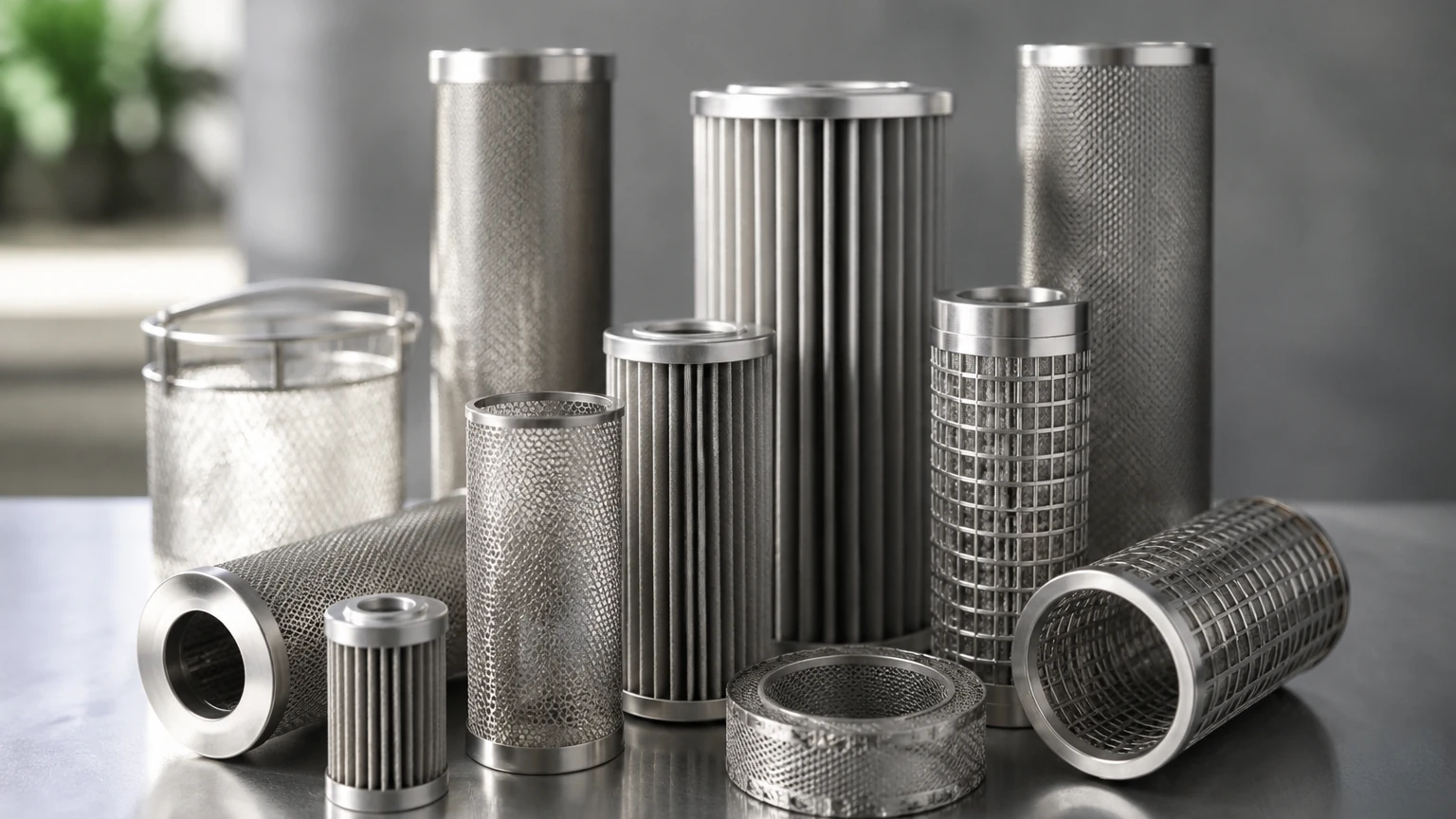
Sintered wire mesh is a preferred material for high-pressure and high-temperature applications. By diffusion-bonding multiple layers of stainless steel wire cloth, manufacturers create a porous medium that combines high mechanical strength with precise filtration ratings. In brewing, these are often used in trap filters to protect downstream equipment from rogue particles or filter aids like Diatomaceous Earth (DE).
Wedge Wire Elements
Wedge wire, or V-wire, is characterized by its non-clogging surface and high open-area ratio. In the brewing industry, wedge wire is the standard for lauter tun false bottoms and mash tun screens. Its structural integrity allows it to support heavy grain beds while maintaining consistent flow rates, which is essential for efficient wort collection.
Pleated Stainless Steel Cartridges
For applications requiring a large surface area in a compact footprint, pleated stainless steel cartridges are ideal. The pleating process significantly increases the available filtration area, which lowers the flux rate (flow per unit area) and extends the time between cleaning cycles. These are particularly effective for final polishing stages where high throughput and low pressure drop are required.
Key Engineering Parameters for Filter Selection
Selecting the right beer filters involves evaluating several quantitative parameters to ensure the system integrates seamlessly into the existing production line.
Micron Rating: Absolute vs. Nominal
Engineers must distinguish between nominal and absolute micron ratings. A nominal rating refers to the ability of the filter to retain a majority of particles of a specific size, whereas an absolute rating indicates that 99.9% (or higher) of particles above that size are captured. For microbial stabilization, absolute-rated stainless steel cartridges are mandatory to ensure process safety.
Differential Pressure (ΔP)
The pressure drop across a filter is a key indicator of its efficiency and remaining service life. As the filter accumulates solids, the ΔP increases. Industrial filters must be engineered to withstand high differential pressures without bypassing or structural failure. Monitoring ΔP allows for automated triggers in the Clean-in-Place (CIP) cycle, preventing downtime.
Flow Velocity and Flux
High flow velocities can lead to "shear stress," which may break down delicate yeast cells or protein complexes, potentially releasing unwanted compounds back into the beer. Calculating the optimal flux rate ensures that the filtration process remains gentle enough to preserve beer quality while meeting the brewery's hectoliters-per-hour (hl/h) targets.
Sanitary Standards and Material Integrity
In the food and beverage industry, the materials used in beer filters must be chemically inert and resistant to corrosion. Kaifil utilizes high-grade stainless steel, primarily 304 and 316L, to ensure compliance with global food safety standards.
* 316L Stainless Steel: This low-carbon molybdenum-bearing alloy is preferred for brewing applications due to its superior resistance to pitting and crevice corrosion, especially when exposed to the chlorides found in some water supplies and the aggressive chemicals used in sanitation.
* Surface Finish (Ra): The internal surfaces of filter housings and elements must be polished to a specific roughness average (Ra). A smooth surface (typically Ra < 0.8 µm) prevents microbial attachment and ensures that the CIP process is effective. Electropolishing is often employed to achieve the highest levels of surface passivity.
* Seal Compatibility: O-rings and gaskets must be made from FDA-compliant materials such as EPDM, Silicone, or Viton (FKM). These seals must withstand both the acidic/alkaline nature of cleaning agents and the thermal shock of steam sterilization.
Operational Maintenance and Cleaning Protocols (CIP)
One of the primary advantages of stainless steel beer filters is their ability to be cleaned and reused, unlike disposable depth filters. A robust Clean-in-Place (CIP) protocol is essential for maintaining the performance of permanent filter elements.
Backwashing and Backpulsing
Many stainless steel mesh filters are designed for backwashing, where the flow is reversed to dislodge accumulated solids from the surface of the media. This process can be enhanced with backpulsing—short, high-pressure bursts—to effectively clear the pores and restore the original flow characteristics.
Chemical Cleaning
Over time, organic fouling (proteins and polyphenols) and inorganic scaling (beer stone or calcium oxalate) can build up. A typical cleaning cycle involves:
1. Hot Water Rinse: To remove loose debris.
2. Caustic Wash (Sodium Hydroxide): To dissolve organic matter and proteins.
3. Acid Wash (Nitric or Phosphoric Acid): To remove inorganic scale and neutralize the caustic.
4. Sanitization: Using peracetic acid (PAA) or hot water/steam to ensure microbial elimination.
Economic Analysis: Disposable vs. Cleanable Filtration
When evaluating the total cost of ownership (TCO) for beer filters, purchasing teams must look beyond the initial capital expenditure. While stainless steel filter elements have a higher upfront cost compared to polypropylene or cellulose cartridges, their long-term value is significant.
* Reduced Waste: Reusable filters align with sustainability goals by eliminating the constant disposal of spent cartridges.
* Lower OPEX: The recurring cost of purchasing replacement filters is mitigated. In high-volume industrial breweries, the payback period for stainless steel systems is often less than 12 to 18 months.
* Process Reliability: Stainless steel elements are less prone to "unloading" (releasing trapped particles due to pressure surges) and are not susceptible to the fiber migration issues sometimes seen in lower-quality disposable media.
Customization and OEM Integration
Every brewery has a unique configuration, from the size of the bright beer tanks to the specific flow requirements of the bottling line. Standard off-the-shelf filters often fail to meet the exact spatial or performance constraints of a specialized facility.
Kaifil specializes in customized filtration solutions, working closely with brewery engineers to develop bespoke filter elements. Whether it is a unique fitting for a legacy housing, a specific mesh weave for a proprietary filtration process, or a custom-designed cartridge for high-viscosity liquids, tailored engineering ensures that the filtration system supports rather than hinders production efficiency.
For engineers looking to optimize their filtration stages or procurement professionals seeking reliable OEM components, reviewing technical data and material certifications is the first step toward a more efficient brewing process. Detailed information on our manufacturing capabilities and product range can be found on our Main Page.
Conclusion
In the competitive landscape of industrial brewing, the quality of beer filters is a determining factor in operational success. By selecting high-grade stainless steel media and adhering to rigorous engineering standards, breweries can achieve consistent clarity, ensure microbial safety, and reduce long-term operational costs. As filtration technology continues to evolve, the emphasis remains on precision, durability, and sanitary design—qualities that are inherent to professionally manufactured metal filtration solutions.
