


Polymer Filter Cleaning
In the high-stakes environment of polymer processing—encompassing the production of synthetic fibers, plastic films, resins, and sophisticated specialty chemicals—the integrity of the filtration system is paramount. Industrial filters, particularly those constructed from high-grade stainless steel wire mesh or sintered metal fibers, represent a significant capital investment. Unlike disposable media, these precision components are designed for longevity, provided they undergo rigorous and technically sound polymer filter cleaning protocols.
For engineers and plant managers, understanding the nuances of filter recovery is not merely a matter of maintenance; it is a critical factor in managing the total cost of ownership (TCO) and ensuring product purity. Effective cleaning restores the filter’s original pressure drop characteristics and filtration efficiency, preventing premature failure and reducing the frequency of expensive replacements. This guide examines the technical methodologies, engineering considerations, and quality control measures essential for industrial polymer filter restoration.
The Technical Necessity of Polymer Filter Cleaning
During the extrusion or polymerization process, filters are subjected to extreme conditions, including high temperatures, high pressures, and the presence of various additives or catalysts. Over time, the filter media becomes fouled with cross-linked polymers, degraded carbonized residues, and inorganic contaminants.
If these contaminants are not thoroughly removed, the filter experiences a "permanent" increase in differential pressure ($ΔP$). This leads to reduced flow rates, increased energy consumption, and the potential for "breakthrough," where contaminants bypass the filter media or the media itself deforms under excessive stress.
Professional polymer filter cleaning aims to return the element to near-new condition without compromising its structural metallurgy. This is particularly vital for the custom stainless steel filtration solutions found on the Kaifil Main Page, where precision-engineered pore structures must be preserved across multiple cleaning cycles.
Primary Methodologies for Polymer Removal
Selecting the appropriate cleaning method depends on the chemical composition of the polymer, the geometry of the filter (e.g., pleated, cylindrical, or leaf disc), and the material of construction. The following are the industry-standard techniques utilized in modern filtration maintenance.
1. Vacuum Calcination (Pyrolysis)
Vacuum calcination is widely regarded as one of the safest and most effective methods for removing bulk polymer from stainless steel filters. In this process, the filter elements are placed in a vacuum furnace. Under controlled heating and reduced oxygen levels, the polymer undergoes thermal decomposition (pyrolysis).
* The Process: The temperature is gradually increased to a point where the polymer chains break down into gaseous monomers and carbonaceous residue. Because the environment is oxygen-depleted, the risk of uncontrolled combustion (which could cause localized overheating and damage the metal) is eliminated.
* Advantages: It is highly effective for a wide range of thermoplastics and ensures that the internal layers of sintered metal fiber or multi-layer mesh are reached.
2. Hydrolysis and Solvolysis
For polymers that are susceptible to chemical breakdown via water or specific solvents—such as Polyesters (PET), Polyamides (Nylon), and Polycarbonates—hydrolysis is a preferred route.
* The Process: Filter elements are subjected to high-pressure steam (hydrolysis) or specialized chemical baths (solvolysis) at elevated temperatures. This chemically shears the polymer chains, converting the solid plastic into a liquid or water-soluble state that can be easily flushed away.
* Advantages: This method is gentler on the filter’s metallurgy than high-heat pyrolysis and is highly effective for complex, pleated geometries where mechanical access is limited.
3. TEG (Triethylene Glycol) Cleaning
Triethylene Glycol cleaning is a classic industrial method specifically used for PET and other polyesters.
* The Process: The filters are immersed in a boiling TEG bath (typically around 285°C). The TEG acts as a solvent that dissolves the polyester. Following the bath, the elements are rinsed with water or steam to remove the glycol and dissolved polymer.
* Considerations: While effective, TEG cleaning requires stringent environmental controls and safety measures due to the handling of hot chemicals and the generation of vapors.
4. Ultrasonic Cleaning
Ultrasonic cleaning is rarely a standalone method for bulk polymer removal but is an indispensable final stage in the polymer filter cleaning workflow.
* The Process: After the bulk polymer has been removed via pyrolysis or hydrolysis, the filters are submerged in an ultrasonic tank filled with a specialized cleaning solution. High-frequency sound waves create microscopic cavitation bubbles. When these bubbles collapse near the surface of the filter media, they generate intense localized energy that displaces microscopic carbon particles and inorganic debris trapped deep within the mesh pores.
* Advantages: It provides a level of cleanliness that mechanical flushing cannot achieve, ensuring the restoration of the filter’s original permeability.
Engineering Considerations for Filter Longevity
When designing or purchasing industrial filters, engineers must account for the stresses of the cleaning process itself. A filter that performs well in production but fails after two cleaning cycles is not a cost-effective solution.
Material Selection and Metallurgy
Most polymer filters are manufactured from 316L stainless steel due to its excellent corrosion resistance and thermal stability. However, for highly aggressive chemical environments or extremely high-temperature cleaning cycles, alloys like Hastelloy or Inconel may be required.
During thermal cleaning, there is a risk of "sensitization," where chromium carbides precipitate at the grain boundaries of the steel, potentially leading to intergranular corrosion. Utilizing low-carbon variants (like 316L) and strictly controlling furnace temperatures are essential engineering safeguards.
Structural Integrity
Pleated filter elements provide high surface area but are sensitive to mechanical handling. During the polymer filter cleaning process, the pleats must be protected from deformation. Furthermore, the welds (longitudinal and end-cap) must be robust enough to withstand the thermal expansion and contraction cycles inherent in pyrolysis and hydrolysis.
Quality Control and Performance Verification
How do you know if a filter is truly clean? Visual inspection is insufficient for precision industrial components. A rigorous QC protocol must follow every cleaning cycle.
The Bubble Point Test
The Bubble Point Test is the industry standard for verifying the integrity of a filter element. The filter is submerged in a fluid (usually isopropyl alcohol or water), and air pressure is gradually applied to the interior. The pressure at which the first continuous stream of bubbles appears (the "initial bubble point") correlates to the largest pore size.
If the bubble point is lower than the manufacturer’s specification, it indicates that the filter media has been damaged or the pores have enlarged, meaning the filter can no longer guarantee its rated filtration micron rating.
Pressure Drop ($ΔP$) Testing
Clean filters are subjected to a flow test using a standardized fluid at a specific flow rate. The resulting pressure drop is compared against the original "clean" pressure drop of a new element. A significant deviation suggests that residual contaminants remain trapped within the media, which will lead to a shortened service life in the next production run.
Weight Verification
By weighing the filter element before and after cleaning—and comparing it to the original "dry weight" of the new element—technicians can quantify the amount of contaminant removed. While simple, this provides a reliable metric for the effectiveness of the bulk removal stage.
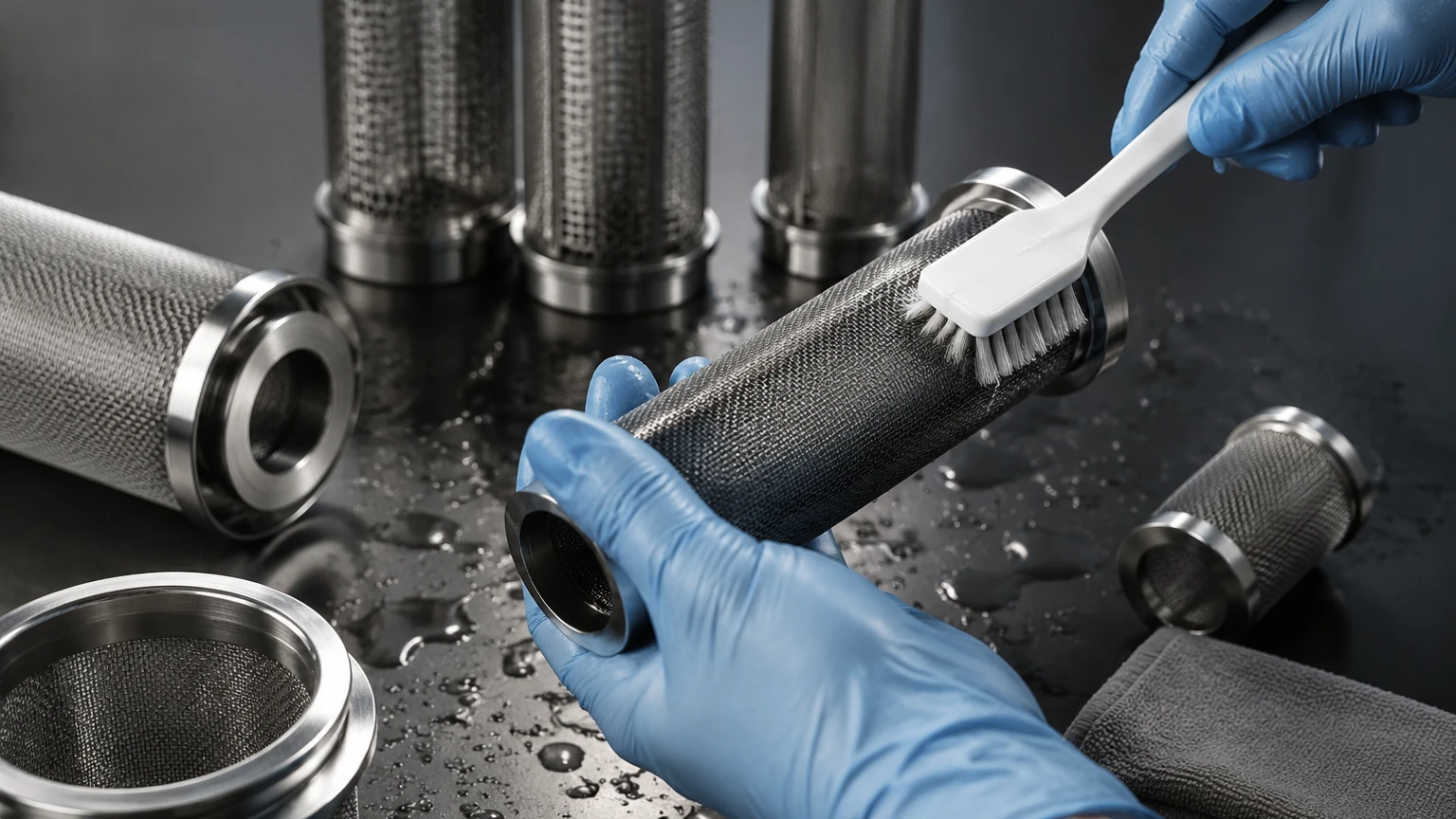
Common Risks and Prohibitions in Cleaning
Improper cleaning can be more damaging to a filter than the production process itself. Engineers should be aware of the following risks:
1. Overheating: Exceeding the recommended temperature during pyrolysis can cause the metal to soften or change its crystalline structure, leading to catastrophic failure under pressure.
2. Chemical Incompatibility: Using acid-based cleaning agents on certain alloys can lead to rapid pitting or stress-corrosion cracking.
3. Mechanical Damage: High-pressure water jetting, if applied incorrectly, can flatten pleats or tear delicate wire mesh layers.
4. Residue Retention: If the final rinsing and ultrasonic stages are skipped, residual carbon can leach into the polymer melt during the next production run, resulting in "black specks" and rejected product batches.
Strategic Sourcing and Support
For B2B purchasing teams, the recyclability of a filter should be a primary specification during the procurement phase. Working with a manufacturer that understands the rigors of polymer filter cleaning ensures that the filters supplied are engineered for durability.
Kaifil specializes in custom stainless steel filtration components designed for high-demand industrial environments. Whether you require sintered fiber felt for fine gel removal or heavy-duty wire mesh for high-viscosity polymers, our products are built to withstand repeated restoration cycles. For detailed technical specifications and to explore our range of customizable filtration solutions, visit the Kaifil Main Page.
Conclusion
In the polymer industry, the filter is the final guardian of product quality. While the accumulation of contaminants is inevitable, the loss of the filter element is not. By implementing a sophisticated cleaning strategy—utilizing vacuum calcination, chemical hydrolysis, and ultrasonic finishing—manufacturers can significantly extend the life of their filtration assets.
Success in this area requires a combination of the right cleaning technology and high-quality filter construction. By prioritizing structural integrity and material compatibility from the outset, engineering teams can ensure that their filtration systems deliver consistent, high-performance results across many years of service. Confirming the cleaning compatibility of your filter elements today is the first step toward optimizing your production efficiency and reducing long-term operational costs.
