


Polymer Melt Filtration
In the production of high-quality plastics, synthetic fibers, and resins, the purity of the polymer melt is a critical factor that determines the mechanical properties and aesthetic quality of the final product. Polymer melt filtration is the process of removing solid contaminants, such as gels, carbonized particles, and inorganic impurities, from a molten polymer stream before it is extruded or molded. This process is essential for preventing defects in thin films, ensuring the continuity of fine fibers, and protecting downstream equipment like spinnerets and precision dies.
For engineers and production managers, selecting the right filtration system involves a complex balance of filtration efficiency, pressure stability, and the rheological behavior of the polymer. As a specialized manufacturer of stainless steel filtration solutions, Kaifil provides the technical components necessary to maintain high-performance standards in these demanding industrial environments.
Understanding the Role of Polymer Melt Filtration in Industrial Processing
Polymer melt filtration serves as the final barrier against contaminants that can compromise the integrity of the end product. In industries such as PET film production or high-tenacity yarn manufacturing, even a single microscopic particle can cause a "bubble" or a break in the production line, leading to significant downtime and material waste.
Contaminants in a polymer melt can be categorized into two main types: hard particles and soft particles (gels). Hard particles include metal fragments from machinery wear, un-melted additives, or environmental dust. Soft particles, or gels, are often cross-linked polymer chains or degraded material that have different flow characteristics than the bulk melt. Effective polymer melt filtration must address both, requiring a nuanced approach to filter media selection and system design.
By implementing a robust filtration strategy, manufacturers can achieve:
- Improved Product Quality: Consistent clarity and strength in films and fibers.
- Extended Equipment Life: Reduced wear on precision extrusion dies and pumps.
- Operational Efficiency: Fewer line breaks and reduced scrap rates.
Key Filtration Mechanisms for Molten Polymers
The behavior of a molten polymer under pressure is significantly different from that of water or air. High viscosity and non-Newtonian flow characteristics mean that filtration mechanisms must be carefully engineered. There are two primary mechanisms used in this field:
1. Surface Filtration (Sieving)
Surface filtration occurs when particles larger than the pore size of the filter media are trapped on the upstream surface. This is typically achieved using high-precision stainless steel wire mesh. As the process continues, a "filter cake" builds up, which can actually improve filtration efficiency but also leads to a rapid increase in differential pressure. Surface filtration is most effective for removing rigid, inorganic contaminants.
2. Depth Filtration
Depth filtration utilizes a thicker medium, such as sintered metal fiber felt, where contaminants are trapped within the tortuous path of the material's internal structure. This mechanism is particularly effective for capturing gels. Because gels are deformable, they can often squeeze through the pores of a thin surface filter under high pressure. A depth filter provides multiple opportunities to capture these particles as they navigate the complex internal matrix.
Materials and Construction of High-Performance Melt Filters
Given the extreme temperatures (often exceeding 300°C) and high pressures (up to 350 bar) involved in extrusion, the materials used for polymer melt filtration must be exceptionally durable. Stainless steel is the industry standard due to its thermal stability and chemical resistance.
Stainless Steel Wire Mesh
Kaifil utilizes various weaves, such as plain Dutch weave or twilled Dutch weave, to create filter screens that offer precise micron ratings. These meshes are often layered to provide a balance of filtration accuracy and structural support. For many standard applications, a combination of coarse and fine meshes—known as a screen pack—is used to provide graduated filtration.
Sintered Metal Fiber Felt
For more demanding applications, sintered metal fiber felt is preferred. This material consists of fine stainless steel fibers that are randomly laid and then sintered (bonded by heat without melting) to create a high-porosity depth medium. This construction offers a much higher dirt-holding capacity and lower initial pressure drop compared to traditional wire mesh, making it ideal for high-viscosity polymers.
Sintered Multi-Layer Mesh
In environments where mechanical strength is paramount, multiple layers of wire mesh are sintered together. This creates a robust, integrated filter plate that can withstand high differential pressures without deforming, ensuring that the filtration rating remains constant throughout the production cycle.
Engineering Challenges: Pressure, Temperature, and Viscosity
Designing a system for polymer melt filtration requires a deep understanding of fluid dynamics. Several engineering variables must be monitored to ensure the process remains stable.
Differential Pressure (ΔP)
As the filter media captures contaminants, the resistance to flow increases, leading to a rise in differential pressure. If ΔP becomes too high, it can lead to several problems: the polymer may begin to degrade due to excessive shear heat, or the filter media itself may suffer structural failure. Engineers must determine the "terminal ΔP"—the point at which the filter must be cleaned or replaced.
Residence Time
In the molten state, polymers are sensitive to heat. If a polymer stays in the filtration system for too long (high residence time), it can undergo thermal degradation, leading to the formation of more gels or carbonized specks. Filtration systems must be designed with "dead-zone-free" flow paths to ensure that all polymer moves through the system at a consistent rate.
Shear Stress
High-velocity flow through small pores can subject polymer chains to high shear stress. For certain shear-sensitive polymers, this can alter the molecular weight distribution and affect the physical properties of the final product. Selecting a filter with a larger effective surface area can help reduce the flow velocity through individual pores, thereby mitigating shear-related issues.
Common Filter Configurations: From Screen Packs to Pleated Cartridges
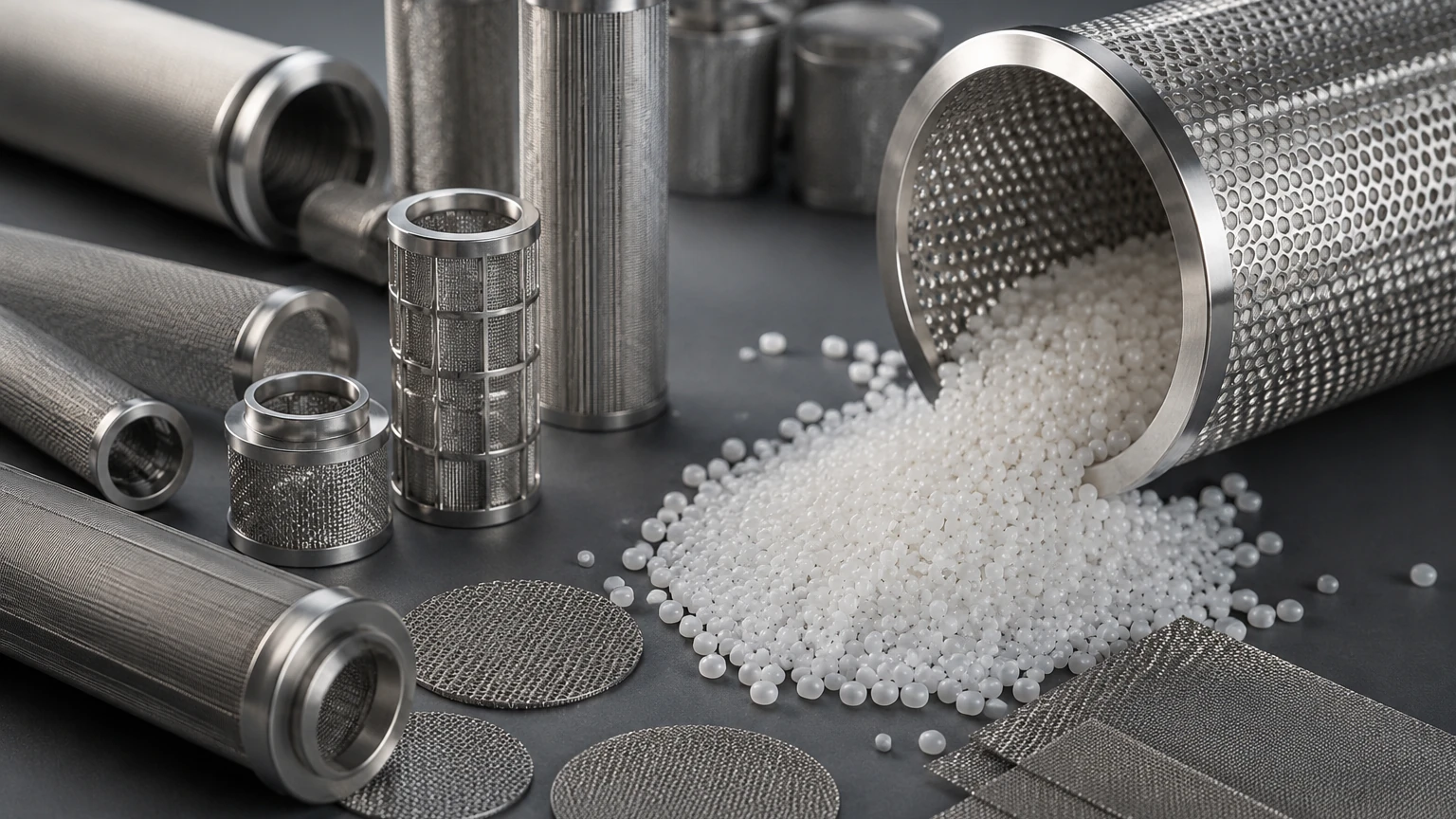
The physical form of the filter is determined by the required surface area and the type of equipment being used. Common configurations provided by manufacturers like Kaifil include:
- Spin Packs: Used in the production of synthetic fibers, these are circular or rectangular assemblies that fit directly into the spinning head. They often contain multiple layers of mesh and sometimes sand or metal powder as a filtration aid.
- Leaf Discs: These are flat, circular filter elements used in large-scale polymer production. They are often stacked on a central mandrel to provide a massive surface area within a compact pressurized vessel.
- Pleated Filter Cartridges: By pleating the filter media (either mesh or sintered felt), the available surface area can be increased by 200% to 400% compared to a cylindrical filter of the same size. This significantly extends the service life between filter changes and is a common choice for high-capacity extrusion lines.
- Continuous Screen Changers: In high-volume recycling or compounding, manual filter changes are impractical. Continuous screen changers allow the filter media to be replaced without stopping the extrusion process, maintaining a constant melt pressure.
Evaluation Criteria for Selecting Filtration Solutions
When specifying a filter for a new or existing line, technical professionals should evaluate the following criteria to ensure optimal performance:
1. Micron Rating (Absolute vs. Nominal): Ensure the filter can capture the smallest particle that would cause a defect. In polymer processing, an absolute rating is usually required to guarantee quality.
2. Dirt Holding Capacity: This determines how much contaminant the filter can hold before reaching the terminal pressure drop. Higher capacity means longer production runs.
3. Alloy Compatibility: While Stainless Steel 304 is standard, 316L is often preferred for its superior corrosion resistance, especially when processing polymers that may release acidic byproducts (like PVC or certain fluoropolymers).
4. Structural Integrity: The filter must be able to withstand the maximum system pressure and potential pressure spikes during start-up without bypassing or collapsing.
For those looking to optimize their current systems, it is often beneficial to consult with a manufacturer that offers customized engineering. You can Review product options and application support on the Kaifil Main Page to see how specific metal filtration components are tailored to these industrial requirements.
Maintenance, Cleaning, and the Impact on Total Cost of Ownership
One of the primary advantages of stainless steel polymer melt filtration media is that it is often cleanable and reusable. Given the high cost of sintered metal fiber and precision mesh, a robust cleaning program is essential for reducing the total cost of ownership.
Cleaning Methods
- Pyrolysis (Burn-off): The filters are placed in a vacuum oven or a fluidized bed furnace to thermally decompose the polymer residue into carbon and ash.
- Chemical Cleaning: Strong solvents or ultrasonic baths with specialized detergents are used to remove the remaining ash and inorganic particles from the deep pores of the media.
- Bubble Point Testing: After cleaning, filters should undergo a bubble point test to verify that the pore structure has not been damaged and that the filtration integrity is maintained.
While cleaning extends the life of the filter, it is not infinite. Each cleaning cycle can slightly degrade the metal fibers or the structural bonds. Monitoring the "clean pressure drop" after each cycle is a best practice to determine when a filter element has reached the end of its functional life.
Conclusion
Polymer melt filtration is a sophisticated discipline that sits at the intersection of material science and mechanical engineering. By selecting the appropriate filtration media and configuration, manufacturers can significantly enhance product quality and process stability. Whether dealing with the high pressures of virgin resin production or the high contaminant loads of plastic recycling, the use of precision-engineered stainless steel filters remains the most reliable method for achieving consistent results. As industrial requirements for thinner films and stronger fibers continue to evolve, the technology behind these filtration systems will remain a cornerstone of modern polymer processing.
