


Whole House Water Filter Cartridge Types
In industrial, commercial, and large-scale residential water management, selecting the appropriate filtration media is critical for protecting downstream equipment, ensuring water quality, and optimizing operational costs. Whole house filtration systems—often referred to as point-of-entry (POE) systems in technical contexts—rely on various cartridge technologies to remove contaminants from the total water supply. Understanding the diverse whole house water filter cartridge types is essential for engineers and facility managers who must balance filtration efficiency with flow rate requirements and maintenance intervals.
Industrial filtration involves more than just removing particulates; it requires a strategic approach to material compatibility, pressure management, and the specific chemistry of the source water. This guide examines the technical specifications and application scenarios for the most common filter cartridges used in large-scale systems.
Understanding the Mechanics of Whole House Filtration
Before evaluating specific whole house water filter cartridge types, it is necessary to understand the primary mechanical principles that govern their performance. Filtration in these systems generally falls into two categories: depth filtration and surface filtration.
Depth Filtration
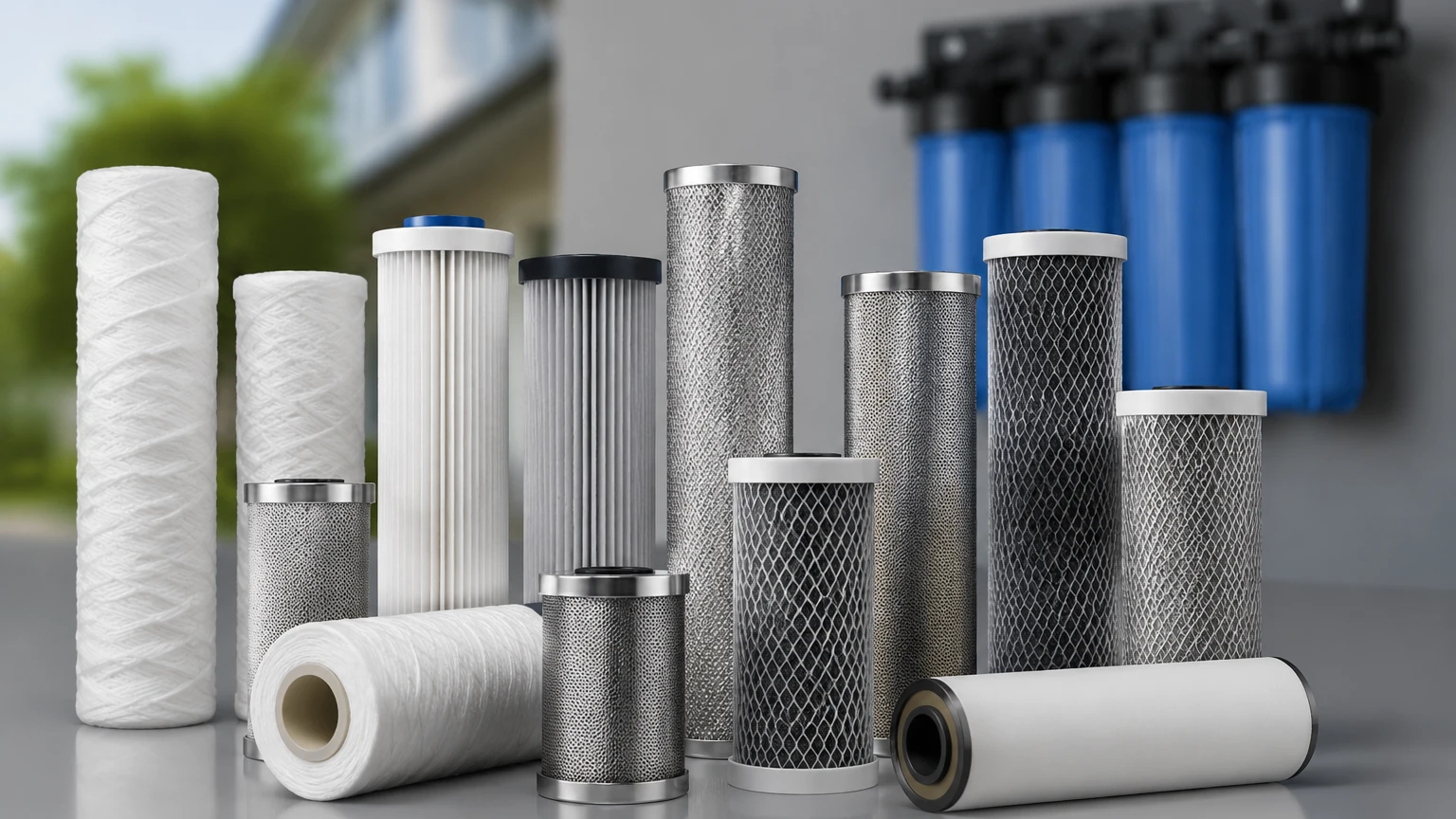
Depth filters, such as melt-blown polypropylene or string-wound cartridges, capture particles throughout the entire thickness of the filter media. These are highly effective for handling a wide range of particle sizes and offer a high dirt-holding capacity. However, they are typically non-cleanable and must be replaced once the pressure differential ($ΔP$) reaches a specific threshold.
Surface Filtration
Surface filters, including pleated cartridges and stainless steel wire mesh, trap contaminants on the surface of the media. These filters often provide more precise micron ratings and, in the case of metal media, can be cleaned and reused multiple times. For industrial applications where high flow rates and durability are paramount, surface filtration using robust materials is often the preferred engineering choice.
Sediment Filter Cartridges: The First Line of Defense
Sediment filtration is the foundational step in any water treatment process. These cartridges are designed to remove suspended solids such as sand, silt, rust, and scale. Failure to adequately remove these particulates can lead to the clogging of sensitive valves, damage to pumps, and the fouling of more expensive secondary filtration stages.
Polypropylene (PP) Melt-Blown Cartridges
These are among the most common depth filters. They are manufactured using a thermal bonding process that creates a complex matrix of fibers. They are valued for their chemical resistance and are available in various densities, allowing for graded pore structures that capture larger particles on the outside and finer particles toward the core.
String-Wound Cartridges
These are created by winding yarn (often polypropylene, cotton, or glass fiber) around a central core. The winding pattern creates diamond-shaped openings that become progressively smaller toward the center. These are particularly effective in high-temperature or high-pressure environments where a rigid internal support core is necessary.
Pleated Sediment Filters
By pleating the filter media (typically polyester or cellulose), manufacturers significantly increase the surface area within a standard cartridge footprint. This results in lower initial pressure drops and longer service lives compared to standard depth filters. Pleated filters are excellent for applications requiring high flow rates with minimal resistance.
Carbon Filtration: Adsorption and Chemical Removal
While sediment filters focus on physical particulates, carbon cartridges address dissolved chemicals, tastes, and odors. The primary mechanism here is adsorption, where contaminants adhere to the vast surface area of the activated carbon.
Granular Activated Carbon (GAC)
GAC cartridges contain loose granules of carbon. They are highly effective at removing chlorine and organic compounds. However, because the media is loose, there is a risk of "channeling," where water finds the path of least resistance, bypassing some of the carbon and reducing contact time. GAC filters are often used as a pre-treatment step for reverse osmosis systems.
Carbon Block Cartridges
Carbon blocks are formed by compressing fine carbon powder and a binding agent into a solid cylindrical shape. This structure eliminates channeling and provides a much higher surface area for adsorption. Additionally, many carbon blocks are rated for sediment removal, acting as a dual-purpose filter. For industrial facilities, carbon blocks are generally preferred for their consistent performance and structural integrity.
Stainless Steel and High-Performance Metal Filters
In demanding industrial environments where traditional polymer-based whole house water filter cartridge types fail due to temperature, pressure, or chemical aggression, stainless steel filtration solutions become necessary. As a professional manufacturer, Kaifil specializes in these high-durability components.
Stainless Steel Wire Mesh Filters
Constructed from 304 or 316L stainless steel, these filters utilize precision-woven wire mesh to provide exact surface filtration. Unlike disposable cartridges, stainless steel mesh is cleanable via backwashing or ultrasonic cleaning, making it a cost-effective long-term solution for heavy-duty industrial water intake.
Sintered Metal Cartridges
Sintered metal filters are created by fusing layers of wire mesh or metal powder under high heat and pressure. This creates a porous structure with exceptional mechanical strength. These cartridges are used in applications involving high-pressure steam, aggressive chemicals, or extreme temperatures where synthetic fibers would degrade.
Engineers looking for robust, customized filtration components can Review product options and application support to determine which metal alloys and mesh configurations best suit their specific facility requirements.
Engineering Considerations for Cartridge Selection
Selecting the right whole house water filter cartridge types requires a technical evaluation of several variables. A mismatch between the filter type and the application can lead to premature failure or insufficient water quality.
1. Micron Rating (Nominal vs. Absolute): A nominal rating indicates the filter's ability to trap a major percentage of particles of a given size. An absolute rating implies that 99.9% of particles at that size will be retained. For critical process water, absolute-rated filters are mandatory.
2. Flow Rate and Pressure Drop: Every filter introduces resistance. Engineers must calculate the maximum required Gallons Per Minute (GPM) and ensure the selected cartridge can maintain that flow without exceeding the maximum allowable pressure drop.
3. Chemical Compatibility: While polypropylene is resistant to many acids and bases, it may swell or degrade in the presence of certain hydrocarbons or high concentrations of chlorine. Stainless steel offers broader compatibility but must be evaluated for potential pitting in high-chloride environments.
4. Temperature Limits: Standard plastic cartridges are often limited to temperatures below 100°F (38°C). For hot water loops or industrial processes, metal or specialized high-temperature polymers are required.
Total Cost of Ownership and Maintenance Cycles
In a B2B context, the purchase price of a filter cartridge is only one component of the Total Cost of Ownership (TCO). A low-cost disposable filter may seem economical initially, but frequent replacement labor, disposal costs, and system downtime can quickly exceed the cost of a premium, cleanable alternative.
* Disposable Cartridges: Best for low-sediment loads where the replacement interval is six months or longer. The primary cost is the recurring purchase of media.
* Cleanable Stainless Steel Filters: High initial investment, but significantly lower TCO over a 5-to-10-year horizon. These are ideal for high-load environments where disposables would need weekly or monthly replacement.
Maintenance cycles should be determined by monitoring the pressure differential across the filter housing. Installing pressure gauges on both the inlet and outlet allows operators to identify exactly when a cartridge has reached its holding capacity, preventing "breakthrough" where contaminants are forced through the media due to high pressure.
Conclusion
Navigating the various whole house water filter cartridge types is a matter of matching the physical and chemical properties of the media to the specific demands of the water supply. Whether the goal is protecting a commercial boiler system, ensuring the purity of food and beverage process water, or providing clean water to a residential complex, the choice of cartridge impacts both performance and the bottom line.
For organizations requiring precision-engineered filtration, the transition from standard disposables to customized metal solutions can offer enhanced reliability and durability. By focusing on technical specifications—such as micron accuracy, material integrity, and flow dynamics—purchasing teams can secure filtration systems that perform consistently in even the most demanding industrial environments. For more detailed technical specifications and customized engineering support, visiting the Kaifil Main Page provides access to professional resources for industrial filtration design.
