


Porous Metal Filter Disc
In industrial filtration, the selection of a filter medium is a critical engineering decision that directly impacts process efficiency, product purity, and equipment longevity. Among the various options available, the porous metal filter disc stands out as a high-performance component designed for demanding environments where polymer-based or ceramic filters may fail. These discs, often manufactured through advanced powder metallurgy and sintering processes, offer a unique combination of mechanical strength, thermal stability, and precise filtration accuracy.
For engineers and procurement teams, understanding the technical nuances of a porous metal filter disc is essential for optimizing system performance. Whether the application involves high-pressure hydraulic systems, corrosive chemical processing, or sterile pharmaceutical production, the choice of material, pore structure, and disc geometry must be carefully aligned with the operational parameters. To explore the full range of custom filtration solutions, technical professionals can visit the Main Page for detailed product specifications and engineering support.
Engineering Principles of Sintered Porous Metal Discs
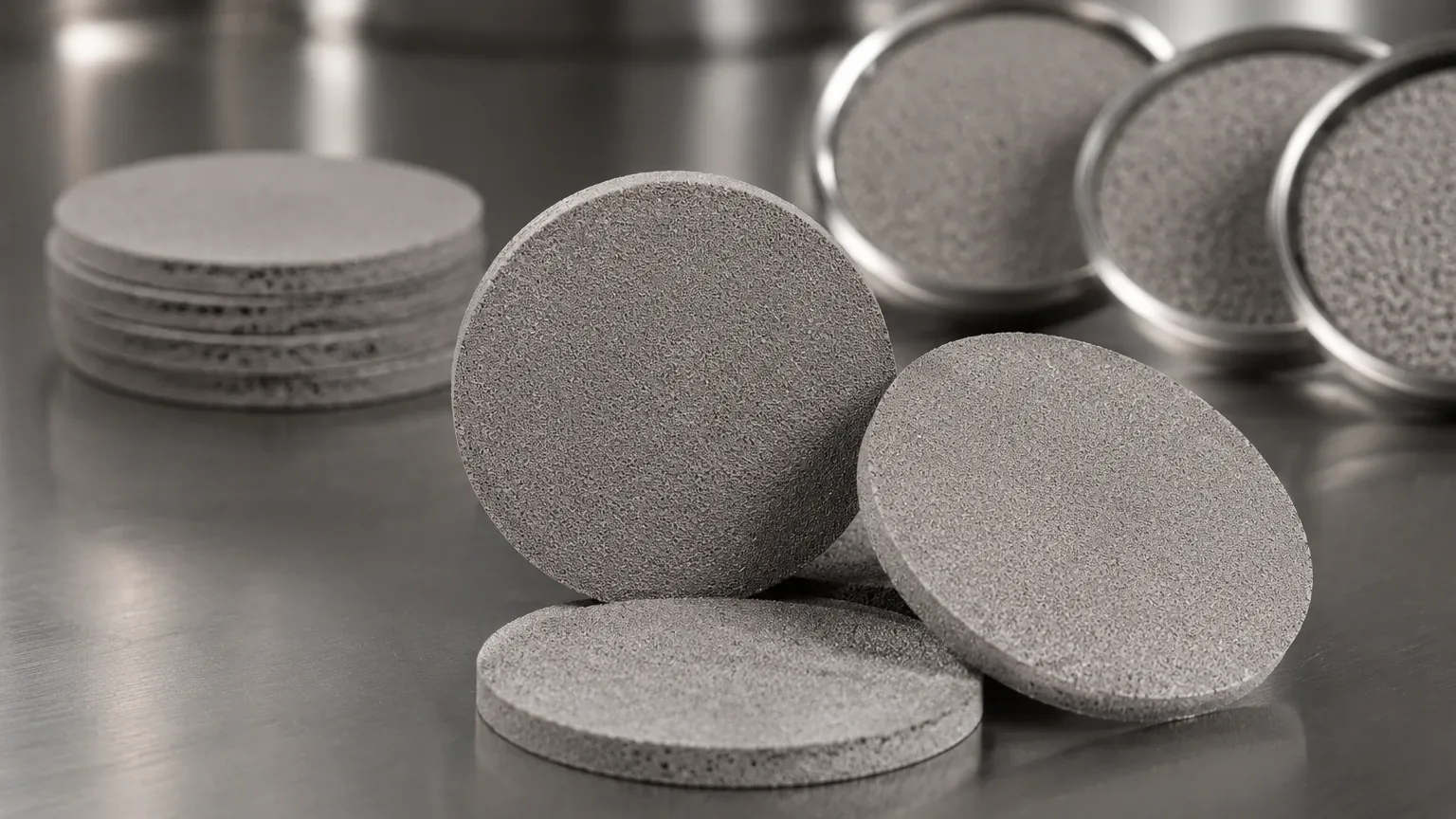
The manufacturing of a porous metal filter disc typically involves the sintering of metallic powders or multi-layer wire meshes. Sintering is a thermal process where metal particles are bonded together at temperatures below their melting point. This results in a rigid, porous structure with interconnected voids that allow fluid flow while capturing solid contaminants.
Material Selection and Metallurgy
The most common material for these components is 316L stainless steel, chosen for its excellent corrosion resistance and mechanical properties. However, for specialized applications, other alloys are utilized:
* 316L Stainless Steel: The industry standard for general chemical resistance and durability.
* Nickel and Monel: Used in highly corrosive environments, particularly those involving hydrofluoric acid or seawater.
* Inconel and Hastelloy: Reserved for extreme high-temperature applications and aggressive chemical processing where oxidation resistance is paramount.
* Titanium: Preferred for its high strength-to-weight ratio and biocompatibility in medical or aerospace sectors.
Pore Structure and Porosity
The performance of a porous metal filter disc is defined by its porosity—the ratio of void volume to total volume—and its pore size distribution. Unlike surface filters, sintered metal discs often act as depth filters. The tortuous path created by the sintered particles ensures that particles are trapped throughout the thickness of the disc, providing a higher dirt-holding capacity and preventing premature surface blinding.
Key Performance Metrics for Industrial Filtration
When evaluating a porous metal filter disc for a specific application, several technical metrics must be confirmed to ensure the component meets the required safety and efficiency standards.
Micron Rating: Absolute vs. Nominal
In the context of sintered metal, the micron rating is a measure of the filter's ability to remove particles of a certain size.
* Nominal Rating: Indicates the ability to retain a major percentage (e.g., 60-90%) of particles of a specific size.
* Absolute Rating: Refers to the diameter of the largest hard spherical particle that will pass through the filter under specified test conditions. For critical applications, such as catalyst recovery or sterile gas filtration, an absolute rating is usually required to prevent downstream contamination.
Differential Pressure and Permeability
Permeability is the measure of how easily a fluid can pass through the porous medium. A high-quality porous metal filter disc must balance filtration efficiency with a low initial pressure drop (∆P). As the filter accumulates contaminants, the differential pressure increases. Engineers must calculate the maximum allowable ∆P before the disc requires cleaning or replacement to avoid structural failure or pump cavitation.
Mechanical Integrity and Burst Strength
One of the primary advantages of metal filters is their ability to withstand high differential pressures. A sintered disc is a self-supporting structure that does not require additional backing in many applications. However, for large-diameter discs or extremely high-pressure systems, the thickness of the disc and the sintering quality must be sufficient to prevent deformation or "media migration," where metal particles break off and enter the filtrate stream.
Applications Across Critical Industries
The versatility of the porous metal filter disc allows it to be integrated into various stages of industrial production. Its ability to be cleaned and reused makes it a cost-effective alternative to disposable filters in high-volume processes.
Chemical and Petrochemical Processing
In chemical manufacturing, filters are often exposed to aggressive solvents and high temperatures. Sintered metal discs are used for catalyst recovery, where valuable metal catalysts must be separated from a liquid stream. Their resistance to thermal shock allows them to handle rapid temperature fluctuations without cracking.
Food and Beverage Filtration
For the food industry, hygiene and cleanability are the highest priorities. Porous metal filter discs are used in steam filtration to remove pipe scale and rust from culinary-grade steam. Because they are made from food-grade stainless steel, they comply with stringent regulatory standards and can undergo frequent Clean-in-Place (CIP) cycles.
Pharmaceutical and Biotechnology
In sterile environments, the filtration of gases and liquids must be absolute. Sintered discs are employed in sparging applications—introducing gases into liquids—where the controlled pore size ensures the creation of fine, uniform bubbles, maximizing gas-liquid interface area for fermentation or carbonation processes.
Customization and OEM Integration
Standard off-the-shelf filtration components rarely meet the exact needs of specialized industrial machinery. This is where customization becomes a vital part of the procurement process. At Kaifil, the focus is on providing tailored solutions that align with specific engineering drawings and performance requirements.
Geometry and Dimensions
Discs can be manufactured in a wide range of diameters, from a few millimeters for miniature instrumentation filters to several hundred millimeters for large-scale industrial housings. Thickness is another variable that can be adjusted to balance flow rate and filtration depth.
Multi-Layer Lamination
In some cases, a single layer of sintered powder or mesh is insufficient. Multi-layer sintered discs combine different grades of mesh or powder to create a composite structure. For example, a fine filtration layer can be protected by coarser drainage and support layers, resulting in a disc that offers both high precision and extreme mechanical robustness.
Edge Treatments and Fitting
To ensure a leak-proof seal within a filter housing, the edges of a porous metal filter disc can be modified. Options include solid metal rims, welded fittings, or specialized gaskets. These modifications ensure that the fluid is forced through the porous medium rather than bypassing it through the edges.
Maintenance, Cleaning, and Total Cost of Ownership
While the initial purchase price of a porous metal filter disc is higher than that of a polymer or paper filter, the total cost of ownership (TCO) is often lower due to its durability and reusability. Understanding the proper maintenance protocols is key to maximizing this investment.
Cleaning Methodologies
Unlike disposable filters, sintered metal discs can be restored to near-original permeability through various cleaning techniques:
* Ultrasonic Cleaning: Uses high-frequency sound waves in a cleaning solution to dislodge particles from deep within the pores.
* Backwashing/Backpulsing: Reversing the flow of fluid through the filter to push contaminants out.
* Chemical Cleaning: Utilizing acids, alkalis, or solvents to dissolve organic or inorganic deposits.
* Thermal Cleaning (Burn-off): High-temperature treatment to oxidize organic contaminants, though this must be done carefully to avoid altering the metal's properties.
Determining Replacement Cycles
Even with regular cleaning, a filter disc will eventually reach a point where its original permeability cannot be restored. This is often due to the gradual accumulation of sub-micron particles or physical wear. Monitoring the "clean pressure drop" after each cleaning cycle allows maintenance teams to predict the end-of-life for the component and schedule replacements before a failure occurs.
Technical Checklist for Purchasing Teams
Before finalizing a specification for a porous metal filter disc, engineers should confirm the following data points with their manufacturer:
1. Fluid Characteristics: Viscosity, density, and chemical composition at operating temperatures.
2. Contaminant Profile: Particle size distribution and concentration (ppm).
3. Operating Conditions: Normal and maximum temperature, operating pressure, and maximum allowable differential pressure.
4. Flow Rate Requirements: Minimum and maximum flow rates to determine the required surface area.
5. Housing Compatibility: Exact dimensions and sealing requirements to ensure a proper fit.
By addressing these factors, purchasing teams can ensure they receive a filtration solution that is not only functional but optimized for their specific industrial environment. For more information on how custom engineering can improve your filtration efficiency, visit the Main Page to connect with technical experts who can guide you through the selection and design process.
