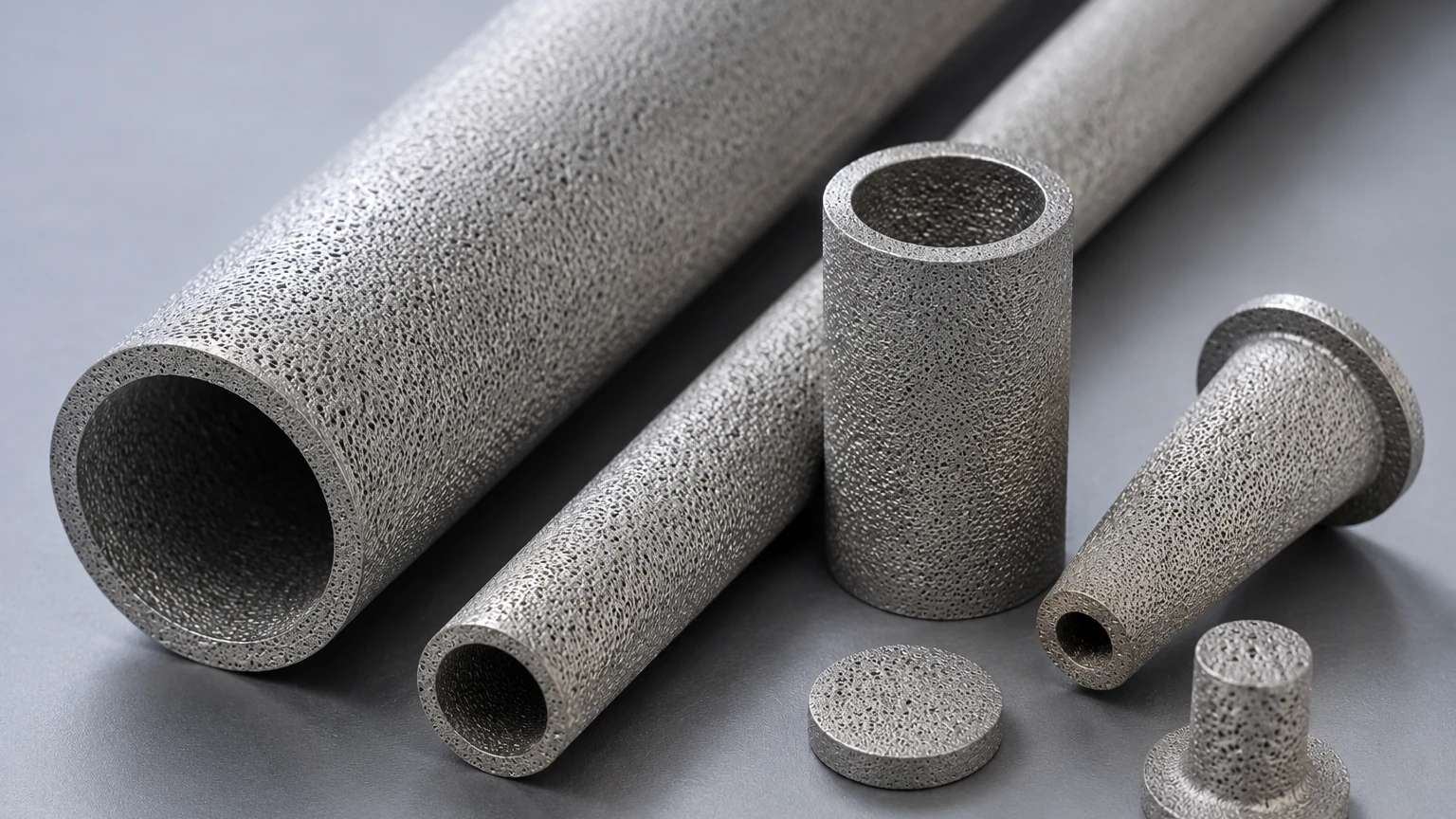
Porous Metal Tube
In industrial filtration and fluid processing, the porous metal tube represents a critical component for applications requiring high structural integrity, thermal stability, and precise filtration control. Unlike traditional fabric or polymer-based filters, these tubes are engineered from metallic powders or fibers through a process known as sintering. This manufacturing technique creates a rigid, interconnected pore structure that allows for the controlled passage of gases or liquids while retaining solid particulates. For engineers and procurement teams, understanding the technical nuances of these components is essential for optimizing system performance and ensuring long-term operational reliability.
Manufacturing and Material Science of Porous Metal Tubes
The performance of a porous metal tube is fundamentally determined by its manufacturing process and the base materials used. Most industrial-grade tubes are produced using powder metallurgy. In this process, metallic powders—typically stainless steel 316L—are compacted into a cylindrical shape and then heated in a controlled-atmosphere furnace below their melting point. This sintering process causes the particles to bond at their contact points, creating a strong, porous matrix.
While 316L stainless steel is the industry standard due to its excellent corrosion resistance and mechanical strength, other materials are selected based on specific environmental demands:
- 304 Stainless Steel: Suitable for less corrosive environments or applications where cost-effectiveness is prioritized over maximum chemical resistance.
- Nickel-Based Alloys (Inconel, Hastelloy): Utilized in extreme chemical processing environments involving high concentrations of acids or chlorides at elevated temperatures.
- Titanium: Often chosen for its high strength-to-weight ratio and superior resistance to seawater and oxidizing environments, making it common in aerospace and marine applications.
The resulting structure is a self-supporting element that does not require an internal core for mechanical stability under standard operating pressures. This rigidity is a significant advantage over flexible filter media, as it prevents media migration and ensures consistent pore geometry even under fluctuating flow conditions.
Key Performance Characteristics
When evaluating a porous metal tube for industrial use, engineers must consider several performance metrics that define its suitability for a specific task. These characteristics are not just theoretical values but practical indicators of how the filter will behave in a live system.
Filtration Efficiency and Micron Rating
Filtration efficiency is typically defined by the micron rating, which can be categorized as nominal or absolute. A nominal rating indicates the ability of the tube to retain a majority of particles of a certain size, whereas an absolute rating (often determined via the bubble point test) specifies the size of the largest particle that can pass through the media. Sintered metal tubes offer highly consistent pore size distributions, allowing for precise filtration down to 0.1 microns in some specialized designs.
Permeability and Pressure Drop
Permeability refers to the ease with which a fluid can pass through the porous matrix. It is inversely related to filtration efficiency; finer pores generally result in a higher pressure drop (Delta P) across the filter. In system design, it is crucial to balance the required filtration fineness with the available pump head or system pressure to avoid premature clogging or excessive energy consumption. Kaifil specializes in optimizing this balance by tailoring the porosity—the volume of open space within the tube—to meet specific flow requirements.
Thermal and Mechanical Stability
One of the primary reasons for selecting a porous metal tube over synthetic alternatives is its ability to withstand extreme conditions. These tubes can operate at temperatures exceeding 450°C (842°F) in oxidizing environments and even higher in reducing atmospheres. Mechanically, they exhibit high collapse pressure ratings, making them ideal for high-pressure hydraulic systems or applications involving significant back-pressure during cleaning cycles.
Engineering Specifications and Selection Criteria
Selecting the correct porous metal tube requires a detailed analysis of the operating environment. Engineers should confirm several technical parameters before finalizing a specification for a Main Page inquiry.
1. Fluid Compatibility: The chemical composition of the process fluid must be compatible with the metal alloy. This includes considering not only the primary fluid but also any trace contaminants or cleaning agents used in the system.
2. Operating Temperature: While the metal itself may handle high heat, thermal expansion must be accounted for in the housing design and the connection points (fittings) to prevent mechanical failure.
3. Flow Rate and Velocity: High fluid velocities can lead to erosion of the pore structure over time or cause "depth loading," where particles become embedded so deeply in the matrix that they cannot be removed by backwashing.
4. Connection Types: Porous metal tubes can be manufactured with various end-fittings, including NPT/BSP threads, flanged connections, or plain ends for welding. The choice of connection impacts both the ease of installation and the integrity of the seal.
Common Industrial Applications
The versatility of the porous metal tube allows it to serve multiple functions beyond simple particulate filtration. Its rigid structure and uniform porosity make it a preferred choice in several specialized industrial sectors.
Gas-Liquid Sparging
In chemical reactors and water treatment plants, porous metal tubes are used as spargers to inject gases (such as oxygen, CO2, or nitrogen) into liquids. The fine pores create millions of tiny bubbles, vastly increasing the surface area for gas-to-liquid mass transfer. This efficiency is critical in fermentation processes and carbonation in the food and beverage industry.
Catalyst Recovery
In the petrochemical and pharmaceutical industries, expensive catalysts are often used in slurry reactors. Sintered metal tubes are employed to capture these catalyst particles from the product stream, allowing them to be washed and returned to the reactor. The ability to backwash these tubes in-situ is a major operational advantage, reducing downtime and material loss.
Flow Control and Flame Arrestors
The tortuous path created by the sintered metal powder acts as a natural flow restrictor and heat sink. In gas delivery systems, these tubes can be used to dampen pressure surges or as flame arrestors, where the metal matrix absorbs heat rapidly enough to extinguish a flame front before it can propagate through the piping.
Maintenance, Cleaning, and Service Life
A significant advantage of the porous metal tube is its cleanability. Unlike disposable cartridges, sintered metal elements are designed for long-term use, provided they are maintained correctly. There are three primary methods for restoring the permeability of a fouled tube:
- Backwashing/Backpulsing: This involves reversing the flow of the fluid (or using a compressed gas) to dislodge particles from the surface of the tube. This is most effective for "cake-forming" applications where solids accumulate on the outer diameter.
- Ultrasonic Cleaning: For tubes with deep-seated particulates, ultrasonic baths use high-frequency sound waves to create cavitation bubbles that scrub the internal pore surfaces without damaging the metal matrix.
- Chemical Cleaning: Using acids, alkalis, or specialized solvents can dissolve organic or inorganic scaling. It is imperative that the cleaning chemicals are compatible with the tube material (e.g., avoiding high concentrations of hydrochloric acid with 316L stainless steel).
The total cost of ownership for a porous metal tube is often lower than disposable options when the costs of replacement media, disposal of hazardous waste, and system downtime are factored into the lifecycle analysis.
Quality Assurance and Technical Validation
To ensure the reliability of filtration components in critical applications, several validation steps are standard in the manufacturing of porous metal tubes. These include:
- Bubble Point Testing (ISO 4003): To verify the maximum pore size and ensure there are no defects or leaks in the sintered structure.
- Permeability Testing (ISO 4022): To measure the pressure drop across the media at specific flow rates, ensuring the tube meets the system's hydraulic requirements.
- SEM Analysis: Scanning Electron Microscopy is often used during the design phase to inspect the uniformity of the sintered bonds and the distribution of the powder particles.
By adhering to these rigorous standards, manufacturers like Kaifil provide engineers with the data necessary to integrate these components into complex industrial systems with confidence. Whether the goal is to protect downstream equipment from particulate damage or to facilitate a complex chemical reaction through precise gas sparging, the porous metal tube remains a foundational tool in modern engineering.
For more information on custom dimensions, material grades, and application-specific designs, technical teams are encouraged to Review product options and application support to determine the optimal configuration for their filtration challenges.