


Reticulated Polyurethane Foam Porosity Percentage
In the field of industrial filtration and fluid dynamics, understanding the structural characteristics of porous media is essential for optimizing system performance. Reticulated polyurethane foam is a unique material characterized by its highly open, three-dimensional skeletal structure. Unlike conventional flexible foams, which contain a mix of open and closed cells, reticulated foam undergoes a specific manufacturing process to remove the thin membranes (windows) between the cell strands. This results in a material that is almost entirely composed of void space. For engineers and procurement specialists, the reticulated polyurethane foam porosity percentage is a critical metric that dictates flow resistance, particulate holding capacity, and overall filtration efficiency.
While often confused with Pores Per Inch (PPI), the porosity percentage refers specifically to the ratio of the volume of voids to the total volume of the material. In high-quality reticulated foams, this percentage typically ranges between 95% and 98%, making it one of the most efficient lightweight materials for air and liquid management. However, achieving the correct balance between porosity, pore size, and mechanical strength requires a deep understanding of the material's physical properties and the specific demands of the industrial environment.
Defining Porosity vs. Pores Per Inch (PPI)
To accurately specify materials for industrial applications, it is necessary to distinguish between two frequently conflated terms: PPI and porosity percentage.
Pores Per Inch (PPI) is a measure of the linear density of the cells. It describes the number of pores encountered over one inch of the material's surface. Common industrial grades range from 10 PPI (very coarse, large pores) to 100 PPI (very fine, small pores). While PPI influences the surface area available for filtration, it does not directly define the void volume.
Porosity Percentage, on the other hand, is a volumetric measurement. It quantifies the "emptiness" of the foam. Because reticulated foam has had its cell membranes removed through either thermal or chemical reticulation, the remaining structure consists only of the polymer strands. Consequently, a 10 PPI foam and a 60 PPI foam may both have a reticulated polyurethane foam porosity percentage of approximately 97%, even though their pore sizes are vastly different. The high void volume is what allows for exceptionally low pressure drops across the filter media, a key advantage in high-velocity air filtration and fluid processing.
Calculating the Reticulated Polyurethane Foam Porosity Percentage
For engineering verification, the porosity percentage can be calculated using the density of the final foam product compared to the density of the base polyurethane polymer. The formula is generally expressed as:
\[ \text{Porosity } \% = \left( 1 – \frac{\rho_{\text{foam}}}{\rho_{\text{polymer}}} \right) \times 100 \]
Where:
* \(\rho_{\text{foam}}\) is the bulk density of the reticulated foam (typically ranging from 1.5 to 2.0 lbs/ft³ for standard industrial grades).
* \(\rho_{\text{polymer}}\) is the density of the solid polyurethane resin (approximately 70 to 75 lbs/ft³).
Because the mass of the air within the voids is negligible, the density of the foam is almost entirely determined by the thickness of the polymer strands. In the reticulation process, the removal of cell membranes significantly reduces the bulk density while maximizing the reticulated polyurethane foam porosity percentage. This high void fraction ensures that the material provides minimal resistance to fluid flow while maintaining enough structural integrity to withstand the mechanical stresses of the application.
The Impact of Porosity on Filtration Performance
The reticulated polyurethane foam porosity percentage directly influences several key performance indicators in industrial filtration systems:
1. Pressure Drop and Flow Rate
In any filtration system, the goal is often to maximize particulate capture while minimizing the energy required to move the fluid through the media. Because reticulated foam has a porosity percentage exceeding 95%, it offers a very low initial pressure drop. This is particularly beneficial in HVAC systems, small engine air intakes, and electronic cabinet cooling where high airflow must be maintained without overtaxing fans or blowers.
2. Dust Holding Capacity (DHC)
Unlike surface-loading filters (such as paper or thin membranes), reticulated foam acts as a depth filter. The high porosity percentage allows particles to penetrate deep into the foam's skeletal structure. Particles are trapped as they collide with the polymer strands. This three-dimensional loading capability means the filter can hold a significant volume of contaminants before the pressure drop increases to a level requiring maintenance or replacement.
3. Surface Area for Impingement
While the porosity percentage remains high across various PPI grades, the total internal surface area increases as the pore size decreases. A 100 PPI foam has significantly more strand surface area than a 10 PPI foam. In applications like oil mist elimination or moisture separation, a higher PPI (while maintaining high porosity) increases the probability of droplets impinging on the strands and coalescing.
Engineering Considerations: Material Selection and Compatibility
When specifying reticulated foam based on its porosity percentage, engineers must also consider the chemical and thermal environment of the application. Reticulated polyurethane is generally available in two primary types: polyester and polyether.
* Polyester-based Foam: This type typically offers higher mechanical strength and better resistance to hydrocarbons, oils, and fuels. It is the preferred choice for many automotive and industrial lubricant filtration tasks. However, it is susceptible to hydrolysis (breakdown in hot, humid conditions).
* Polyether-based Foam: This variant is highly resistant to water and microbial growth. It is commonly used in water treatment, outdoor power equipment, and medical applications where moisture exposure is constant. While its mechanical properties might be slightly lower than polyester, its stability in aqueous environments is superior.
For those seeking comprehensive filtration components that integrate these materials with robust housings or support structures, visiting the Main Page of a specialized manufacturer like Kaifil provides insights into how different filtration media can be customized for specific industrial demands.
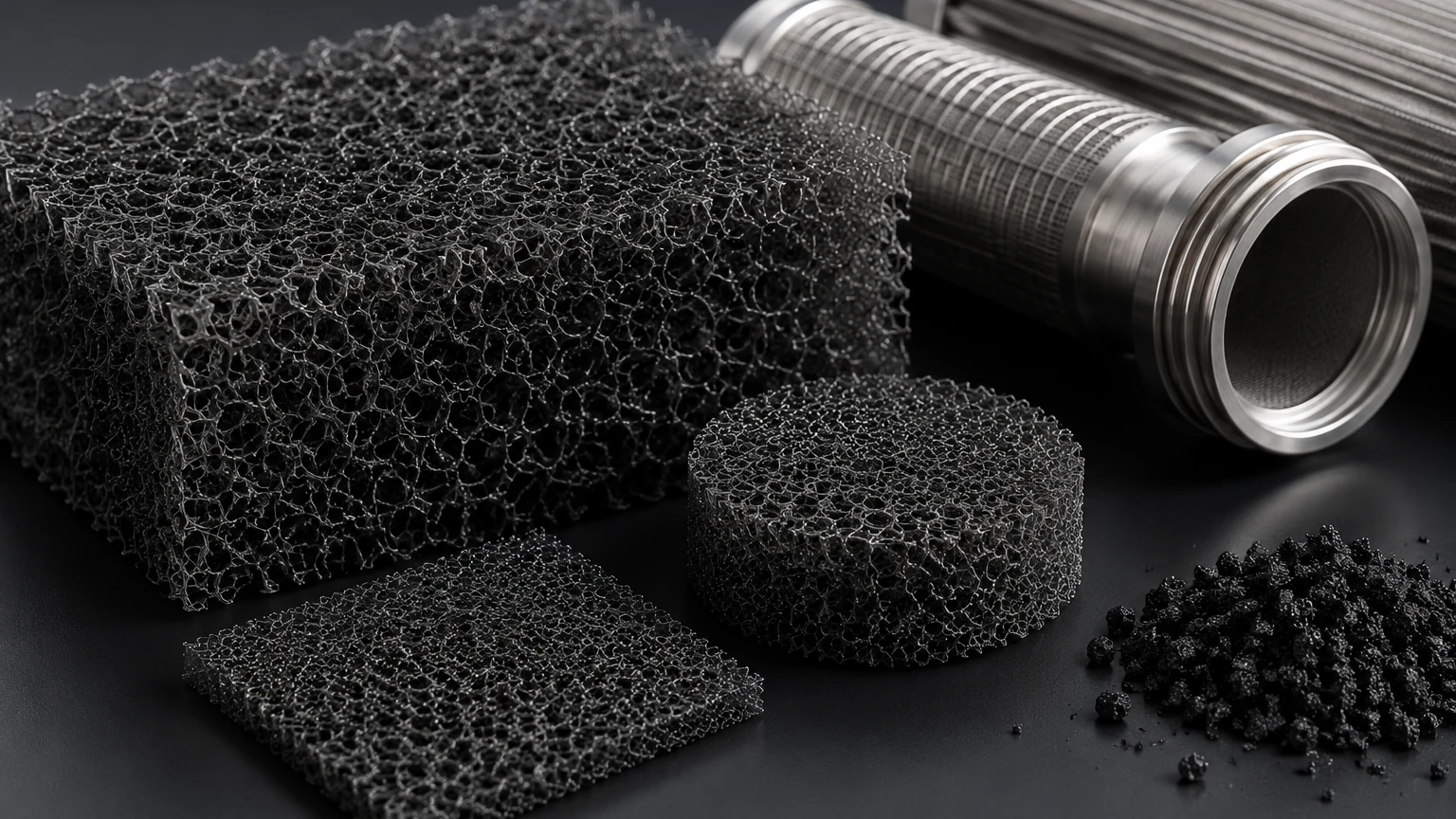
Comparing Reticulated Foam to Stainless Steel Filtration
While reticulated polyurethane foam is an excellent choice for many low-to-medium temperature applications, industrial engineers often face environments where polymer-based media are insufficient. In such cases, the principles of porosity and flow dynamics remain the same, but the material requirements shift toward metals.
Temperature and Chemical Resistance
Polyurethane foams are generally limited to operating temperatures below 250°F (121°C). In chemical processing or steam filtration, temperatures often exceed these limits. Stainless steel wire mesh and sintered metal filters, such as those produced by Kaifil, offer the same high-porosity benefits but can withstand temperatures upwards of 800°F and resist aggressive solvents that would dissolve polyurethane.
Cleanability and Lifespan
Reticulated foam is often treated as a semi-disposable or limited-reuse material. While some grades can be washed, the polymer strands eventually degrade. In contrast, stainless steel filter cartridges are designed for long-term service. They can be cleaned via backwashing, ultrasonic cleaning, or chemical baths, making them more cost-effective in high-volume industrial processes where the total cost of ownership is a primary concern.
Precision and Micron Ratings
While reticulated foam is excellent for coarse to medium filtration (down to approximately 10-20 microns in very high PPI grades), stainless steel mesh can be woven to precise specifications, reaching sub-micron levels when sintered. For critical applications in the pharmaceutical or food and beverage industries, the absolute filtration ratings provided by metal media are often required over the nominal ratings of foam.
Applications of High-Porosity Reticulated Foam
The high reticulated polyurethane foam porosity percentage makes it suitable for a wide array of specialized industrial functions beyond simple air filtration:
* Ceramic Foam Precursors: In the production of ceramic filters for molten metal filtration, reticulated polyurethane foam serves as a template. The foam is coated with a ceramic slurry and then fired. The polyurethane burns away, leaving a ceramic structure that mirrors the high porosity and open-cell nature of the original foam.
* Acoustic Absorption: The open-cell structure allows sound waves to enter the material where they are converted into low-grade heat through friction against the cell strands. This makes it an effective material for lining compressor housings and engine compartments.
* Fluid Reservoirs and Wicking: Due to its high void volume, reticulated foam can hold large quantities of liquid and release it at a controlled rate through capillary action, useful in industrial lubrication systems.
* Biological Growth Media: In wastewater treatment, the high surface area provided by the reticulated structure (while maintaining high porosity for flow) serves as an ideal substrate for beneficial biofilm growth.
Evaluating Total Cost of Ownership (TCO) in Filter Selection
When choosing between a high-porosity reticulated foam and a more permanent solution like a stainless steel filter, purchasing teams must evaluate the total cost of ownership. The initial cost of reticulated foam is significantly lower, making it attractive for high-volume, low-criticality applications. However, the frequency of replacement, the potential for system downtime during changeouts, and the environmental impact of waste must be balanced against the higher upfront investment of a durable stainless steel solution.
For complex systems, a hybrid approach is often best. Reticulated foam with a high porosity percentage can serve as an effective pre-filter, capturing large particulates and extending the life of more expensive, high-precision stainless steel secondary filters. This staged filtration strategy optimizes both the reticulated polyurethane foam porosity percentage and the technical advantages of metal filtration components.
Conclusion
The reticulated polyurethane foam porosity percentage is a foundational specification for any engineer designing or maintaining fluid handling systems. By providing a void volume of 95% or greater, this material ensures efficient flow and significant contaminant capacity. However, the selection process must go beyond porosity alone, accounting for PPI, polymer base, and the specific environmental stressors of the application. In demanding industrial sectors where durability and precision are paramount, comparing these polymer solutions with advanced metal filtration options—such as those found on the Kaifil Main Page—allows for the development of filtration systems that are both high-performing and cost-effective over the long term.
Download Reticulated Polyurethane Foam Porosity Percentage as a PDF
