


Rotary Screens
In the landscape of industrial solid-liquid separation, rotary screens represent a critical technology for continuous, automated filtration. These systems are designed to handle high-volume flow rates while maintaining precise separation of solids from liquid streams. For engineers and procurement teams, selecting the right filtration media for these screens is essential to ensuring operational uptime and maintaining product quality. As a specialist in stainless steel filtration solutions, Kaifil provides the precision-engineered components that define the efficiency and durability of industrial rotary screens.
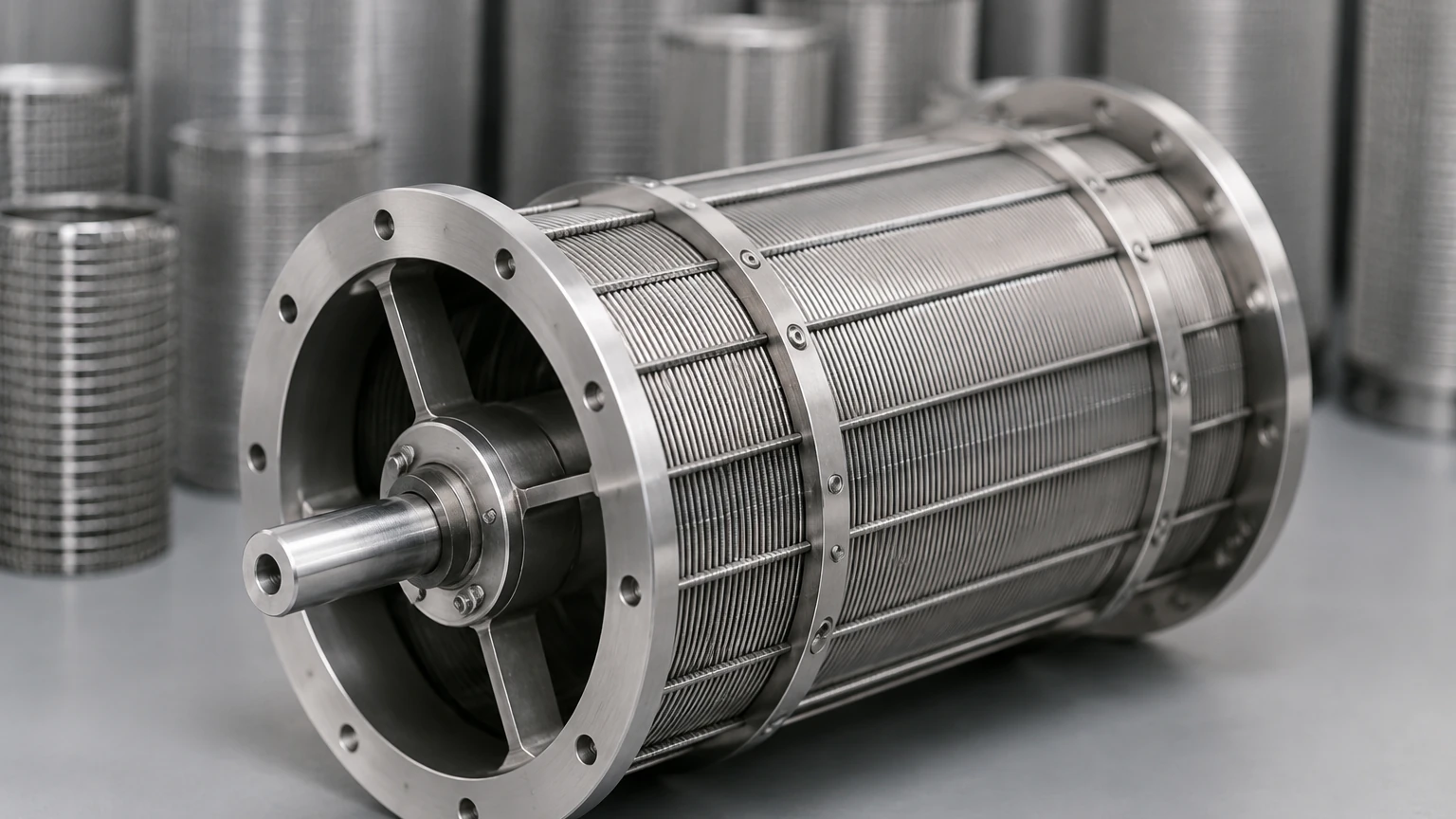
Industrial rotary screens, often referred to as drum screens or trommel screens in specific contexts, utilize a rotating cylindrical drum covered with a filtration medium—typically stainless steel wire mesh or wedge wire. As the drum rotates, the liquid passes through the screen while the solids are retained on the surface and eventually discharged. This continuous process is vital for industries where downtime for manual cleaning is not an option.
The Role of Rotary Screens in Industrial Filtration
Rotary screens serve as the primary line of defense in many process loops. Their main function is to remove suspended solids, debris, or specific particulate matter from a liquid carrier. Unlike static screens, the rotational motion provides a self-cleaning effect that is crucial for handling high-solids loading.
In a typical industrial setup, the rotary screen is integrated into the early stages of a treatment or production line. By removing larger particles efficiently, these screens protect downstream equipment—such as high-pressure pumps, heat exchangers, and fine membrane filters—from damage and clogging. The engineering focus for these systems is often on the balance between throughput and filtration accuracy. High-performance rotary screens must be capable of processing thousands of gallons per minute while ensuring that no particles above a specific micron rating pass through the system.
For more information on the technical specifications of filtration media used in these systems, you can visit our Main Page.
Engineering Design: Internal vs. External Feed Systems
When evaluating rotary screens, engineers must choose between two primary flow configurations: internally fed and externally fed systems. Each design offers distinct advantages depending on the nature of the slurry and the goals of the filtration process.
Internally Fed Rotary Screens
In an internally fed system, the influent enters the center of the rotating drum. The liquid is forced outward through the screen media by gravity or pressure. The solids remain on the inside surface of the drum and are moved toward the discharge end by internal flights or the tilt of the drum. This design is particularly effective for applications with high flow rates and low solids concentrations, as it allows for a large effective filtration area.
Externally Fed Rotary Screens
Externally fed systems operate by directing the influent onto the outer surface of the rotating drum. The liquid passes through to the interior, while solids are trapped on the outside. A doctor blade or scraper is typically used to remove the accumulated solids as the drum rotates. This configuration is often preferred for applications involving sticky or fibrous materials that might otherwise clog the internal mechanisms of a drum.
Both designs rely heavily on the quality of the stainless steel mesh or wedge wire. The structural integrity of the drum and the precision of the filter media determine the overall reliability of the unit. At Kaifil, we focus on manufacturing the high-durability components required to sustain these demanding mechanical operations.
Material Science in Screen Media: Why Stainless Steel Dominates
The choice of material for rotary screens is not merely a matter of cost; it is a matter of chemical compatibility, mechanical strength, and longevity. Stainless steel, specifically grades 304 and 316L, is the industry standard for several reasons.
1. Corrosion Resistance: Many industrial filtration processes involve corrosive chemicals, high salinity, or extreme pH levels. 316L stainless steel, with its molybdenum content, provides superior resistance to pitting and crevice corrosion, making it ideal for chemical processing and marine environments.
2. Mechanical Strength: Rotary screens are subject to constant mechanical stress, including the weight of the solids, the pressure of the fluid, and the centrifugal forces of rotation. Stainless steel provides the necessary tensile strength to prevent screen deformation or tearing over long operational cycles.
3. Thermal Stability: In industries like food processing or petrochemicals, filtration may occur at elevated temperatures. Stainless steel maintains its structural properties at temperatures where synthetic materials would fail.
4. Sanitary Standards: For the food, beverage, and pharmaceutical sectors, the non-porous surface of stainless steel is essential for preventing bacterial growth and facilitating thorough CIP (Clean-in-Place) procedures.
Critical Selection Criteria: Accuracy, Flow, and Durability
Selecting the appropriate rotary screens for a specific application requires a deep dive into technical specifications. Engineers must look beyond the surface to understand how the filter media interacts with the process fluid.
Filtration Accuracy (Micron Rating)
The micron rating of the screen determines the size of the smallest particle that will be retained. In rotary screens, this is achieved through either woven wire mesh or wedge wire. Woven mesh offers higher precision for fine filtration, while wedge wire (V-wire) provides a non-clogging surface that is excellent for heavier solids separation. Defining the exact particle size distribution (PSD) of the influent is the first step in selecting the correct screen aperture.
Open Area and Flow Capacity
The "open area" percentage of a screen is a calculation of the total area of the openings divided by the total area of the screen. A higher open area allows for greater flow capacity and lower pressure drops (Delta P). However, increasing the open area often means using thinner wires, which can compromise the mechanical durability of the screen. Engineering a rotary screen involves finding the "sweet spot" where flow is maximized without sacrificing the lifespan of the component.
Surface Loading and Velocity
Engineers must also consider the velocity at which the fluid hits the screen. If the velocity is too high, it can cause "particle bypass," where flexible or soft solids are forced through the openings. It can also lead to premature erosion of the screen material. Proper sizing of the drum diameter and length is necessary to ensure that the surface loading remains within acceptable limits for the chosen mesh.
Addressing Operational Challenges: Blinding and Mechanical Wear
Even the best-designed rotary screens face operational challenges, most notably blinding and mechanical wear. Understanding these risks is essential for developing an effective maintenance strategy.
Blinding occurs when particles become lodged in the screen openings or when a film (such as oil or biofilm) builds up over the surface, effectively blocking the flow. To combat this, many rotary screens are equipped with high-pressure spray bars that continuously or periodically wash the screen from the opposite side of the flow. The choice of screen media—such as the smooth, tapered openings of wedge wire—can also significantly reduce the risk of blinding.
Mechanical Wear is an inevitable result of the continuous rotation and the abrasive nature of many industrial slurries. In mining or wastewater applications, grit and sand can quickly erode the screen surface. Selecting a screen with appropriate wire thickness and hardening treatments can extend the replacement cycle. Engineers should also monitor the alignment of the drum and the condition of the seals to prevent localized wear patterns that could lead to premature failure.
Industry-Specific Implementation and Compliance
Rotary screens are utilized across a diverse range of sectors, each with its own set of regulatory and functional requirements.
* Wastewater Treatment: In municipal and industrial wastewater plants, rotary screens are used for fine screening to remove plastics, rags, and organic solids. The focus here is on high-volume throughput and resistance to abrasive grit.
* Food and Beverage Processing: From vegetable washing to juice extraction, rotary screens must meet strict sanitary standards. Components must be free of crevices where organic matter could accumulate, and the materials must be FDA-compliant.
* Chemical and Petrochemical: These applications often require specialized alloys and the ability to withstand high temperatures and aggressive solvents. The precision of the filtration is critical to maintaining the purity of the final chemical product.
* Pulp and Paper: Rotary screens are used for fiber recovery and white water filtration. The ability to handle fibrous materials without plugging is the primary engineering concern in this sector.
Customization and OEM Filtration Solutions
No two industrial processes are identical, which is why customization is a hallmark of effective filtration. Off-the-shelf rotary screens may not provide the optimal performance required for specialized applications. Customization options include:
* Variable Mesh Configurations: Combining different mesh sizes or types within a single drum to achieve multi-stage separation.
* Reinforced Structures: Adding support rods or specialized frames to the screen media to handle high-pressure or high-weight loads.
* Specific Dimensions: Tailoring the drum diameter, length, and mounting interfaces to fit existing machinery or space-constrained environments.
* Surface Treatments: Applying coatings or finishes to enhance corrosion resistance or reduce the adhesion of sticky materials.
At Kaifil, we work closely with OEM manufacturers and end-users to develop customized stainless steel filter components that meet these exact needs. By focusing on the technical nuances of the filtration media, we help our clients achieve higher efficiency, lower maintenance costs, and a lower total cost of ownership.
In conclusion, the performance of rotary screens is fundamentally tied to the quality of their filtration components. By understanding the engineering principles, material science, and operational demands of these systems, technical professionals can make informed decisions that optimize their processes. Whether you are designing a new system or looking to improve the performance of an existing installation, selecting high-quality stainless steel media is the key to long-term success in industrial filtration.
