


Sand Control Equipment
In industrial fluid processing and extraction, the management of solid particulates is a critical factor in maintaining operational efficiency and protecting downstream assets. Sand control equipment represents a specialized category of filtration technology designed to mitigate the risks associated with sand production and particulate contamination. For engineers and procurement professionals, selecting the appropriate sand control solution requires a deep understanding of material science, fluid dynamics, and the specific mechanical stresses of the application environment.
Effective sand control is not merely about blocking particles; it is about balancing filtration accuracy with flow capacity and mechanical durability. As a professional manufacturer specializing in stainless steel filtration, Kaifil provides engineered solutions that address these complex requirements. For more information on our full range of industrial filters, visit our Main Page.
Understanding the Critical Role of Sand Control Equipment
Sand control equipment is deployed in various sectors, including oil and gas, water treatment, and chemical processing, where the influx of formation sand or process debris can lead to severe operational issues. The primary objective is to prevent solids from entering the production stream or damaging sensitive equipment such as pumps, valves, and heat exchangers.
Uncontrolled sand production leads to several high-cost problems:
1. Erosion and Abrasion: High-velocity fluid carrying sand particles acts as an abrasive, rapidly wearing down metal components and seals.
2. Equipment Plugging: Sand accumulation in separators, tanks, and piping can restrict flow, leading to increased pressure drops and reduced throughput.
3. Environmental and Safety Risks: Integrity failure due to erosion can lead to leaks, while sand disposal presents logistical and environmental challenges.
By implementing robust sand control equipment, facilities can extend the mean time between failures (MTBF) for their mechanical systems and ensure consistent product quality.
Material Engineering in Sand Control Systems
The performance of sand control equipment is heavily dependent on the materials used in its construction. In industrial environments characterized by high temperatures, corrosive fluids, and high mechanical stress, stainless steel is often the material of choice.
Stainless Steel Grades
Kaifil utilizes high-grade alloys to ensure longevity and performance:
* AISI 304: Suitable for general industrial applications where moderate corrosion resistance is required.
* AISI 316L: The industry standard for sand control in marine or chemical environments. The low carbon content prevents sensitization during welding, while the addition of molybdenum provides superior resistance to pitting and crevice corrosion.
* Duplex and Super Duplex: For extreme environments involving high chloride concentrations or high-pressure differentials, these materials offer higher yield strength and exceptional corrosion resistance.
Mechanical Integrity
Sand control components must withstand significant radial and axial loads. Engineering considerations include the collapse strength of the filter base and the burst pressure of the filtration media. Precision manufacturing techniques, such as TIG welding and plasma welding, are employed to ensure that the structural integrity of the filter is maintained even under fluctuating pressure conditions.
Comparison of Filtration Media: Wire Mesh vs. Sintered Components
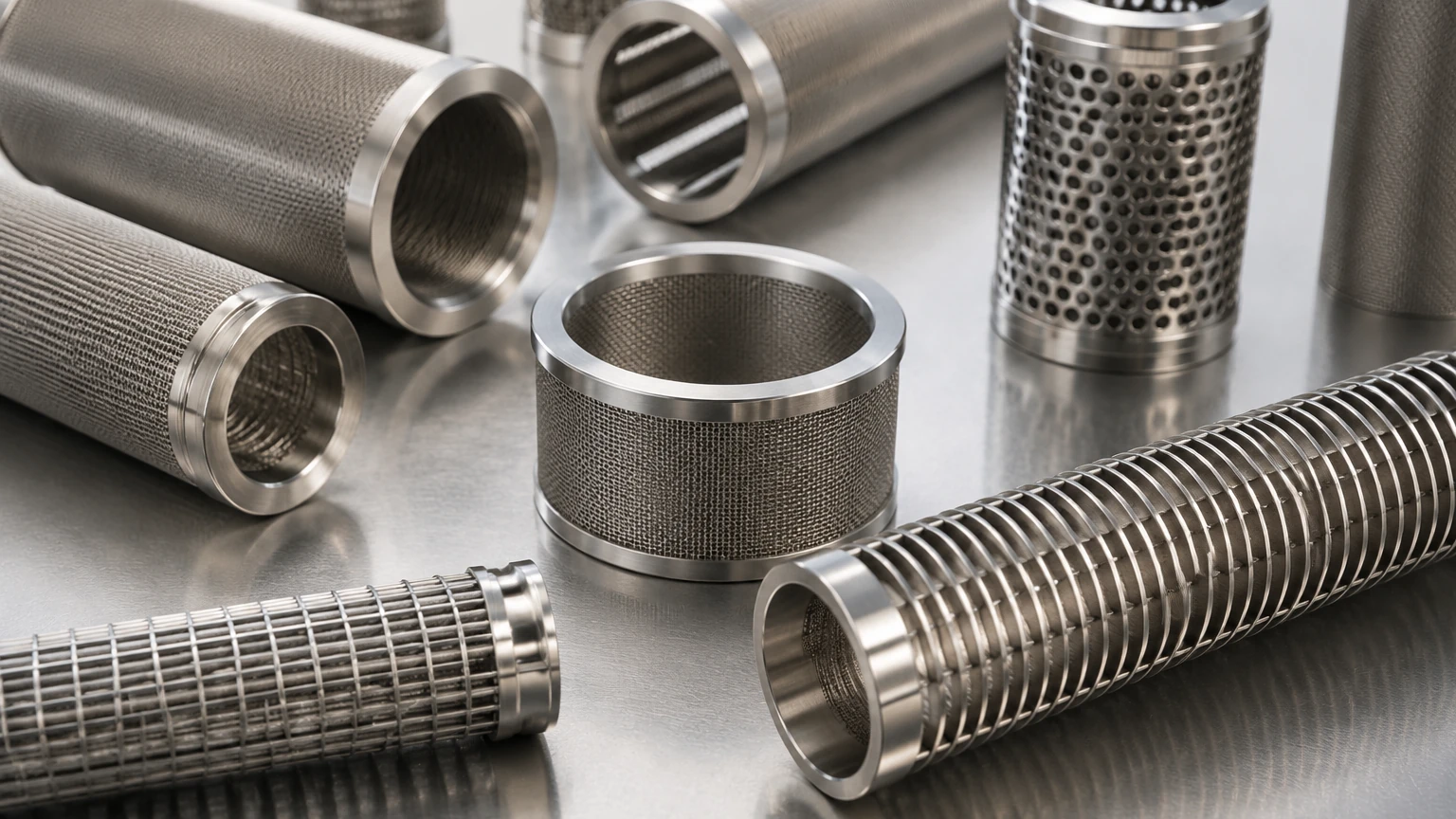
When designing sand control equipment, the choice of filtration media is paramount. The two most common types used in precision industrial filtration are woven wire mesh and sintered metal components.
Woven Wire Mesh Filters
Wire mesh filters are constructed by weaving individual metal wires into specific patterns, such as plain weave, twill weave, or Dutch weave.
* Advantages: High porosity allows for excellent flow rates and low initial pressure drop. They are relatively easy to clean through backwashing.
* Applications: Ideal for applications where the particle size distribution is relatively uniform and the mechanical stress is moderate.
Sintered Metal Filters
Sintered media are created by bonding multiple layers of wire mesh or metal fibers through a high-temperature heat treatment process. This creates a rigid, porous structure with high mechanical strength.
* Advantages: Superior resistance to high pressure and temperature. The fixed pore structure ensures consistent filtration accuracy even under high differential pressure.
* Applications: Used in demanding sand control scenarios where the equipment must endure harsh cleaning cycles or high-velocity fluid impacts.
Choosing between these media requires an analysis of the fluid viscosity, the expected sand concentration, and the desired filtration rating (measured in microns).
Performance Evaluation and Selection Criteria
Selecting the right sand control equipment is a technical process that involves several key evaluation criteria. Engineers must look beyond the initial purchase price and consider the total cost of ownership and operational compatibility.
Filtration Accuracy (Micron Rating)
The micron rating must be matched to the grain size distribution (GSD) of the sand being controlled. If the pore size is too large, sand will pass through; if it is too small, the filter will plug prematurely. A common rule of thumb is the "D50" or "D10" sizing method, where the filter opening is sized based on the median diameter of the sand particles.
Permeability and Flow Capacity
Sand control equipment should offer the highest possible permeability to minimize the impact on production rates. A high-quality filter design maximizes the open area while maintaining the necessary structural strength. Engineers must calculate the expected pressure drop (∆P) across the filter at maximum flow rates to ensure it remains within the system's operational limits.
Plugging Resistance
In many industrial processes, the sand is accompanied by fines, scales, or organic matter. The design of the sand control equipment must resist "blinding" or plugging. Wedge wire screens, for example, are often used because their V-shaped profile provides only two points of contact for particles, making them inherently more resistant to plugging than square mesh.
Operational Challenges and Maintenance Strategies
Even the most advanced sand control equipment requires a clear maintenance and monitoring strategy to ensure long-term reliability. Understanding the lifecycle of the filter helps in planning for replacements and avoiding unscheduled downtime.
Monitoring Differential Pressure
The primary indicator of filter health is the differential pressure. An escalating ∆P suggests that the filter is accumulating solids. Modern industrial systems often incorporate sensors to provide real-time data to control rooms, allowing for proactive maintenance before the filter reaches its maximum allowable pressure drop.
Cleaning Protocols
Many stainless steel sand control filters are designed to be reusable. Cleaning methods include:
* Backwashing: Reversing the flow of fluid to dislodge particles from the surface of the media.
* Ultrasonic Cleaning: Using high-frequency sound waves in a solvent bath to remove fine particulates from within the depth of the media.
* Chemical Cleaning: Utilizing acids or surfactants to dissolve organic or mineral scales that have bonded to the metal surface.
Replacement Cycles
While stainless steel filters are durable, they are eventually subject to fatigue and erosion. Establishing a replacement cycle based on historical performance data and regular inspections is essential for preventing catastrophic failure in the field.
Custom Engineering and OEM Capabilities
No two industrial applications are identical, and off-the-shelf sand control equipment may not always provide the optimal solution. Customization is a core component of effective filtration engineering.
Kaifil specializes in providing OEM and customized filtration solutions tailored to specific project requirements. This includes:
* Custom Dimensions: Tailoring the length, diameter, and connection types (such as NPT, BSP, or flange) to fit existing infrastructure.
* Layer Configuration: Designing multi-layer sintered structures to provide both fine filtration and high mechanical support in a single component.
* Specialty Coatings: Applying surface treatments to enhance corrosion resistance or reduce the adhesion of sticky particulates.
By working closely with an experienced manufacturer, engineering teams can develop sand control equipment that is specifically optimized for their fluid chemistry, pressure profiles, and particle characteristics.
Conclusion: Investing in Reliable Filtration
Sand control equipment is a vital investment for any industrial operation dealing with particulate-laden fluids. The choice of equipment impacts not only the purity of the final product but also the longevity of the entire processing system. By prioritizing high-grade materials like stainless steel, selecting the appropriate filtration media, and focusing on custom-engineered designs, organizations can achieve a balance of performance and cost-effectiveness.
For engineers and purchasing managers seeking reliable, high-performance filtration components, Kaifil offers the technical expertise and manufacturing precision required for demanding industrial environments. Explore our capabilities and product range by visiting our Main Page to find the right solution for your sand control and filtration challenges.
