


Sandscreen
In industrial filtration and well completion, the sandscreen serves as a critical mechanical barrier designed to prevent the migration of formation sand and particulate matter into the production stream. Whether applied in oil and gas extraction, water well management, or specialized chemical processing, the primary function of a sandscreen is to maintain the structural integrity of the wellbore or filtration system while maximizing the flow of desired fluids. Selecting the appropriate sandscreen requires a deep understanding of particle size distribution, fluid dynamics, and material science to ensure long-term operational efficiency and prevent premature equipment failure.
For engineers and procurement professionals, the choice of a sandscreen is rarely a one-size-fits-all decision. It involves balancing filtration precision with mechanical strength and corrosion resistance. As a specialized manufacturer of stainless steel filtration components, Kaifil provides the technical expertise and manufacturing precision necessary to develop high-performance solutions for these demanding environments. Detailed specifications and custom engineering support can be explored through our Main Page.
Understanding the Fundamentals of Sandscreen Technology
A sandscreen is essentially a sophisticated filter jacket or liner. Its design must allow for the passage of fluids—such as oil, gas, or water—while retaining solids that could otherwise erode downstream equipment, clog valves, or lead to the collapse of the production zone. The effectiveness of a sandscreen is measured by its ability to provide a stable filter cake, its resistance to plugging, and its durability under high-pressure differentials.
The geometry of the filtration media is a key engineering consideration. Most industrial sandscreens utilize either a continuous slot design (wire-wrapped) or a multi-layered metal mesh. The goal is to create a "bridge" of sand particles across the screen openings. If the openings are too large, the sand flows through, causing erosion; if they are too small, the screen may plug rapidly, significantly reducing production rates. Therefore, the design must be tailored to the specific geological or process conditions of the application.
Primary Types of Sandscreen Configurations
There are several distinct types of sandscreens used in industrial applications, each offering different advantages in terms of flow area, filtration accuracy, and mechanical robustness.
Wire-Wrapped Screens
Wire-wrapped screens are among the most common configurations. They consist of a V-shaped profile wire wrapped helically around a series of longitudinal support rods. This design creates a continuous slot that widens inwardly. The V-shape is intentional; it ensures that any particle small enough to pass through the outer opening will continue through the screen without getting stuck, thereby reducing the risk of internal plugging. These screens offer a high open area, which translates to lower fluid velocity at the screen face and reduced erosion.
Metal Mesh Screens (Premium Screens)
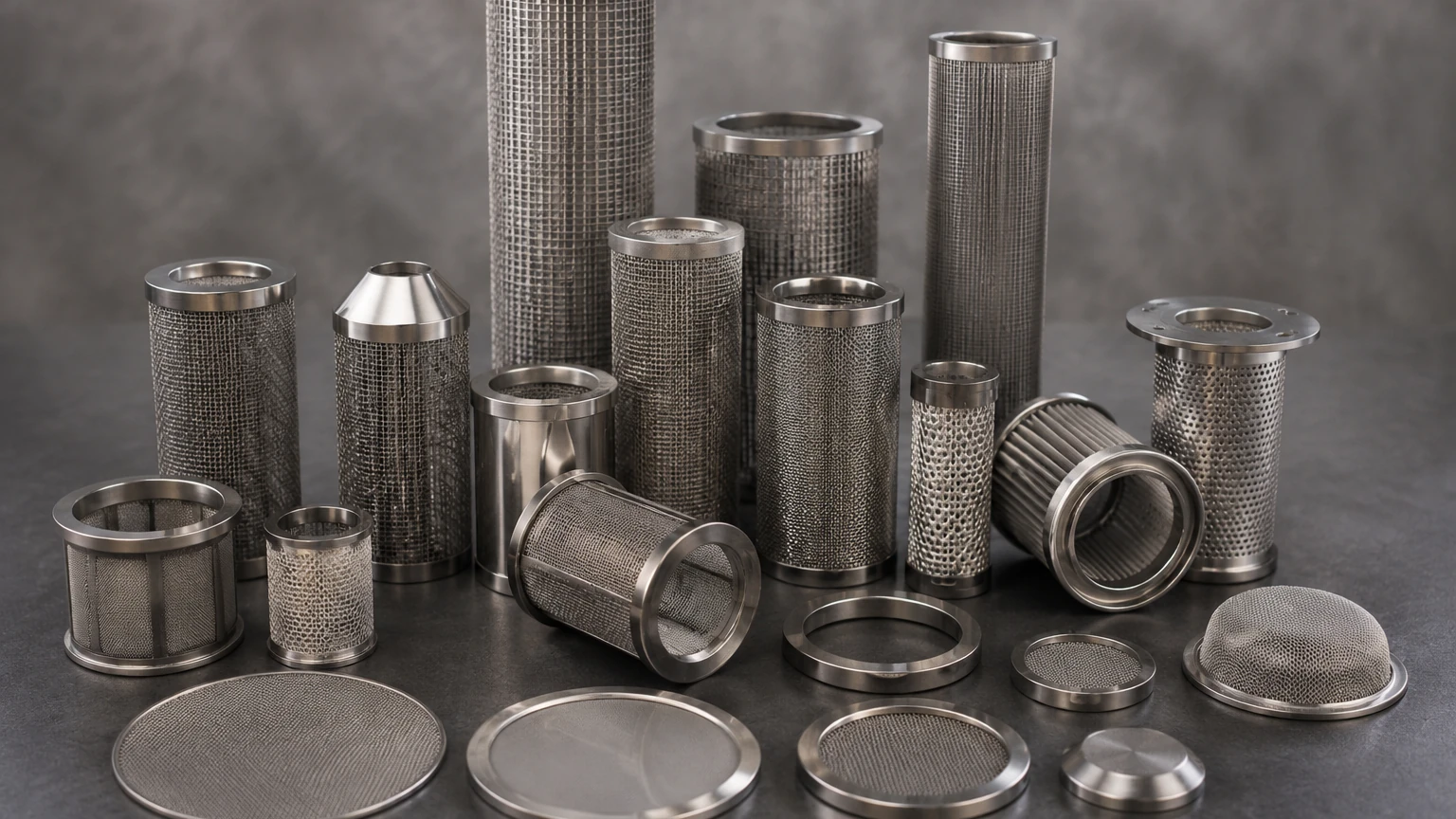
Premium mesh screens utilize multiple layers of stainless steel wire mesh, often sintered together to provide a rigid and precise filtration media. These are frequently used in environments where the particle size distribution is fine or unpredictable. The multi-layer construction allows for depth filtration, where particles are trapped within the matrix of the mesh rather than just on the surface. This configuration provides excellent mechanical strength and can be customized to specific micron ratings, making it a preferred choice for high-pressure industrial filtration.
Pre-Packed Screens
In applications where a traditional gravel pack is difficult to implement, pre-packed screens are used. These consist of an inner and outer screen with a layer of resin-coated or consolidated gravel sandwiched between them. This provides an integrated filtration bed that acts as a secondary barrier against fine sand migration. While effective, they are typically thicker and may have a lower flow capacity compared to single-layer mesh or wire-wrapped designs.
Slotted Liners
Slotted liners are the most basic form of sand control. They are created by cutting longitudinal slots into a standard pipe or casing. While cost-effective and mechanically strong, they offer a very low open area (often less than 3%) and are prone to erosion and plugging. They are generally reserved for applications where sand control requirements are minimal or where the budget is the primary constraint.
Material Selection and Corrosion Resistance
The environment in which a sandscreen operates is often chemically aggressive. In deep-well applications, the presence of hydrogen sulfide (H2S), carbon dioxide (CO2), and high-salinity brines can lead to rapid corrosion of standard carbon steel. Consequently, stainless steel is the industry standard for high-quality sandscreens.
* 304/304L Stainless Steel: Suitable for general industrial use and less aggressive water well applications where cost is a factor and chloride levels are relatively low.
* 316L Stainless Steel: The most common choice for industrial filtration due to the addition of molybdenum, which enhances resistance to pitting and crevice corrosion in chloride-rich environments.
* Duplex and Super Duplex Stainless Steel: Used in highly corrosive environments where high mechanical strength is also required. These alloys provide superior resistance to stress corrosion cracking and are essential for high-pressure, high-temperature (HPHT) applications.
At Kaifil, we focus on high-grade stainless steel alloys to ensure that our filtration components maintain their integrity throughout the intended service life of the project. Selecting the right alloy is a balance between the total cost of ownership and the expected chemical exposure of the system.
Engineering Filtration Accuracy: Pore Size and Particle Control
The most critical technical specification for a sandscreen is its filtration rating, often expressed in microns or slot width. To determine the correct rating, engineers perform a Sieve Analysis or Particle Size Distribution (PSD) test on samples from the formation or process stream.
A common rule of thumb in sand control is the "D10" or "D50" rule, which relates the screen opening size to the diameter of the particles. For instance, the screen slot might be sized to be 2 to 2.5 times the diameter of the 50th percentile particle size (D50). If the goal is absolute filtration, the pore size must be smaller than the smallest anticipated particle. However, in most industrial sand control scenarios, the objective is to allow a controlled amount of fines to pass while the larger particles form a stable, permeable bridge over the screen openings.
Precision in manufacturing is vital here. If the slot widths or mesh openings are inconsistent, the screen will experience localized high-velocity zones, leading to "hot spot" erosion and eventual failure of the entire filtration assembly.
Mechanical Strength and Structural Integrity
Sandscreens are subjected to significant mechanical loads during installation and operation. In downhole environments, they must withstand the weight of the string, the torque of installation, and the collapse pressure exerted by the surrounding formation.
1. Collapse Resistance: This is the ability of the screen to resist being crushed by external pressure. In many designs, the filtration jacket is supported by an internal perforated base pipe, which provides the necessary structural rigidity.
2. Burst Pressure: The internal pressure the screen can withstand before failing. This is critical during well stimulation or cleaning operations where high-pressure fluids are pumped through the screen.
3. Tensile Strength: The ability to withstand the longitudinal pull during installation, especially in horizontal or highly deviated wells.
By integrating precision-engineered wire mesh or wire-wrapped jackets with robust support structures, manufacturers can ensure that the sandscreen performs its filtration function without compromising the mechanical stability of the well or process line.
Operational Challenges: Erosion, Plugging, and Scaling
Even a well-designed sandscreen faces operational risks over its lifecycle. Understanding these risks is essential for developing a maintenance and replacement strategy.
* Erosion: High fluid velocities, especially when carrying abrasive solids, can wear down the edges of the screen openings. Once the openings are enlarged, the screen loses its ability to control sand, leading to a rapid failure of the system.
* Plugging (Skin Effect): If the screen is sized too conservatively, or if the fluid contains high levels of fines or polymers, a low-permeability layer can form on the screen surface. This increases the pressure drop across the screen and reduces the flow rate.
* Scaling: Chemical precipitates, such as calcium carbonate or barium sulfate, can deposit on the screen surface and within the pore spaces. This is common in water-producing wells and requires chemical treatment or mechanical cleaning to restore flow.
To mitigate these risks, engineers often specify screens with a larger total flow area (TFA) than theoretically required, providing a safety margin for partial plugging or localized erosion.
Customization and OEM Manufacturing for Industrial Filtration
Every industrial environment presents unique challenges, from the specific chemistry of the fluid to the physical constraints of the equipment. Off-the-shelf solutions often fail to meet the rigorous demands of specialized chemical processing or high-pressure hydraulic systems. This is where custom manufacturing becomes essential.
Kaifil specializes in the production of custom stainless steel filtration solutions, including high-precision wire mesh components that serve as the core of advanced sandscreen designs. Our manufacturing process emphasizes quality control at every stage, from material verification to the final inspection of filtration accuracy. By working closely with engineering teams, we develop components that are optimized for specific micron ratings, flow requirements, and mechanical constraints.
When evaluating a provider for filtration components, it is important to confirm their ability to handle specialized alloys, their experience with precision welding or sintering, and their capacity for providing technical documentation. These factors directly impact the reliability of the final sandscreen assembly.
Conclusion: Selecting the Right Solution
The selection of a sandscreen is a technical decision that impacts the longevity and productivity of an entire industrial operation. By focusing on the specific particle size distribution, the chemical nature of the environment, and the mechanical loads of the application, engineers can specify a solution that provides reliable sand control without sacrificing flow performance.
As a dedicated manufacturer of stainless steel filter cartridges and wire mesh components, Kaifil is committed to supporting global industries with durable and precise filtration technology. For more information on our manufacturing capabilities, material options, and technical support for custom filtration projects, please visit our Main Page. Our team is ready to assist in the development of high-performance filtration components tailored to your specific industrial requirements.
