


Sanitary Filters and Strainers for Pharmaceutical Applications
In the pharmaceutical manufacturing sector, the integrity of the filtration process is directly linked to product safety, efficacy, and regulatory compliance. Whether producing Active Pharmaceutical Ingredients (APIs), parenteral drugs, or oral solid dosages, the removal of particulate matter and microbial contaminants is a critical process step. The implementation of sanitary filters and strainers for pharmaceutical applications requires a deep understanding of material science, fluid dynamics, and hygienic design principles to ensure that the equipment does not become a source of contamination itself.
Industrial filtration solutions must transition from standard industrial grades to sanitary grades when used in pharmaceutical environments. This transition involves specialized manufacturing techniques, such as high-precision welding and electropolishing, to meet the stringent requirements of the industry. For engineers and procurement teams, selecting the right filtration component involves balancing filtration efficiency with the need for rapid cleaning and sterilization. Detailed technical specifications and product ranges can be found on the Main Page of the manufacturer’s site, which serves as a primary resource for custom filtration engineering.
Fundamental Requirements for Sanitary Filtration Systems
Sanitary filtration systems are distinguished from standard industrial filters by their design, which prioritizes the elimination of areas where bacteria can grow. In pharmaceutical applications, the primary concern is the prevention of microbial proliferation and cross-contamination. This is achieved through several key design features.
First, the concept of "dead legs" must be addressed. A dead leg is an area in a piping system or filter housing where fluid can stagnate, leading to the buildup of biofilms. Sanitary filters are engineered to be self-draining and free of stagnant zones. This ensures that during cleaning cycles, the cleaning agents can reach every surface, and during production, the product flows continuously through the entire volume of the filter housing.
Second, the internal geometry of the filter must facilitate easy cleaning. This includes the use of large-radius curves instead of sharp corners and the elimination of exposed threads within the fluid path. Every internal component, from the filter element support to the housing gaskets, must be designed for accessibility during Clean-In-Place (CIP) and Steam-In-Place (SIP) procedures.
Distinguishing Between Sanitary Strainers and Filters
While the terms are often used interchangeably, there is a technical distinction between strainers and filters based on their placement in the process and the size of the particles they are designed to remove. Understanding this distinction is vital for optimizing the lifespan of filtration media.
Sanitary Strainers
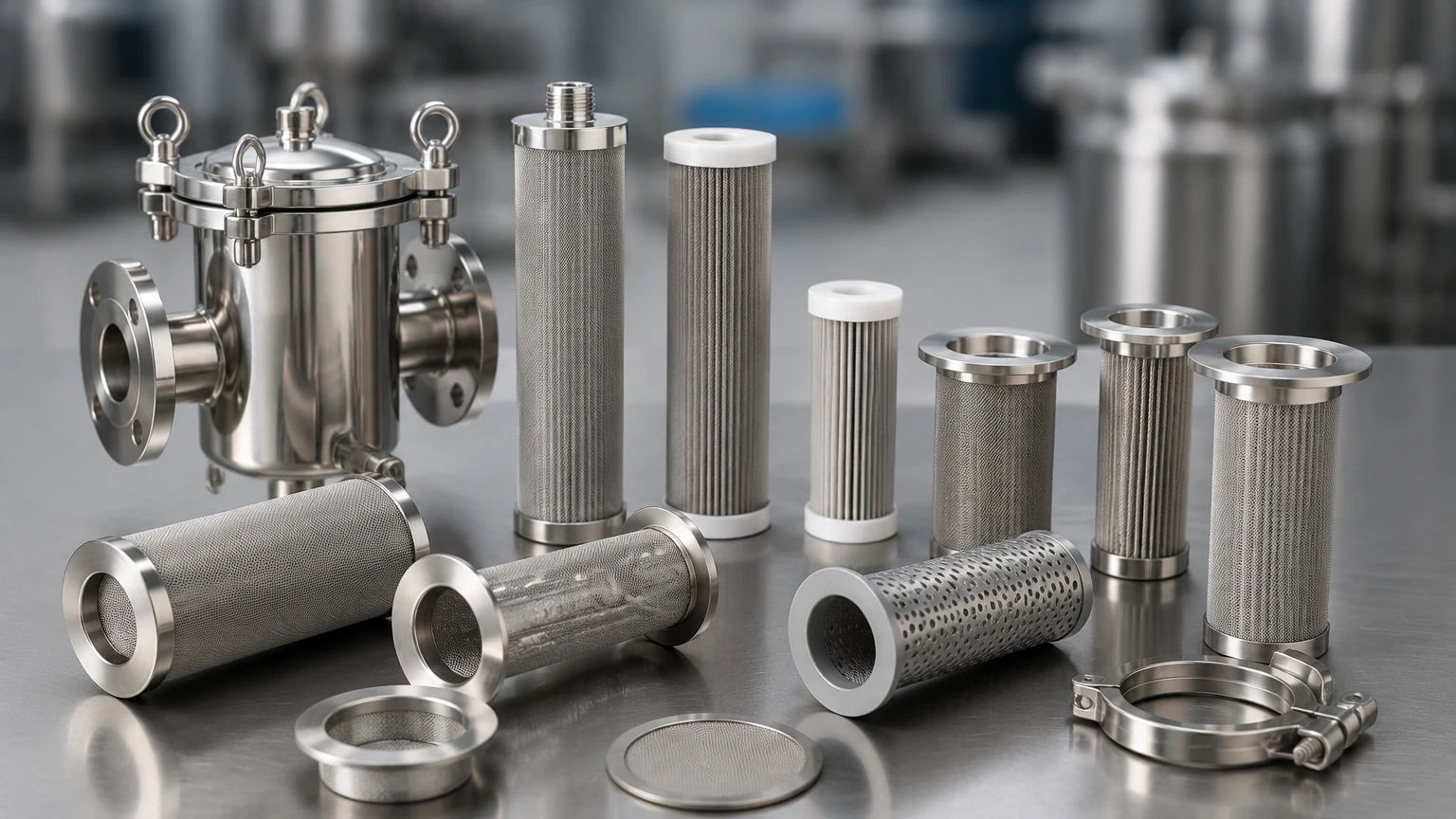
Sanitary strainers are typically used for "coarse" filtration, generally removing particles larger than 40 to 50 microns. In pharmaceutical lines, they serve as pre-filtration devices to protect downstream equipment such as pumps, heat exchangers, and fine filters from damage caused by large debris, undissolved powders, or scale. Common configurations include Y-strainers and basket strainers. Because they handle larger particulate loads, they must be easy to disassemble and clean manually or be compatible with automated backwashing systems.
Sanitary Filters
Sanitary filters are designed for fine filtration, often reaching sub-micron levels. These are used for clarifying liquids, removing fine precipitates, or achieving sterility. In pharmaceutical applications, these often utilize stainless steel filter cartridges or sintered metal elements. The focus here is on precise retention ratings and the ability of the filter medium to withstand high differential pressures without shedding fibers or bypassing particles. When evaluating sanitary filters and strainers for pharmaceutical applications, engineers must determine if the process requires the high-holding capacity of a strainer or the precision of a filter.
Material Science and Surface Finish Specifications
The choice of material is non-negotiable in pharmaceutical filtration. Stainless steel, specifically Grade 316L, is the industry standard due to its superior corrosion resistance and ability to withstand repeated sterilization cycles. 316L contains lower carbon content than standard 316, which minimizes carbide precipitation during welding, thereby maintaining the integrity of the material’s corrosion resistance at the joints.
Surface finish is measured by Roughness Average (Ra). For pharmaceutical sanitary applications, internal surfaces typically require an Ra of 0.8 μm (32 micro-inches) or better. To achieve this, mechanical polishing is often followed by electropolishing. Electropolishing is an electrochemical process that removes the "peaks" of the metal surface at a microscopic level, resulting in a mirror-like finish. This smooth surface is essential because it reduces the mechanical bond between the product and the metal, making it significantly easier to remove residues during the cleaning cycle.
Furthermore, all non-metallic components, such as O-rings and gaskets, must be made from FDA-compliant and USP Class VI materials. Common materials include EPDM, PTFE (Teflon), and Silicone. These materials must be chemically compatible with both the pharmaceutical product and the aggressive chemicals used in CIP cycles, such as sodium hydroxide or phosphoric acid.
Operational Parameters: Flow, Pressure, and Micron Ratings
Selecting a filtration solution requires a detailed analysis of the operational parameters to ensure the system performs reliably under production conditions. Engineers must consider the following factors:
1. Micron Rating (Absolute vs. Nominal): In pharmaceutical processes, absolute micron ratings are preferred. An absolute rating indicates that the filter will retain 99.9% or more of particles at the specified size. Nominal ratings are less precise and may allow a percentage of particles to pass through. For sterile filtration, a rating of 0.22 microns is standard for removing bacteria.
2. Differential Pressure (Delta P): This is the difference in pressure between the upstream and downstream sides of the filter. As the filter collects particulates, the Delta P increases. It is essential to monitor this to prevent filter collapse or bypass. Systems should be designed with a low initial Delta P to maximize the dirt-holding capacity and extend the time between filter changes.
3. Flow Rate and Velocity: High flow rates can cause turbulence and increased pressure drop. In sanitary systems, fluid velocity is often managed to prevent shearing of sensitive biological products. The filter housing and the element must be sized appropriately to handle the peak flow requirements of the process line without exceeding the manufacturer's recommended flux rates.
Cleaning Protocols: CIP and SIP Integration
The ability to clean and sterilize equipment without disassembly is a cornerstone of modern pharmaceutical manufacturing. Sanitary filters and strainers must be fully compatible with these protocols.
Clean-In-Place (CIP): This involves circulating cleaning solutions through the filter at high velocities. The design of the filter must ensure that the cleaning fluid reaches all internal surfaces. The use of spray balls within larger filter housings can help ensure complete coverage. The materials must be resistant to the high temperatures (often up to 80°C) and varying pH levels of the cleaning agents.
Steam-In-Place (SIP): This is the process of sterilizing the equipment using saturated steam, typically at 121°C or 134°C. The filter housing and the filter elements must be able to withstand the thermal expansion and pressure associated with steam sterilization. For stainless steel wire mesh or sintered filters, this is generally not an issue, but it requires careful selection of gasket materials to ensure they do not lose their seal or degrade under repeated thermal stress.
Custom Engineering for Pharmaceutical OEM Applications
Standard off-the-shelf filtration products often fail to meet the specific spatial or functional requirements of a pharmaceutical production suite. This is where custom manufacturing becomes essential. OEM (Original Equipment Manufacturer) solutions allow for the integration of filtration components directly into specialized machinery, such as tablet presses, filling machines, or bioreactors.
Customization options include:
* Bespoke Housing Dimensions: Fitting a high-capacity filter into a constrained footprint.
* Specialized Connection Types: Utilizing Tri-Clamp, DIN, or SMS sanitary fittings to match existing piping standards.
* Multi-Stage Filtration: Combining a coarse strainer and a fine filter into a single integrated housing to save space and reduce the number of connection points.
* Material Upgrades: Utilizing exotic alloys like Hastelloy for applications involving highly corrosive media that would degrade 316L stainless steel.
By working with a manufacturer that understands these technical nuances, pharmaceutical companies can ensure that their filtration systems are optimized for their specific fluid characteristics and throughput requirements. For more information on customization capabilities, visiting the Main Page provides insight into the engineering support available for complex projects.
Risk Mitigation and Quality Assurance
The risks of improper filtration in a pharmaceutical context include batch loss, regulatory fines, and, most importantly, patient harm. To mitigate these risks, every sanitary filter and strainer should be accompanied by a comprehensive documentation package. This usually includes:
* Material Traceability Reports (MTRs): Confirming the chemical composition of the stainless steel.
* Certificates of Conformance: Stating that the product meets the ordered specifications.
* Surface Finish Certification: Documentation of the Ra values achieved through polishing.
* Pressure Test Reports: Ensuring the structural integrity of the housing and elements.
Regular inspection of filter elements is also required. Over time, even stainless steel mesh can suffer from mechanical fatigue or blinding (permanent clogging). Establishing a clear replacement cycle based on differential pressure trends or batch counts is a best practice for maintaining consistent product quality.
In conclusion, the selection and implementation of sanitary filters and strainers for pharmaceutical applications is a technical process that demands attention to detail. From the initial material selection to the integration of CIP/SIP protocols, every decision impacts the safety and efficiency of the pharmaceutical production line. By adhering to sanitary design standards and utilizing high-quality stainless steel components, manufacturers can achieve the high levels of purity required by global health authorities.
Download Sanitary Filters and Strainers for Pharmaceutical Applications as a PDF
