


Self-cleaning Filter
In modern industrial processing, maintaining continuous flow and consistent product quality is a primary engineering challenge. Manual filtration systems, while effective for low-solids applications, often become a bottleneck in high-capacity or high-viscosity environments due to the downtime required for cleaning and element replacement. A self-cleaning filter addresses these inefficiencies by providing an automated solution that removes contaminants from a fluid stream without interrupting the process flow.
As a specialized manufacturer of stainless steel filtration components, Kaifil provides the precision-engineered elements that serve as the heart of these automated systems. Understanding the mechanical principles, material requirements, and selection criteria for a self-cleaning filter is essential for engineers and procurement teams looking to optimize their filtration infrastructure.
The Mechanics of Automated Filtration
A self-cleaning filter operates on the principle of detecting a rise in differential pressure or following a pre-set time interval to trigger a cleaning cycle. When the internal filter element becomes loaded with debris, the resistance to flow increases, creating a pressure drop between the inlet and outlet. Once a specific threshold is reached, the system initiates a cleaning mechanism while the main flow continues.
There are two primary mechanical designs used in industrial self-cleaning systems:
1. Mechanical Scraper Filters
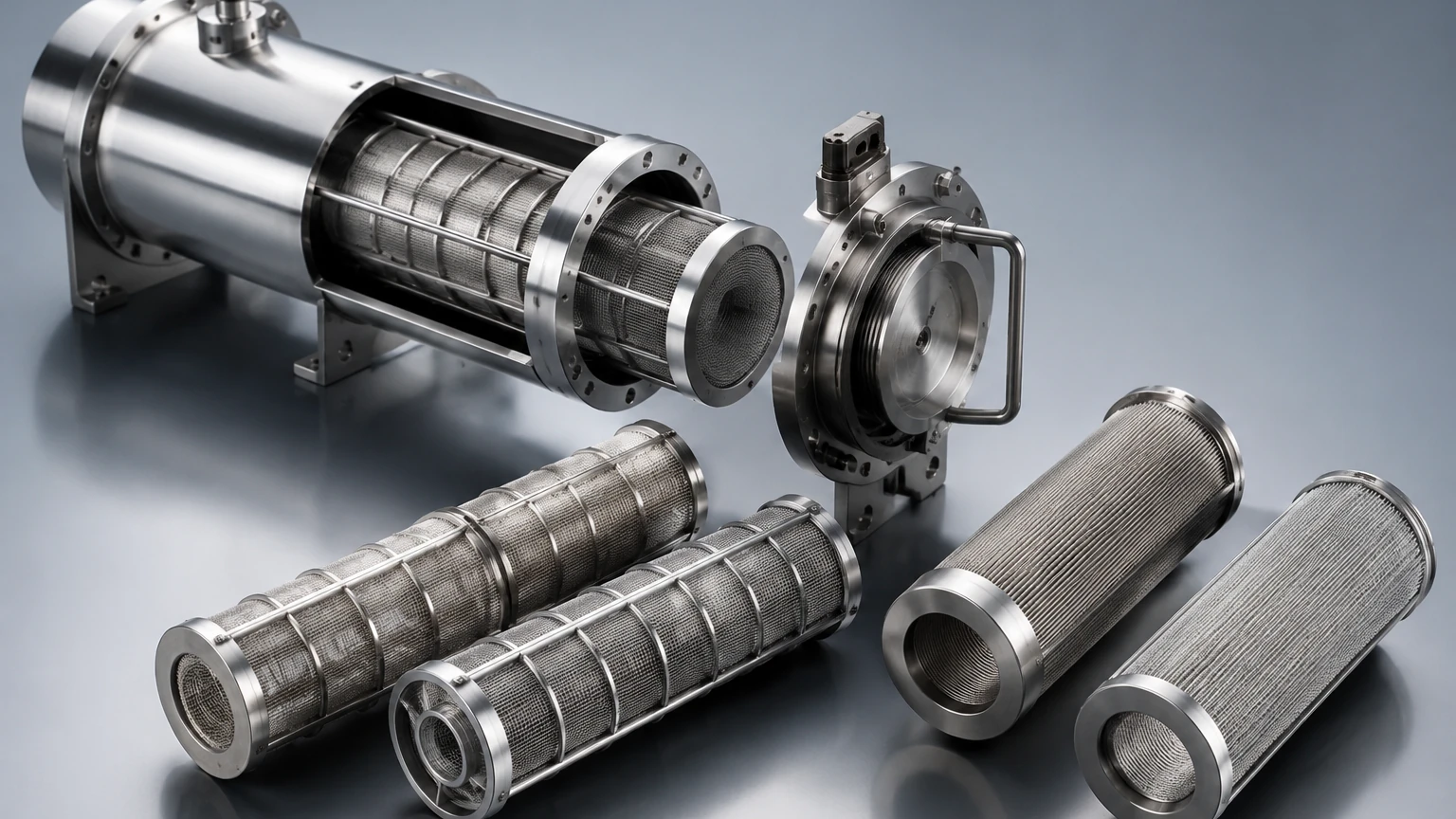
In these systems, a scraper blade or brush moves across the surface of the filter element—typically a wedge wire screen or a perforated metal tube. The scraper physically dislodges the accumulated solids, which then settle into a collection chamber at the bottom of the housing. This method is particularly effective for highly viscous fluids, such as oils, resins, and food products, where particles tend to adhere strongly to the filter surface.
2. Backwash Filters
Backwash systems utilize a portion of the filtered fluid (or an external clean fluid source) to reverse the flow through a section of the filter element. This reversal of flow flushes the trapped particles off the surface and out through a dedicated discharge valve. These are commonly used in water treatment, cooling towers, and low-viscosity chemical processing where the particles are easily suspended and removed by hydraulic force.
Engineering the Filter Element: Materials and Structures
The performance of any self-cleaning filter is fundamentally limited by the quality and design of its internal filter element. Because these elements are subjected to constant mechanical stress—either from scrapers or high-pressure backwash cycles—they must be engineered for exceptional durability.
Stainless Steel Wedge Wire
Wedge wire is the preferred medium for many self-cleaning applications. It consists of V-shaped profiles resistance-welded onto support rods. The V-shape creates a "slot" that widens inwardly, which significantly reduces the risk of particles becoming permanently wedged in the opening (blinding). For a self-cleaning filter, the smooth surface of the wedge wire allows scraper blades to pass over it with minimal friction and wear.
Sintered Metal Mesh
For applications requiring finer filtration (down to 1-5 microns), multi-layer sintered metal mesh is often utilized. Sintering bonds multiple layers of stainless steel wire mesh together through heat and pressure, creating a robust, porous structure that can withstand the high differential pressures encountered during backwash cycles without deforming. Kaifil specializes in customizing these sintered structures to balance permeability with structural integrity.
Material Selection (SS304 vs. SS316L)
Material compatibility is a critical engineering boundary. While SS304 is suitable for general industrial water and non-corrosive fluids, SS316L is the standard for pharmaceutical, food and beverage, and chemical processing due to its superior resistance to pitting and crevice corrosion, particularly in the presence of chlorides.
Key Selection Criteria for Industrial Engineers
When specifying a self-cleaning filter for a new or existing line, several technical parameters must be confirmed to ensure the system meets performance expectations.
1. Micron Rating and Efficiency: Engineers must distinguish between nominal and absolute filtration. In self-cleaning systems, the "cleanability" of the medium is as important as its rating. A medium that is too fine for the particle distribution may lead to excessive cleaning cycles and premature wear.
2. Flow Rate and Pressure Drop: The filter must be sized to handle the maximum system flow rate with an acceptable initial pressure drop (usually less than 2-3 psi). Over-sizing the filter can reduce the frequency of cleaning cycles, extending the life of the internal components.
3. Viscosity and Temperature: High-viscosity fluids require more robust scraper mechanisms and potentially larger motor drives. Temperature affects both the fluid viscosity and the thermal expansion of the filter internals, which must be accounted for in the tolerances between the scraper and the element.
4. Solid Loading and Particle Type: The nature of the contaminants (fibrous, granular, or gelatinous) dictates whether a scraper or backwash mechanism is more appropriate. Fibrous materials, for example, often require mechanical scraping to prevent them from intertwining with the mesh.
Customization and OEM Integration
Industrial filtration is rarely a one-size-fits-all discipline. Many systems require custom-designed filter elements to fit proprietary housing dimensions or to meet specific hydraulic requirements. Kaifil works closely with global customers to develop tailored filtration components that integrate seamlessly into complex self-cleaning assemblies.
Customization options often include:
* Variable Slot Sizes: For wedge wire elements, slot widths can be customized to precise increments to match the specific particle size distribution of the process fluid.
* Reinforced Support Structures: In high-pressure hydraulic systems, the filter element may require additional internal or external reinforcement to prevent collapse during a pressure spike.
* Surface Treatments: Electropolishing or specialized coatings can be applied to stainless steel elements to improve release characteristics for sticky contaminants, thereby increasing the efficiency of each cleaning cycle.
Total Cost of Ownership (TCO) Considerations
While the initial capital expenditure (CAPEX) for a self-cleaning filter is higher than that of a simple bag or cartridge filter housing, the total cost of ownership is significantly lower in the long term. Engineers should evaluate the following factors when justifying the investment:
* Labor Savings: Automated cleaning eliminates the need for manual intervention, freeing up maintenance personnel for higher-value tasks.
* Reduced Consumable Costs: Unlike disposable bags or pleated cartridges, a high-quality stainless steel filter element can last for years if properly maintained.
* Minimized Product Loss: Backwash and scraper systems are designed to minimize the volume of fluid lost during the purge cycle, which is critical when processing expensive chemicals or food products.
* Increased Uptime: Continuous filtration means no process shutdowns for filter changes, leading to higher overall equipment effectiveness (OEE).
Maintenance and Replacement Cycles
Even in a "self-cleaning" system, the internal components are not permanent. The scraper blades will eventually wear, and the filter element may suffer from fatigue or chemical erosion over time.
Regular inspection intervals should be established to check the integrity of the filter medium. For scraper systems, the gap between the blade and the element must be monitored; if the gap becomes too wide, cleaning efficiency drops, leading to more frequent cycles and higher pressure drops. In backwash systems, the discharge valves should be inspected for leaks, as a faulty valve can lead to continuous fluid loss and reduced system pressure.
When the time comes for replacement, sourcing high-quality, precision-manufactured elements is vital. Using sub-standard replacement parts can lead to bypass (where unfiltered fluid leaks past the element) or mechanical failure that damages the entire filter housing.
Conclusion
The implementation of a self-cleaning filter is a strategic decision that enhances process reliability and operational efficiency. By selecting the correct mechanical design and ensuring the internal filter elements are engineered to the highest standards of precision and durability, industrial facilities can achieve consistent filtration performance in even the most demanding environments.
For technical professionals seeking to optimize their filtration systems, reviewing the available hardware and engineering options is the first step toward a more automated and cost-effective process. You can explore a wide range of specialized filtration components and custom OEM solutions by visiting the Main Page of our primary technical resource, where we detail our manufacturing capabilities and material specifications for industrial applications.
