


Sintered Bronze Filter
In the landscape of industrial filtration, the sintered bronze filter stands as a cornerstone for applications requiring high mechanical strength, thermal stability, and precise permeability. Unlike traditional mesh or fabric filters, these components are manufactured through a powder metallurgy process that creates a rigid, self-supporting structure. For engineers and procurement specialists, understanding the nuances of sintered bronze—from its manufacturing constraints to its operational limits—is essential for optimizing system performance and longevity.
Industrial filtration often demands materials that can withstand high differential pressures while maintaining a consistent pore size. Sintered bronze meets these requirements by utilizing spherical powder particles fused together to form a tortuous path for fluids and gases. This article provides a technical overview of the engineering principles, selection criteria, and maintenance protocols associated with sintered bronze filtration media.
Understanding the Sintering Process for Bronze Filters
The performance of a sintered bronze filter is fundamentally tied to its manufacturing process. Sintering is a thermal treatment that bonds metallic particles together at temperatures below their melting point. For bronze filters, the raw material is typically spherical bronze powder, often a 90/10 copper-tin alloy (CuSn10).
Powder Selection and Packing
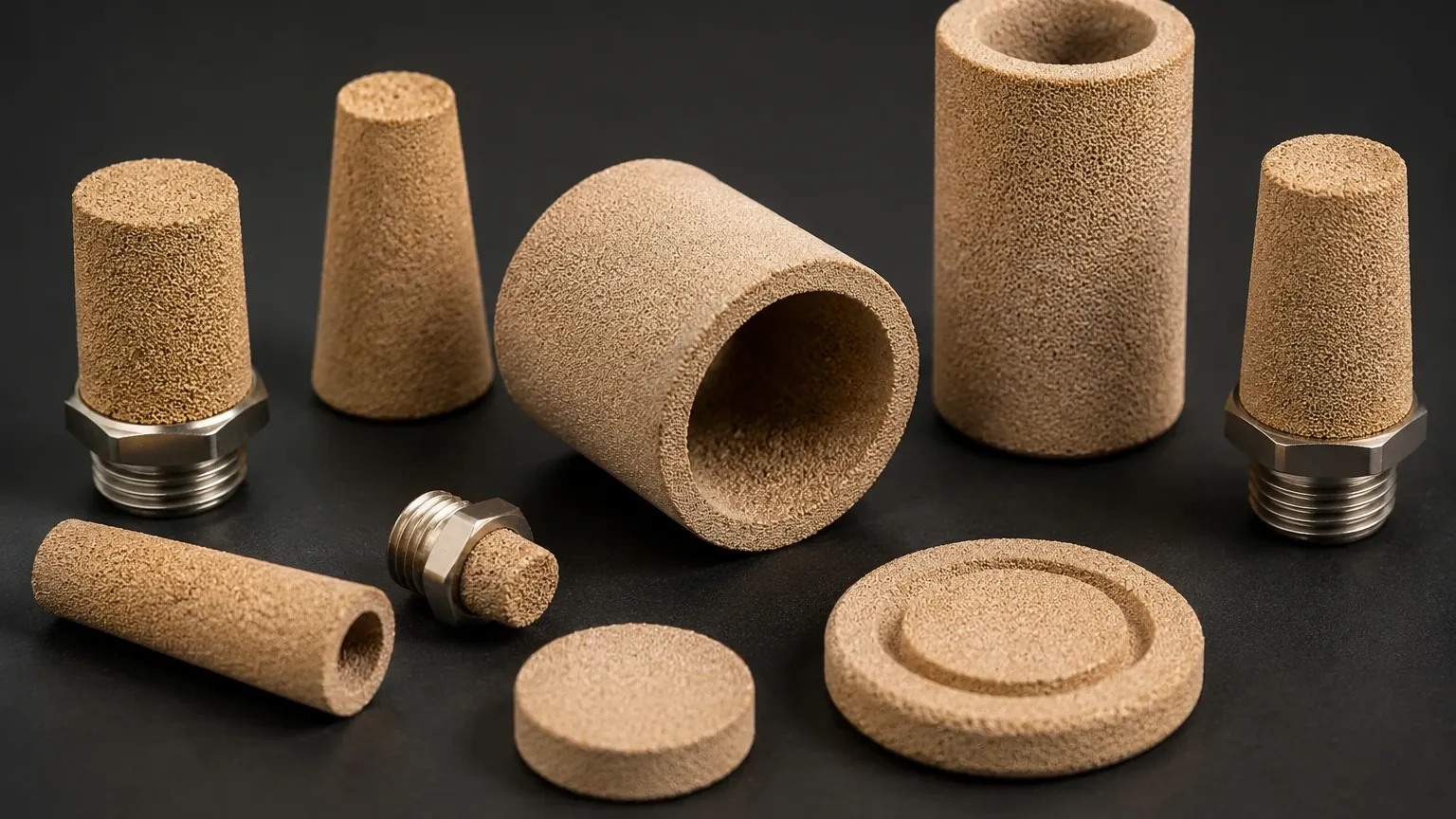
The process begins with the selection of high-purity bronze powder. The shape and size distribution of these particles determine the final porosity and micron rating of the filter. Spherical particles are preferred because they pack uniformly, creating predictable and repeatable pore structures. During the molding phase, the powder is placed into a die or mold that defines the final shape—be it a disc, cylinder, or custom conical geometry.
The Thermal Bond
Once molded, the component is heated in a controlled-atmosphere furnace. During this stage, solid-state diffusion occurs at the contact points between the spheres. The atoms move across the particle boundaries, creating "necks" that fuse the particles into a solid matrix. Because the material is never fully liquefied, the spaces between the spheres remain open, forming an interconnected network of pores. This allows the finished part to function as a high-strength porous medium.
Key Performance Characteristics and Engineering Benefits
Sintered bronze filters offer several distinct advantages over other porous media, particularly in heavy-duty industrial environments. Their rigid structure and metallic composition provide a unique set of physical properties.
Structural Integrity and Depth Filtration
One of the primary benefits of a sintered bronze filter is its mechanical strength. Unlike wire mesh, which may require support structures to prevent deformation under pressure, sintered bronze is self-supporting. This rigidity allows it to handle high differential pressures without collapsing or shedding particles. Furthermore, it operates as a "depth filter." While a surface filter (like a fine screen) stops particles on its face, the tortuous path within the sintered matrix traps contaminants throughout the thickness of the material, leading to a higher dirt-holding capacity.
Thermal and Chemical Stability
Bronze is naturally resistant to corrosion in many environments, particularly those involving water, oils, and various gases. It can operate effectively at temperatures up to 200°C (392°F) or higher, depending on the specific alloy and atmospheric conditions. This makes it an ideal choice for high-temperature pneumatic systems or hot oil filtration where polymer-based filters would fail.
Uniform Porosity
Because the manufacturing process uses calibrated spherical powders, the resulting pore size distribution is highly uniform. This ensures consistent flow rates and reliable filtration efficiency, which is critical for protecting sensitive downstream components like valves, sensors, and actuators.
Technical Specifications: Micron Ratings and Porosity
When specifying a sintered bronze filter, engineers must balance filtration efficiency with flow requirements. This balance is defined by two main metrics: the micron rating and the percentage of porosity.
Micron Ratings: Nominal vs. Absolute
Sintered bronze filters are typically available in ratings ranging from 1 micron to over 100 microns.
- Nominal Rating: This refers to the filter's ability to retain a majority percentage (usually 60% to 90%) of particles of a specific size.
- Absolute Rating: This indicates the size of the largest spherical particle that can pass through the filter under specific test conditions.
In critical B2B applications, such as protecting high-pressure hydraulic circuits, understanding the difference between these ratings is vital to prevent catastrophic component failure.
Porosity and Permeability
Porosity refers to the percentage of void space within the filter volume, typically ranging from 30% to 50% for sintered bronze. Higher porosity results in lower pressure drops ($ΔP$) and higher flow rates but may compromise the structural strength of the component. Engineers must calculate the expected pressure drop across the filter using Darcy’s Law for porous media to ensure the system pump or compressor can maintain the required flow at the end-of-life pressure differential.
Industrial Applications: Where Sintered Bronze Excels
Due to its durability and noise-dampening properties, sintered bronze is utilized across a wide spectrum of industrial sectors. Its ability to be molded into complex shapes allows it to be integrated into diverse equipment designs.
Pneumatics and Silencing
Perhaps the most common application for sintered bronze is in pneumatic mufflers and silencers. The porous structure allows compressed air to exhaust rapidly while breaking up the air stream to reduce noise. Additionally, these filters protect pneumatic tools by preventing dust and debris from entering the exhaust ports.
Hydraulic Fluid Filtration
In hydraulic systems, sintered bronze filters serve as breather elements for reservoirs or as last-chance filters before sensitive valves. Their ability to withstand the pulsing pressures inherent in hydraulic circuits makes them superior to many paper-based alternatives.
Gas Diffusion and Sparging
In the chemical processing and beverage industries, sintered bronze is used for gas sparging—the process of injecting gas into a liquid. The uniform pore structure creates fine, consistent bubbles, which maximizes the surface area for gas-liquid interaction, improving the efficiency of carbonation or aeration processes.
Flame Arrestors
The thermal conductivity of bronze allows it to act as an effective flame arrestor. In systems carrying flammable gases, a sintered bronze element can dissipate the heat of a flame front, cooling the gas below its ignition temperature and preventing the flame from propagating further through the pipeline.
Selection Guide: Factors Engineers Must Consider
Selecting the right sintered bronze filter involves more than just picking a micron rating. A comprehensive evaluation of the operating environment is required to ensure long-term reliability.
1. Fluid Compatibility: While bronze is excellent for air and oils, it should be avoided in highly acidic or caustic environments. For such applications, stainless steel alternatives are often required. For more information on high-performance stainless steel options, engineers can refer to the Main Page of specialized manufacturers who provide custom metal filtration solutions.
2. Operating Temperature: Ensure the maximum operating temperature does not exceed the structural limits of the bronze alloy. Excessive heat can lead to oxidation or a reduction in mechanical strength.
3. Flow Velocity: High-velocity fluids can cause erosion of the filter surface over time. It is often better to increase the surface area of the filter (by using a larger or pleated design) to keep the face velocity within acceptable limits.
4. Pressure Drop Limits: Define the maximum allowable pressure drop before the filter must be cleaned or replaced. This is essential for sizing the filter correctly to avoid frequent maintenance intervals.
Maintenance, Cleaning, and Longevity
One of the primary economic advantages of a sintered bronze filter is its reusability. Unlike disposable cartridges, metal filters can often be cleaned and returned to service multiple times, reducing the total cost of ownership.
Cleaning Methods
- Backwashing: Reversing the flow of the fluid through the filter can dislodge accumulated particles from the surface and the outer layers of the depth matrix.
- Ultrasonic Cleaning: This is the most effective method for sintered metal. High-frequency sound waves create cavitation bubbles that penetrate deep into the pores, loosening fine contaminants that backwashing might miss.
- Chemical Cleaning: Using compatible solvents or mild detergents can help dissolve oils or organic buildup. However, care must be taken to ensure the cleaning agent does not corrode the bronze.
When to Replace
Despite their durability, sintered bronze filters are not infinite. Over time, "permanent fouling" can occur—where particles become so deeply embedded in the matrix that they cannot be removed. If the pressure drop remains high even after thorough cleaning, the filter has reached its end of life and must be replaced to prevent system inefficiency.
Comparing Sintered Bronze with Stainless Steel Filtration
While sintered bronze is a versatile material, it is often compared with stainless steel (such as 316L). Stainless steel offers higher corrosion resistance and can withstand much higher temperatures (up to 450°C-600°C). In the food and pharmaceutical industries, stainless steel is usually the standard due to its inert nature and ease of sterilization.
However, sintered bronze remains the preferred choice for many general industrial applications because of its lower cost and excellent dampening characteristics. When the application involves standard oils, compressed air, or non-corrosive gases, bronze provides a cost-effective solution without sacrificing performance. For projects requiring the extreme durability of stainless steel, visiting the Main Page of a dedicated manufacturer like Kaifil can provide technical guidance on selecting the appropriate metal alloy for demanding chemical or pharmaceutical environments.
In conclusion, the sintered bronze filter is a robust, reliable, and versatile component in the engineer's toolkit. By understanding the powder metallurgy behind its construction and the technical variables that govern its performance, purchasing teams and engineers can ensure they select the most efficient filtration solution for their specific industrial needs.
