


Sintered Filter Working Principle
In industrial filtration, the selection of a filter medium is often the determining factor in process efficiency, equipment longevity, and product purity. Among the most robust solutions available to engineers today are sintered metal filters. Understanding the sintered filter working principle is essential for technical professionals tasked with managing high-pressure, high-temperature, or chemically aggressive environments. This guide examines the mechanics, engineering considerations, and performance expectations of sintered filtration components.
The Fundamentals of Sintering and Filter Structure
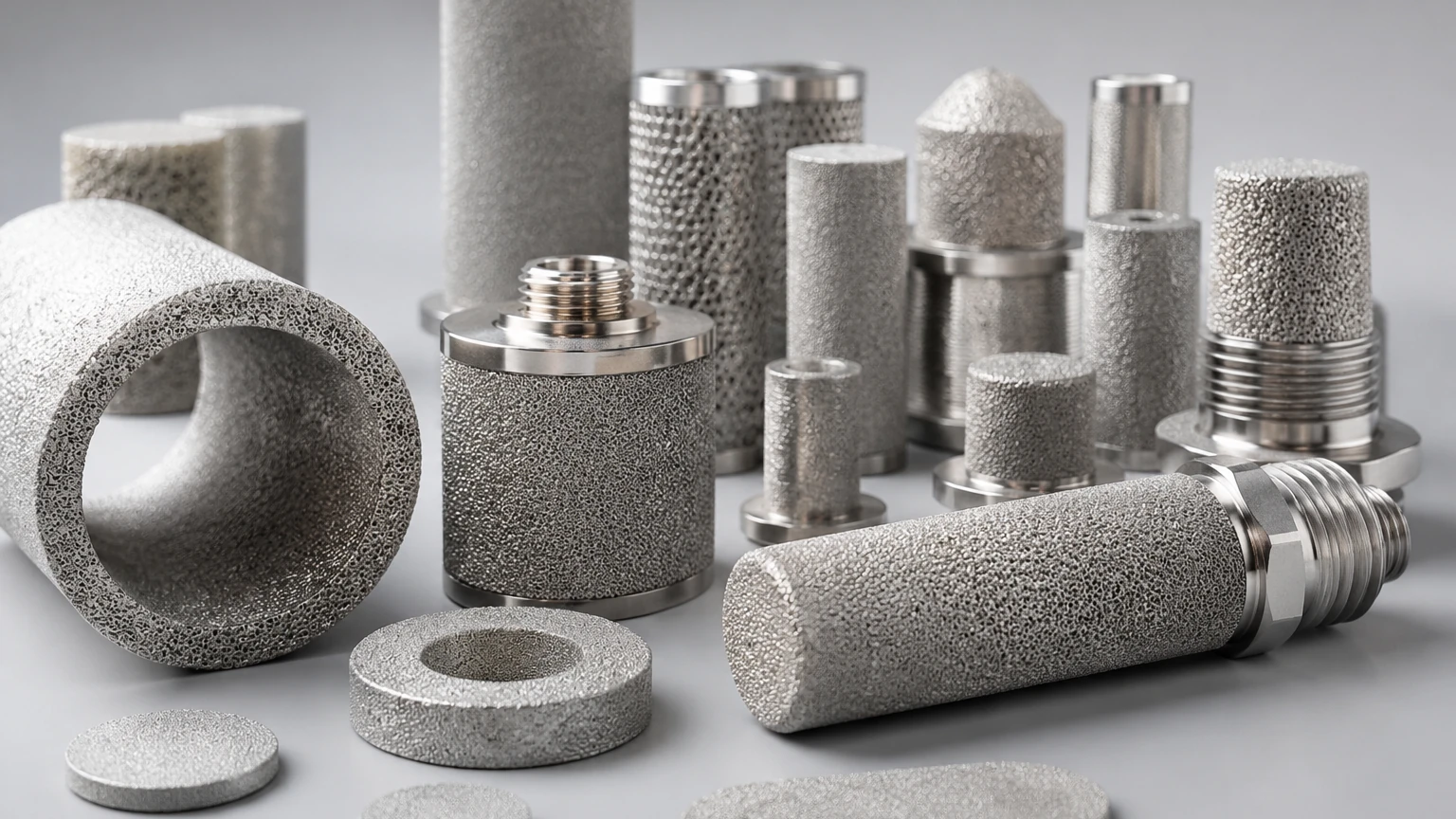
To understand how a sintered filter works, one must first understand how it is constructed. Sintering is a metallurgical process where metal powders, fibers, or multi-layered wire meshes are heated to a temperature just below their melting point. This thermal treatment causes the particles to bond at their contact points through a process called solid-state diffusion.
Unlike woven wire mesh, which relies on the mechanical overlap of wires, or paper filters that use binders, a sintered filter is a monolithic, porous structure. The result is a rigid matrix with a highly controlled pore size distribution. At Kaifil, the manufacturing of these components involves precise control over temperature and atmosphere to ensure that the resulting filter elements—whether in the form of cartridges, discs, or custom shapes—maintain their structural integrity under extreme mechanical stress.
The Sintered Filter Working Principle: Mechanics of Separation
The primary sintered filter working principle relies on a combination of surface filtration and depth filtration. Because the sintering process creates a three-dimensional network of interconnected pores, the filter does not simply act as a flat sieve; it acts as a complex labyrinth for the fluid stream.
1. Mechanical Sieving (Surface Filtration)
Mechanical sieving occurs when particles larger than the pore openings on the filter's surface are physically blocked. In sintered wire mesh filters, this is the dominant mechanism. The rigid nature of the sintered bonds ensures that the pore sizes do not shift or enlarge under pressure, providing a consistent "absolute" filtration rating. This is critical in applications like pharmaceutical processing or food and beverage production, where bypassing even a small percentage of oversized contaminants is unacceptable.
2. Depth Filtration and Tortuosity
For sintered powder metal filters, depth filtration plays a more significant role. The fluid must travel through a "tortuous path"—a winding, non-linear route through the thickness of the metal matrix. As the fluid navigates this path, particles that are actually smaller than the surface pores may become trapped within the internal structure. This occurs through several sub-mechanisms:
* Inertial Impaction: Heavier particles, unable to follow the rapid changes in fluid direction within the pores, strike the metal walls and become lodged.
* Interception: Particles following a streamline come within one particle radius of the pore wall and adhere to it.
* Diffusion (Brownian Motion): In gas filtration, extremely small particles move erratically due to molecular collisions, eventually hitting the filter media and staying there.
3. Cake Formation
As the filtration cycle progresses, a layer of trapped solids—known as a "filter cake"—builds up on the upstream surface. Paradoxically, this cake often improves filtration efficiency, as it acts as a secondary, finer filter bed. However, it also increases the differential pressure across the element, which is a key metric for monitoring filter life.
Engineering Considerations: Porosity and Permeability
When engineers evaluate the sintered filter working principle for a specific application, two technical parameters are paramount: porosity and permeability. These are not interchangeable terms, and understanding the difference is vital for proper selection.
Porosity refers to the percentage of void space within the total volume of the filter material. High porosity generally allows for higher dirt-holding capacity and lower initial pressure drops. However, increasing porosity often comes at the expense of mechanical strength. Sintered stainless steel filters are engineered to find the "sweet spot" where the material is porous enough to allow flow but strong enough to withstand high differential pressures without collapsing.
Permeability is a measure of how easily a fluid can pass through the porous medium. It is influenced by pore size, porosity, and the thickness of the filter wall. Engineers use Darcy’s Law to calculate the expected pressure drop ($ ΔP $). If the permeability is too low, the system will require excessive energy to maintain flow rates, increasing the total cost of ownership. For more detailed technical specifications on flow rates and material grades, you can visit our Main Page to review product options and application support.
Performance Expectations in Demanding Environments
One of the reasons sintered filters are preferred over polymer or ceramic alternatives is their performance envelope. Because they are typically made from stainless steel (316L or 304), they exhibit unique characteristics:
* Thermal Stability: Sintered metal filters can operate at temperatures exceeding 450°C (842°F) in oxidizing environments and even higher in reducing environments. This makes them ideal for steam filtration and hot gas recovery.
* Chemical Compatibility: Stainless steel offers excellent resistance to a wide range of corrosive fluids, including many acids, alkalis, and organic solvents. This is a critical factor in chemical processing and petrochemical refining.
* Mechanical Strength: The sintered bond is nearly as strong as the parent metal. This allows the filters to handle high-pressure surges and reverse-flow cleaning cycles that would destroy other media.
Maintenance and the Cleaning Cycle
A defining feature of the sintered filter working principle is the ability to regenerate the filter media. Unlike disposable depth filters (such as melt-blown polypropylene), sintered metal elements are designed for long-term reuse.
Backwashing and Backpulsing
Because the pores are rigid and the structure is robust, these filters can be cleaned in situ using backwashing (for liquids) or backpulsing (for gases). This involve reversing the flow of fluid at a higher pressure to dislodge the filter cake and trapped particles from the pores. The success of this process depends on the "cleanability" of the specific pore structure—sintered wire mesh generally offers better backwash recovery than sintered powder because of its more uniform, open surface.
Ultrasonic and Chemical Cleaning
When backwashing is no longer sufficient to restore the pressure drop to acceptable levels, sintered filters can be removed and cleaned using ultrasonic baths or chemical solvents. This restores the original permeability of the media, significantly extending the replacement cycle and reducing the environmental impact of the operation.
Customization and Selection Logic
Selecting the right filter involves more than just picking a micron rating. Engineers must confirm several factors before finalizing a design:
1. Fluid Characteristics: Viscosity, density, and chemical composition directly affect the pressure drop and material compatibility.
2. Contaminant Profile: The nature of the solids (deformable vs. hard, spherical vs. irregular) determines whether surface or depth filtration is more appropriate.
3. Operating Conditions: Maximum operating pressure, temperature, and the frequency of pressure pulses must be accounted for in the structural design of the filter housing and element.
4. Target Efficiency: Does the process require 99.9% (absolute) retention of a specific particle size, or is a nominal rating sufficient?
At Kaifil, we specialize in custom filtration solutions that address these specific variables. Whether it is a specialized hydraulic system requiring high-pressure resistance or a food-grade application requiring smooth, cleanable surfaces, the customization of the sintered structure is key to performance.
Conclusion
The sintered filter working principle is a sophisticated interplay of material science and fluid dynamics. By utilizing a rigid, porous metal matrix, these filters provide a level of reliability and durability that disposable media cannot match. For engineers and purchasing teams, understanding these principles allows for better-informed decisions that balance initial capital expenditure with long-term operational efficiency.
When designing a filtration system, it is essential to work with a manufacturer that understands the nuances of sintering and can provide the technical data necessary to validate the filter's performance in a real-world environment. For further technical guidance and to explore our full range of stainless steel filtration components, please refer to the resources available on our Main Page.
