


Sintered Filter
In the landscape of industrial filtration, the sintered filter represents the pinnacle of durability and precision. Unlike traditional disposable filters made from polymers or cellulose, sintered metal filters are engineered to withstand extreme temperatures, high pressures, and corrosive environments while maintaining consistent filtration accuracy. As a specialized manufacturer, Kaifil provides these advanced filtration components to industries where failure is not an option, ranging from chemical processing to pharmaceutical manufacturing. Understanding the technical nuances of sintered media is essential for engineers and procurement teams looking to optimize their filtration systems for long-term performance and cost-efficiency.
The Engineering Behind the Sintered Filter
Sintering is a metallurgical process where metal particles, fibers, or wire meshes are heated in a controlled-atmosphere furnace to a temperature just below their melting point. This process facilitates molecular diffusion across the contact points of the material, creating strong metallic bonds. The result is a porous yet rigid structure that retains the chemical properties of the base metal—typically 316L stainless steel, though specialized alloys like Hastelloy or Monel are used for specific chemical compatibilities.
The primary advantage of a sintered filter is its structural integrity. Because the media is fused at a molecular level, it does not suffer from media migration, a common failure point in fiber-based filters where particles of the filter itself break off and contaminate the filtrate. This makes sintered components ideal for high-purity applications in the food, beverage, and pharmaceutical sectors.
Primary Types of Sintered Filter Media
Selecting the right sintered filter requires an understanding of the different media structures available. Each type offers distinct advantages in terms of flow rate, dirt-holding capacity, and mechanical strength.
Sintered Wire Mesh
Sintered wire mesh is perhaps the most versatile form of sintered media. It is typically constructed by layering multiple sheets of stainless steel wire cloth and sintering them together. A standard configuration is the five-layer sintered mesh, which includes:
1. Protective Layer: Guards the finer filter layer against mechanical damage.
2. Filter Layer: Determines the micron rating and filtration precision.
3. Dispersion Layer: Ensures even flow across the filter surface.
4. Two Support Layers: Provide the necessary mechanical rigidity to withstand high differential pressures.
This structure allows for surface filtration, making it exceptionally easy to clean via backwashing or ultrasonic methods.
Sintered Metal Fiber Felt
Produced from non-woven stainless steel fibers, sintered metal fiber felt creates a three-dimensional depth filtration medium. Unlike wire mesh, which is primarily a surface filter, fiber felt allows particles to be trapped within the thickness of the material. This results in a significantly higher dirt-holding capacity and lower initial pressure drop. Engineers often specify sintered fiber felt for gas filtration or applications involving high-viscosity liquids where maximizing the interval between cleaning cycles is a priority.
Sintered Metal Powder
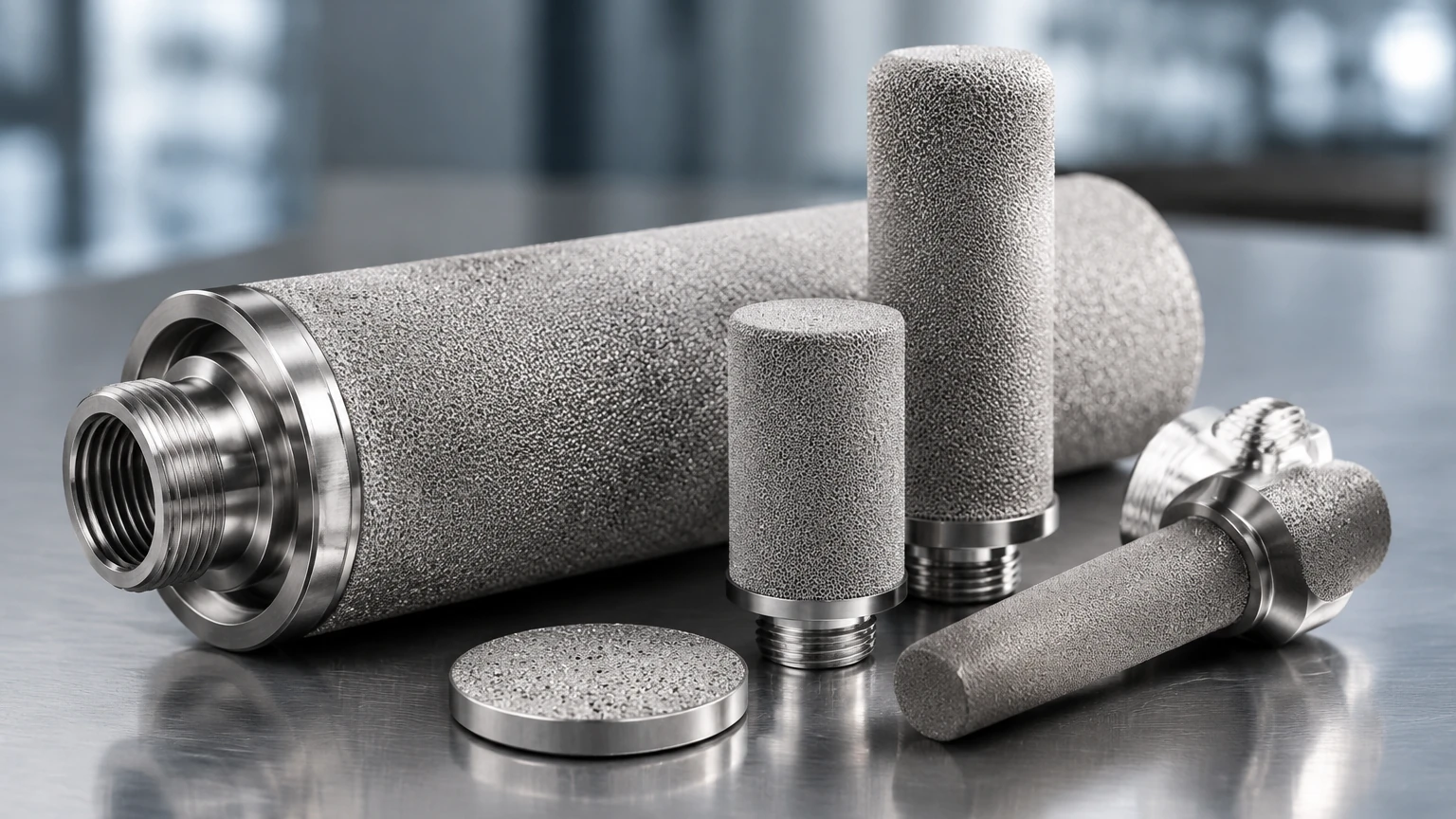
Sintered powder filters are formed by pressing and sintering metal powders into shapes such as tubes, discs, or conical elements. These filters offer the highest level of precision in pore size distribution. They are exceptionally rigid and can be manufactured with very thick walls, making them suitable for high-pressure gas sparging and liquid filtration where the filter must act as a structural component of the machinery.
Performance Evaluation Criteria for Engineers
When specifying a sintered filter for an industrial application, several technical parameters must be evaluated to ensure the component meets the operational requirements of the system.
Filtration Rating: Absolute vs. Nominal
In the context of sintered media, it is critical to distinguish between nominal and absolute filtration ratings. A sintered filter typically offers an absolute rating, meaning it is guaranteed to intercept a specific percentage (usually 99.9%) of particles at the stated micron size. This is achieved through the fixed pore structure created during the sintering process, which does not shift under pressure pulses.
Permeability and Pressure Drop
Permeability refers to the ability of the filter to allow fluid to pass through at a given pressure. A well-designed sintered filter balances fine filtration with high permeability to minimize energy costs associated with pumping. Engineers must calculate the clean pressure drop (ΔP) and determine the maximum allowable terminal pressure drop before the filter requires cleaning or replacement.
Thermal and Chemical Compatibility
One of the strongest arguments for using stainless steel sintered filters is their thermal resistance. Standard 316L sintered filters can operate continuously at temperatures up to 600°C (1112°F) in non-oxidizing environments. Furthermore, the selection of the alloy must match the chemical profile of the process fluid to prevent pitting or stress corrosion cracking.
Customization and OEM Integration
At Kaifil, we recognize that standard off-the-shelf solutions rarely meet the complex demands of modern industrial processes. Customization is at the core of our manufacturing philosophy. For engineers looking for specific configurations, our Main Page provides an overview of our capabilities in developing bespoke filtration solutions.
Customization options include:
* Geometry: Designing filters in pleated, cylindrical, or conical shapes to fit existing housing constraints.
* End Fittings: Integrating specialized threaded connectors, flanges, or O-ring seats (such as 222 or 226 configurations) directly onto the sintered element.
* Reinforcement: Adding internal perforated cores or external shrouds for applications involving extreme hydraulic shock or high-velocity gas flows.
By working closely with an OEM partner, purchasing teams can ensure that the sintered filter is optimized for the specific flow dynamics and contaminant loads of their unique application.
Maintenance, Cleaning, and Total Cost of Ownership
While the initial acquisition cost of a sintered filter is higher than that of a disposable cartridge, the total cost of ownership (TCO) is often significantly lower due to its cleanability and longevity. A properly maintained sintered filter can last for years, reducing waste and downtime associated with frequent filter changes.
Cleaning Methodologies
Effective cleaning is essential to restoring the permeability of the filter. Common industrial methods include:
* Backpulsing/Backwashing: Using a reverse flow of clean fluid or gas to dislodge particles from the surface of the mesh.
* Ultrasonic Cleaning: Utilizing high-frequency sound waves in a cleaning solvent to remove fine particulates trapped deep within the pores of sintered powder or fiber felt.
* Chemical Cleaning: Using acids, alkalis, or surfactants to dissolve organic or inorganic scaling that cannot be removed mechanically.
* High-Temperature Burn-off: For polymer or organic contaminants, heating the filter in a vacuum furnace can carbonize and remove the blockage.
Determining Replacement Cycles
Despite their durability, sintered filters are not infinite. Over time, repeated cleaning cycles and exposure to harsh chemicals can lead to material fatigue or permanent fouling (pore blinding). Engineers should monitor the time it takes for the filter to reach its terminal pressure drop after each cleaning. A significant decrease in the cycle time usually indicates that the filter is nearing the end of its functional life.
Application Profiles: Where Sintered Filters Excel
The unique properties of the sintered filter make it the preferred choice across several demanding sectors:
* Chemical and Petrochemical: Used for catalyst recovery, monomer filtration, and the processing of aggressive solvents where polymer filters would dissolve or deform.
* Pharmaceutical and Biotech: Ideal for steam filtration (SIP – Sterilization in Place) and the removal of carbon or cell debris in sterile environments.
* Food and Beverage: Employed in the filtration of cooking oils, steam for direct food contact, and the clarification of beverages where high-temperature sanitation is required.
* Hydraulic Systems: Sintered elements protect sensitive valves and pumps from particulate wear in high-pressure hydraulic circuits, especially in aerospace and heavy machinery.
Selecting the Right Partner for Filtration Solutions
The performance of a sintered filter is only as reliable as the manufacturing process behind it. Factors such as the purity of the metal powder, the precision of the wire mesh weaving, and the consistency of the furnace temperature during sintering all dictate the final quality of the product.
Kaifil combines advanced manufacturing technology with deep engineering expertise to deliver filtration components that meet the rigorous standards of global industry. Whether you are designing a new system or looking to upgrade an existing process for better efficiency, our team provides the technical support necessary to select the optimal media, micron rating, and structural design. For detailed product specifications and to discuss your specific application requirements, please visit our Main Page to review our full range of stainless steel filtration solutions.
In conclusion, the sintered filter is a critical investment for industrial operations that prioritize reliability and precision. By understanding the material characteristics and engineering trade-offs involved in sintered media selection, technical professionals can significantly improve process uptime and product quality while reducing the environmental impact of disposable filtration waste.
