


Sintered Glassware
In laboratory and precision industrial environments, the separation of solids from liquids or gases requires media that can withstand aggressive chemical environments while maintaining precise pore structures. Sintered glassware, commonly referred to as fritted glass, has long been a standard in these applications. However, as processes scale from laboratory benchtop experiments to industrial production, the engineering requirements for filtration media shift toward mechanical durability, thermal shock resistance, and high-pressure tolerance.
Understanding the technical properties of sintered glassware is essential for engineers and procurement teams who must decide between traditional glass-based filtration and high-performance metal alternatives. This guide explores the construction, performance characteristics, and selection criteria for sintered media, providing the technical foundation necessary for optimizing filtration workflows.
Understanding Sintered Glassware Construction
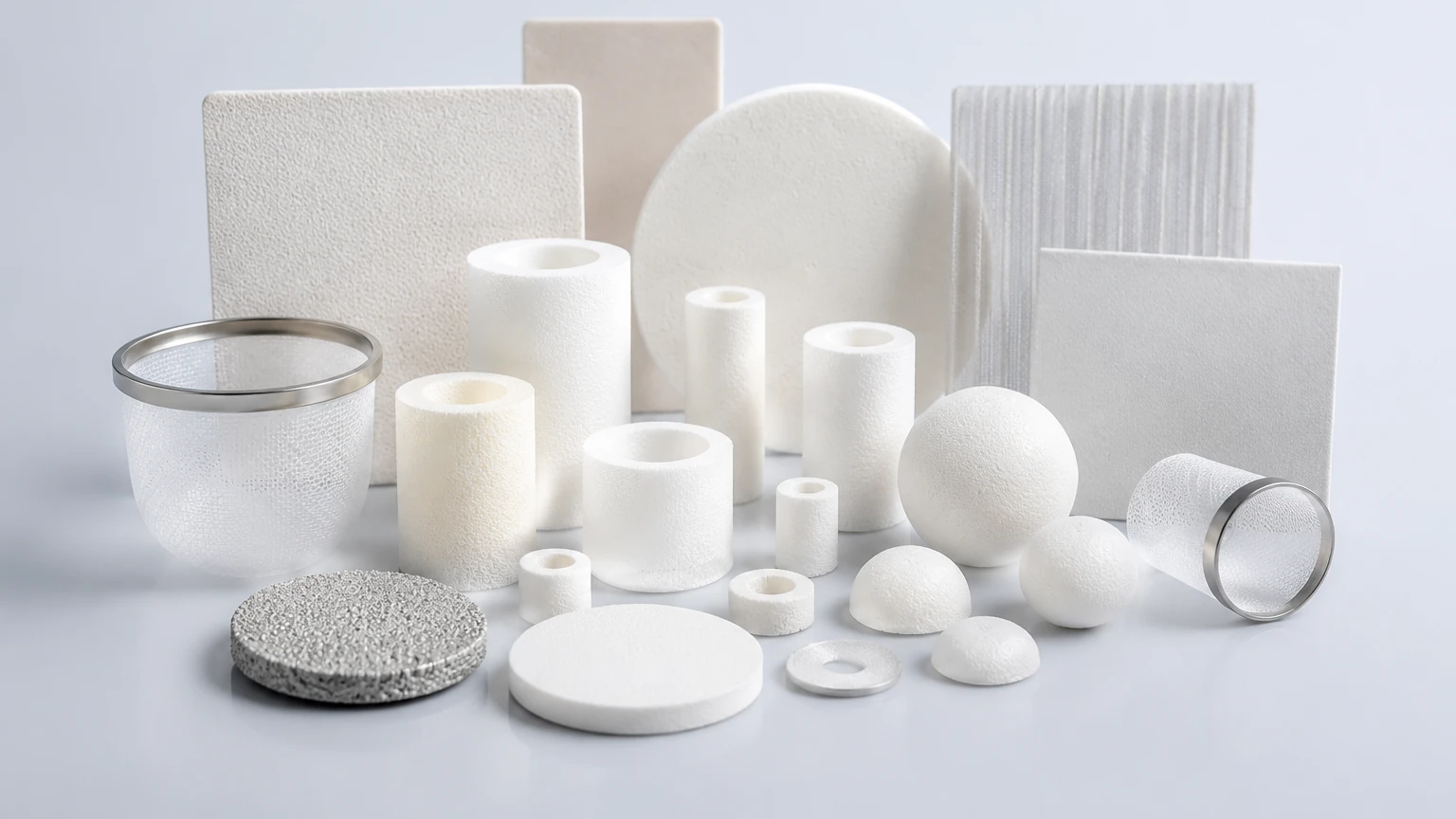
Sintered glassware is produced through a process called sintering, where glass powder (typically borosilicate glass) is heated to a temperature just below its melting point. At this temperature, the glass particles fuse at their contact points without liquefying, creating a rigid, porous structure. The resulting "frit" or disc is then fused into a glass body, such as a funnel, crucible, or tube.
Material Composition
Most industrial-grade sintered glassware is manufactured from Borosilicate 3.3 glass. This material is chosen for its low coefficient of linear thermal expansion (approximately $3.3 \times 10^{-6} K^{-1}$), which provides excellent resistance to thermal shock. Chemically, it is highly resistant to water, neutral and acid solutions, concentrated acids and their mixtures, as well as to chlorine, bromine, iodine, and organic matters.
Porosity and Pore Size Distribution
The porosity of sintered glassware is determined by the grain size of the glass powder used during the sintering process. Standardized grades (such as those defined by ISO 4793 or ASTM standards) categorize these filters based on their maximum pore size.
* Grade 0 (P250): 160–250 µm – Used for coarse filtration and gas dispersion.
* Grade 1 (P160): 100–160 µm – Suitable for coarse precipitates.
* Grade 2 (P100): 40–100 µm – Used for medium precipitates and gas washing.
* Grade 3 (P40): 16–40 µm – The standard for analytical filtration and fine precipitates.
* Grade 4 (P16): 10–16 µm – Used for very fine precipitates and analytical work.
* Grade 5 (P1.6): 1.1–1.6 µm – Ultrafine filtration, often used for bacterial removal in lab settings.
Performance Characteristics and Engineering Considerations
When evaluating sintered glassware for a specific application, engineers must look beyond simple pore size. The performance of the filter is dictated by its interaction with the process fluid and the mechanical stresses of the system.
Chemical Compatibility
While borosilicate glass is remarkably inert, it is susceptible to attack by hydrofluoric acid, hot concentrated phosphoric acid, and strong alkaline solutions (high pH). In processes involving these chemicals, the pore structure of the sintered glassware can degrade, leading to a loss of filtration accuracy or structural failure. In such cases, switching to specialized metal alloys or stainless steel filtration components is often necessary.
Thermal Limits
The maximum recommended working temperature for sintered glassware is typically around 450°C to 500°C. However, the more critical factor is the rate of temperature change. Rapid heating or cooling can cause internal stresses between the porous frit and the solid glass body, leading to cracking. For industrial processes requiring frequent thermal cycling or higher operating temperatures, stainless steel sintered media offers a significantly higher safety margin.
Pressure and Flow Rates
Sintered glassware is primarily designed for vacuum filtration or low-pressure gas applications. The mechanical strength of a glass frit is limited; excessive differential pressure can cause the disc to shear or implode. Flow rates are also inherently limited by the thickness of the frit and the tortuosity of the pore paths. Engineers must calculate the expected pressure drop ($ΔP$) across the filter to ensure it remains within the manufacturer’s safe operating limits.
Sintered Glassware vs. Sintered Stainless Steel Filters
As projects transition from R&D to pilot plants and full-scale production, the limitations of sintered glassware often become a bottleneck. This is where high-performance metal filtration solutions, such as those found on the Kaifil Main Page, become essential.
Mechanical Durability
Glass is brittle. In an industrial environment, vibration, mechanical impact, or improper handling can lead to catastrophic failure. Sintered stainless steel filters, by contrast, are extremely rugged. They can withstand high-pressure differentials, hydraulic shocks, and mechanical stresses that would shatter glassware.
Scale-up and Customization
Sintered glassware is generally limited to standard laboratory geometries (funnels, cylinders). For industrial reactors, pipelines, and high-volume housings, custom-engineered filtration components are required. Stainless steel allows for the fabrication of large-scale pleated cartridges, multi-layered mesh filters, and complex geometries that can be integrated directly into industrial process lines.
Cleanability and Reusability
While sintered glassware can be cleaned with solvents or acids, it is difficult to verify the removal of deeply embedded contaminants without risking damage to the frit. Stainless steel filters support more aggressive cleaning protocols, including ultrasonic cleaning, backwashing, and high-pressure steam sterilization (SIP), making them more cost-effective over a long lifecycle in B2B production environments.
Key Evaluation Criteria for Industrial Filtration Selection
Before finalizing a filtration specification, engineers should confirm several technical parameters to ensure the chosen media—whether glass or metal—is fit for purpose.
1. Filtration Rating (Absolute vs. Nominal): Confirm whether the pore size rating refers to the largest particle that can pass (absolute) or a percentage of particles retained (nominal). Sintered glassware is typically rated by maximum pore size.
2. Fluid Viscosity: Higher viscosity fluids require larger surface areas or higher pressure differentials to maintain flow. If the required pressure exceeds the limits of glassware, metal media is the only viable option.
3. Contaminant Loading: If the process fluid has a high concentration of solids, a depth filter (like sintered glass or metal fiber felt) may clog quickly. In these scenarios, a surface filter like stainless steel wire mesh might be more appropriate.
4. Total Cost of Ownership (TCO): While glass may have a lower initial purchase price for small components, the frequency of breakage and the cost of process downtime often make durable stainless steel filters more economical in the long run.
Common Risks and Failure Modes in Porous Media
Identifying potential failure modes early in the design phase can prevent costly contamination events or equipment damage.
* Clogging (Blinding): This occurs when particles become trapped within the internal pore structure. If the cleaning protocol is ineffective, the differential pressure will rise until the filter fails. For sintered glassware, aggressive chemical cleaning is often the only option, which can eventually widen the pores.
* Thermal Shock: As mentioned, rapid temperature shifts can crack the seal between the frit and the housing. This is a common risk in processes involving steam sterilization or exothermic reactions.
* Media Migration: In low-quality sintered products, individual particles of the filter media (glass or metal) may shed into the filtrate. High-quality manufacturing processes, such as those employed for industrial stainless steel filters, minimize this risk through controlled sintering and rigorous quality control.
Moving from Lab Scale to Industrial Production
For technical professionals managing the transition from laboratory-scale synthesis to industrial manufacturing, the choice of filtration media is a critical engineering decision. While sintered glassware remains an excellent tool for benchtop analysis and small-scale chemical preparation due to its visibility and high chemical inertness, it lacks the scalability required for modern industrial applications.
Industrial filtration requires a focus on reliability and integration. Custom-designed stainless steel filter cartridges and wire mesh components provide the precision of sintered glassware with the added benefits of high mechanical strength, weldability, and superior flow characteristics.
When specifying filtration components for demanding industrial environments—such as chemical processing, pharmaceuticals, or food and beverage production—it is vital to work with a manufacturer that understands the nuances of material science and fluid dynamics. By evaluating the specific needs of the application, including temperature, pressure, and chemical exposure, engineers can select the filtration solution that offers the best balance of performance and durability.
For more information on industrial-grade filtration solutions and custom-engineered metal filter components, you can Review product options and application support to find the right fit for your specific technical requirements.
