


Sintered Porous Metal Tube
In the landscape of industrial filtration and fluid handling, the sintered porous metal tube represents a critical component for high-stakes environments where polymer-based or disposable filters fail. These tubes are engineered through a specialized metallurgical process that transforms metal powders into a rigid, porous structure capable of withstanding extreme temperatures, high pressures, and corrosive chemical interactions. For engineers and procurement teams, selecting the right sintered metal solution requires a deep understanding of material science, fluid dynamics, and the specific mechanical demands of the application.
At Kaifil, we specialize in manufacturing custom stainless steel filtration solutions designed to meet these exact industrial requirements. By focusing on precision engineering and high-quality material selection, we provide filtration components that ensure process continuity and long-term durability in sectors ranging from chemical processing to pharmaceutical manufacturing.
The Engineering Fundamentals of Sintered Porous Metal Tubes
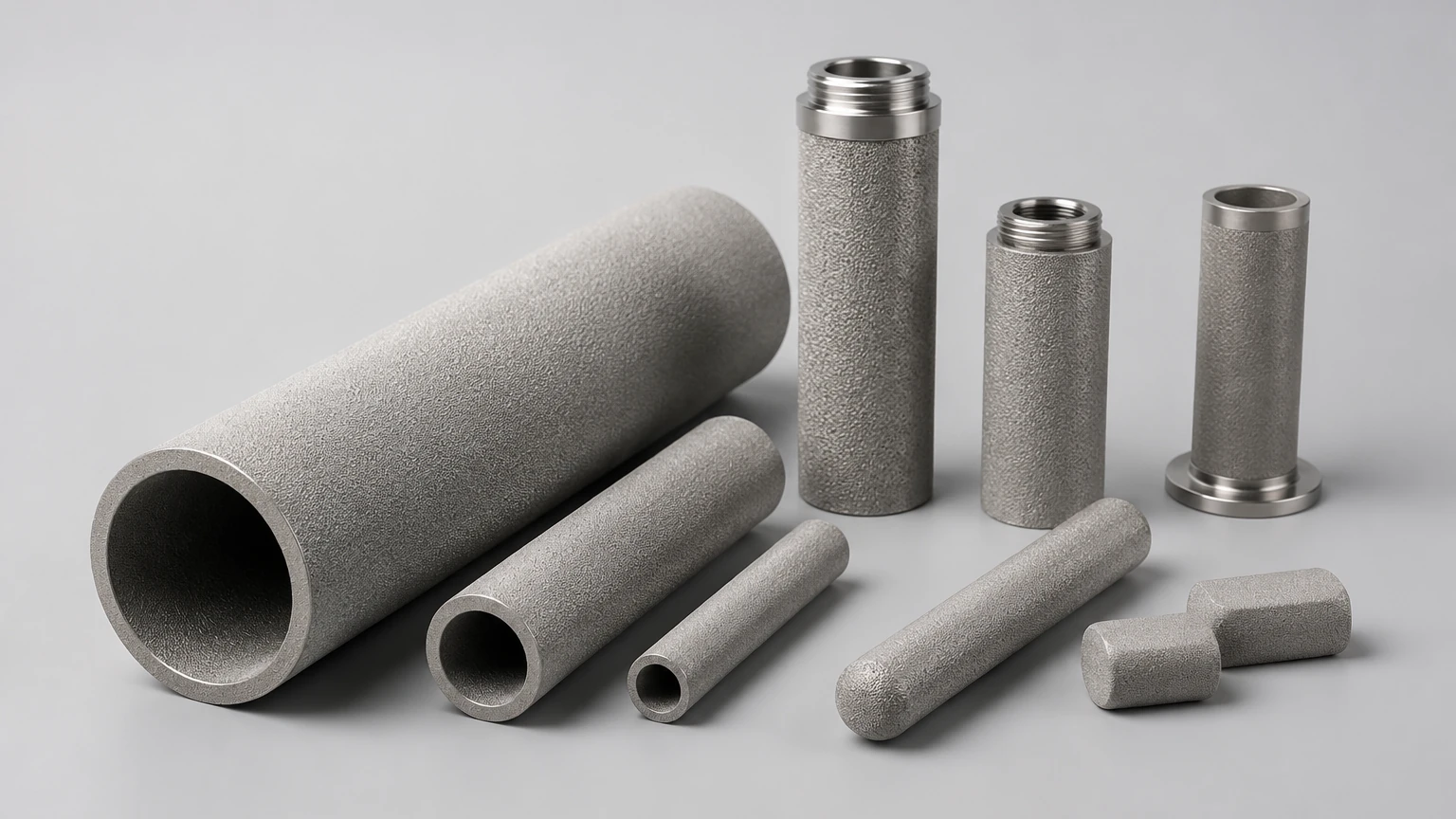
A sintered porous metal tube is not simply a perforated pipe; it is a sophisticated depth-filtration medium. The manufacturing process begins with high-purity metal powder—most commonly 316L stainless steel, though alloys like Inconel or Monel are used for specialized environments. This powder is shaped into a tubular form through techniques such as isostatic pressing or gravity molding and then subjected to a sintering furnace.
During sintering, the temperature is raised to just below the melting point of the metal. This causes the powder particles to bond at their contact points through a process called solid-state diffusion. The result is a mechanically robust structure with a network of interconnected pores. The size, shape, and distribution of these pores are controlled by the powder particle size and the sintering parameters, allowing manufacturers to achieve specific filtration ratings from 0.1 microns up to 100 microns.
Material Selection and Chemical Compatibility
The choice of alloy is the first critical decision in the engineering process. Stainless steel 316L is the industry standard due to its excellent corrosion resistance and mechanical strength at elevated temperatures. However, in environments involving high concentrations of chlorides or highly acidic solutions, engineers may specify Hastelloy or other nickel-based alloys to prevent pitting and stress corrosion cracking.
Key Performance Indicators for Industrial Evaluation
When evaluating a sintered porous metal tube for a specific project, technical professionals must look beyond basic dimensions. The performance of the filter is defined by its interaction with the fluid and the contaminants it is designed to remove.
Filtration Efficiency and Pore Size Distribution
Unlike surface filters (such as thin membranes), a sintered metal tube provides depth filtration. As fluid passes through the tortuous path created by the bonded metal particles, contaminants are trapped within the thickness of the tube wall. Engineers must distinguish between "absolute" and "nominal" filtration ratings. An absolute rating indicates the diameter of the largest spherical particle that will pass through the filter under specific test conditions, while a nominal rating represents an average retention efficiency.
Permeability and Pressure Drop
Permeability refers to the ease with which a fluid flows through the porous medium. A high-quality sintered tube must balance filtration efficiency with a low initial pressure drop (ΔP). If the pores are too small or the wall thickness is excessive, the energy required to pump fluid through the system increases, leading to higher operational costs. Conversely, high porosity improves flow rates but may compromise the mechanical integrity of the tube. Finding the "sweet spot" is a core part of the design phase at the Main Page of any filtration project.
Mechanical Strength and Burst Pressure
Sintered metal tubes are often used in high-pressure hydraulic systems or gas sparging applications where they must withstand significant differential pressures. The structural integrity is determined by the sintering quality and the wall thickness. Engineers must calculate the maximum expected ΔP during the end-of-life stage of the filter (when it is loaded with contaminants) to ensure the tube does not collapse or burst.
Common Applications in Demanding Environments
The versatility of the sintered porous metal tube makes it indispensable across several heavy industries. Its ability to be cleaned and reused provides a significant advantage over disposable alternatives.
1. Chemical and Petrochemical Processing: Used for catalyst recovery, where fine metal catalysts must be separated from liquid product streams at high temperatures. The thermal stability of the sintered metal allows these processes to run continuously without frequent shutdowns.
2. Gas Sparging: In wastewater treatment or bioreactors, these tubes are used to introduce gases (like oxygen or ozone) into liquids. The controlled pore size ensures the creation of fine, uniform bubbles, maximizing the surface area for gas-liquid interaction.
3. Steam Filtration: Sintered tubes are excellent for removing pipe scale and rust from industrial steam, protecting downstream equipment like valves and heat exchangers.
4. Pharmaceutical and Food Production: Due to the non-shedding nature of sintered stainless steel, these filters are ideal for sterile applications. They can be sterilized in place (SIP) using high-pressure steam or cleaned with aggressive caustic chemicals.
Addressing Risks: Clogging, Cleaning, and Maintenance
One of the primary concerns for maintenance engineers is the eventual clogging, or "blinding," of the filter pores. Because these are depth filters, particles can become deeply embedded in the metal matrix. However, unlike polymer filters, sintered metal tubes are highly recoverable.
Cleaning Protocols
To extend the service life of a sintered porous metal tube, several cleaning methods can be employed:
* Backpulsing/Backwashing: Reversing the flow of fluid to dislodge particles from the surface and the outer layers of the pores.
* Ultrasonic Cleaning: Using high-frequency sound waves in a cleaning solvent to vibrate trapped particles loose from the internal pore structure.
* Chemical Cleaning: Soaking the tubes in acids, alkalis, or surfactants to dissolve organic or inorganic deposits.
* Thermal Burnout: For organic contaminants, heating the tube in a controlled furnace can carbonize and remove the blockage, provided the temperature does not exceed the alloy's limits.
Identifying Structural Fatigue
While durable, these components are not immortal. Repeated thermal cycling or excessive vibration can lead to micro-fractures in the sintered bonds. Regular inspection for "bubble point" integrity—a test where the tube is submerged and pressurized to check for uniform pore discharge—is essential to ensure the filtration rating remains intact.
Customization and OEM Considerations
Standard off-the-shelf filtration components rarely meet the specific needs of complex industrial systems. Customization is often required to integrate the filter into existing piping or to meet specific flow dynamics. When sourcing a sintered porous metal tube, engineers should be prepared to confirm the following specifications:
* Dimensions: Precise Inner Diameter (ID), Outer Diameter (OD), and total length.
* End Fittings: Options include threaded connections (NPT, BSP), flanges, or plain ends for welding. Custom machined fittings can also be sintered directly onto the tube to ensure a leak-proof, high-strength bond.
* Operating Environment: Maximum operating temperature, peak pressure, and a full chemical profile of the fluid.
* Filtration Target: The specific micron size of the particles to be removed and the desired efficiency percentage.
By working closely with a manufacturer like Kaifil, purchasing teams can ensure that the components they receive are optimized for their specific total cost of ownership (TCO). While the initial investment in a sintered metal solution is higher than in disposable filters, the longevity and reusability frequently result in lower long-term costs.
Conclusion: Making an Informed Procurement Decision
The selection of a sintered porous metal tube is a technical decision that impacts the efficiency, safety, and reliability of an entire industrial process. By focusing on the material properties, pore architecture, and mechanical limits of the component, engineers can avoid premature failures and optimize fluid handling performance.
For those looking to explore specific product configurations or seeking engineering support for custom filtration challenges, visiting the Main Page provides access to technical resources and manufacturing expertise. Whether you are designing a new system or seeking to improve the reliability of an existing one, understanding the nuances of sintered metal technology is the first step toward achieving superior filtration results.
