


Sintered Ptfe
In the landscape of industrial filtration and high-performance material engineering, sintered PTFE (Polytetrafluoroethylene) represents a critical solution for environments where chemical inertness, thermal stability, and precise porosity are non-negotiable. Unlike standard PTFE membranes or molded components, sintered PTFE is engineered through a controlled thermal process that transforms granular resin into a porous, rigid matrix. This material is widely utilized in the chemical processing, pharmaceutical, and semiconductor industries to handle aggressive fluids and gases that would degrade conventional polymers or even certain metallic alloys.
For engineers and procurement teams, understanding the technical nuances of sintered PTFE is essential for optimizing system longevity and filtration efficiency. This guide explores the manufacturing principles, material properties, and engineering considerations necessary for selecting the appropriate filtration media for demanding industrial applications.
Understanding the Sintering Process for PTFE
The production of sintered PTFE involves a specialized powder metallurgy-like process. It begins with the selection of high-purity PTFE granular resins. These resins are meticulously graded by particle size, as the initial particle dimensions directly influence the final pore structure of the sintered component.
Compaction and Pre-forming
The process starts with cold-pressing the PTFE powder into a specific shape or "green" state using high-pressure molds. During this phase, the particles are mechanically interlocked but not yet fused. The pressure applied during compaction is a critical variable; too much pressure can collapse the intended voids, while too little can lead to structural instability in the finished product.
Thermal Fusion
The pre-formed component is then subjected to a sintering cycle in a high-temperature oven. The temperature is raised to just below or slightly above the crystalline melting point of PTFE (approximately 327°C or 621°F). At these temperatures, the PTFE molecules gain sufficient mobility to promote diffusion across particle boundaries. This creates "necks" or fusion points between the granules, resulting in a cohesive, porous network.
Unlike melt-processable polymers, PTFE does not flow like a liquid when heated. Instead, it maintains its shape while the particles bond. This unique characteristic allows manufacturers to create complex geometries with highly controlled pore sizes, ranging from sub-micron levels to over 100 microns.
Key Material Properties and Performance Benefits
Sintered PTFE is often selected for applications where other porous plastics, such as polyethylene (PE) or polypropylene (PP), fail due to thermal or chemical stress. Its performance is defined by several inherent characteristics:
Universal Chemical Resistance
PTFE is chemically inert to almost all industrial chemicals, including concentrated acids, strong alkalis, and aggressive organic solvents. It is only susceptible to attack by molten alkali metals (like sodium) and certain fluorine-containing compounds at high temperatures and pressures. This makes it the material of choice for filtering corrosive reagents in chemical manufacturing.
Thermal Stability
Sintered PTFE components can operate continuously at temperatures up to 260°C (500°F) and remain functional in cryogenic conditions as low as -200°C. This wide operational window is far superior to most other porous polymers, which typically soften or degrade above 100°C.
Hydrophobicity and Oleophobicity
Naturally hydrophobic, sintered PTFE resists wetting by water and aqueous solutions. This property is leveraged in gas venting applications, where the material allows air to pass through while acting as a barrier to liquid water. For applications requiring the filtration of low-surface-tension liquids, the material can be chemically modified to be hydrophilic.
Low Surface Energy
The non-stick nature of PTFE prevents the permanent adhesion of filtered particulates. This "self-cleaning" tendency often results in lower pressure drops over time and easier cake release during backwashing or manual cleaning cycles.
Filtration Characteristics of Sintered PTFE
When evaluating sintered PTFE for filtration, engineers must look beyond basic material compatibility and focus on the morphology of the porous structure. The effectiveness of a filter is determined by its ability to balance particle retention with flow permeability.
Pore Size and Distribution
Sintered PTFE is characterized by a tortuous path structure. Unlike a simple screen, the fluid must navigate a complex three-dimensional network of interconnected voids. This creates a "depth filtration" effect, where particles are trapped not just on the surface but within the thickness of the material. Manufacturers can achieve precise "Mean Flow Pore" ratings, ensuring that the filter meets the specific requirements of the process fluid.
Permeability and Pressure Drop
The permeability of a sintered PTFE component is a function of its porosity (the percentage of void space) and the thickness of the wall. High porosity leads to higher flow rates and lower initial pressure drops (ΔP). However, there is an engineering trade-off: higher porosity generally reduces the mechanical strength of the component. In high-pressure hydraulic or gas systems, the filter must be designed with sufficient wall thickness or external support to prevent deformation.
Efficiency and Retention
Retention ratings for sintered PTFE are typically expressed as "absolute" or "nominal." An absolute rating implies that 99.9% of particles of a specific size will be captured, whereas a nominal rating suggests a lower percentage (often 60-90%). For critical pharmaceutical or semiconductor applications, absolute-rated sintered PTFE is standard to ensure the removal of contaminants and microorganisms.
Industrial Applications and Regulatory Compliance
The unique combination of properties makes sintered PTFE indispensable across several high-stakes industries. Because it is an inert material, it often meets stringent regulatory standards without the need for additional additives.
Pharmaceutical and Biotechnology
In drug manufacturing, sintered PTFE is used for sterile venting of fermentation tanks and the filtration of aggressive solvents used in API (Active Pharmaceutical Ingredient) synthesis. The material is typically compliant with USP Class VI plastics testing and is naturally free of animal-derived components, making it suitable for sensitive bioprocessing environments.
Chemical Processing and Labs
From laboratory-scale filtration of corrosive acids to industrial-scale gas sampling in petrochemical plants, sintered PTFE protects downstream analytical equipment and ensures the purity of final products. It is also used in "sparging" applications, where it introduces fine gas bubbles into a liquid to facilitate chemical reactions.
Food and Beverage
Sintered PTFE is widely used in food processing due to its FDA compliance. It is used for steam filtration, carbonation, and venting in bottling lines. Its ability to withstand Clean-in-Place (CIP) and Sterilization-in-Place (SIP) procedures involving caustic chemicals and high-pressure steam is a major operational advantage.
Engineering Considerations for Selection and Integration
Integrating sintered PTFE into an industrial system requires careful consideration of mechanical and operational variables. Purchasing teams and engineers should confirm the following before finalizing a specification:
1. Differential Pressure Limits: While PTFE is durable, it is softer than stainless steel. Engineers must calculate the maximum expected differential pressure across the filter. If the pressure exceeds the material's structural limits, the pores may compress, or the component may rupture.
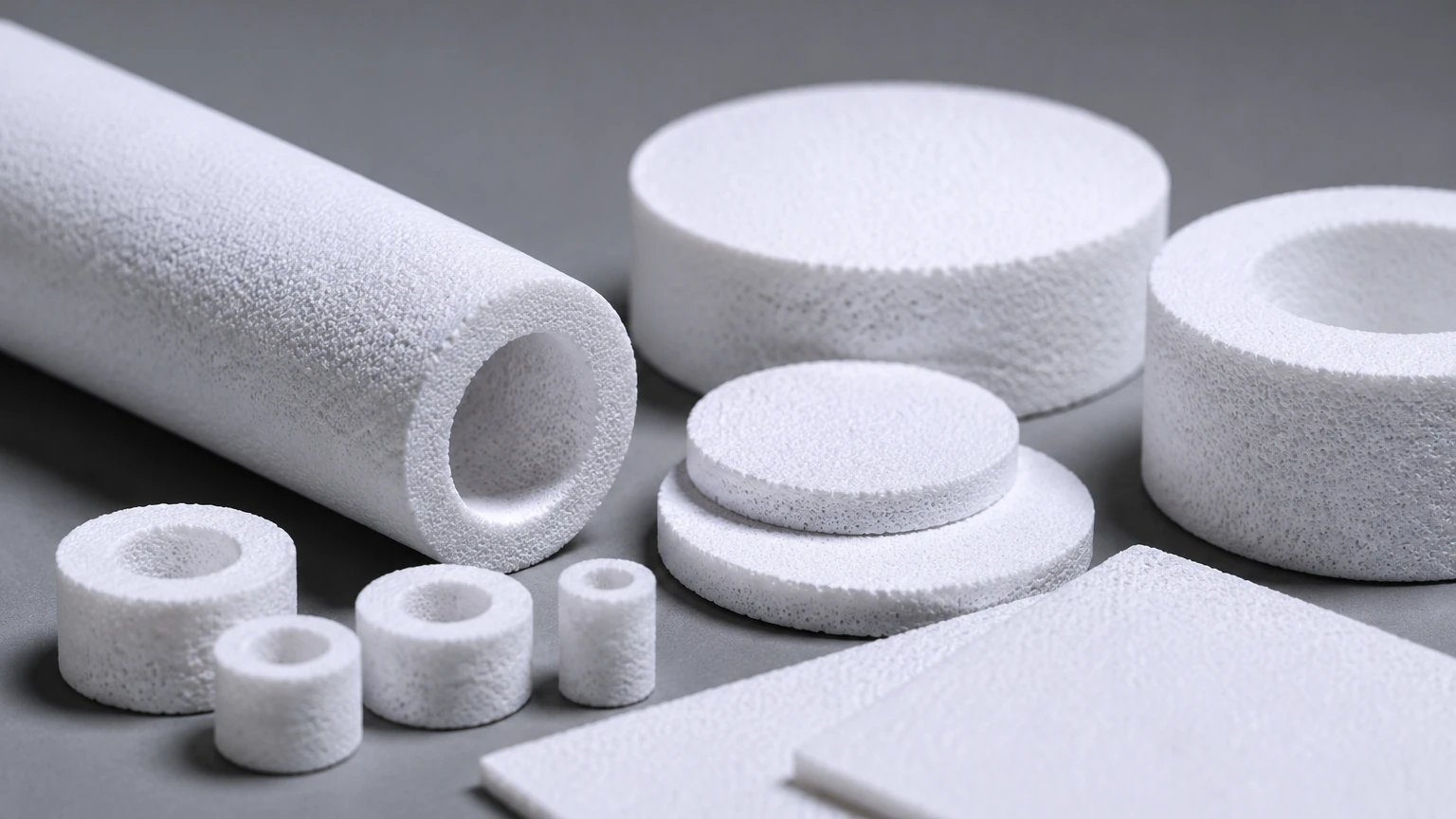
2. Housing Compatibility: Sintered PTFE filters are often manufactured as cartridges, discs, or tubes. It is vital to ensure that the sealing mechanism (O-rings or gaskets) is as chemically resistant as the PTFE itself. Common seal materials include Viton, EPDM, or PTFE-encapsulated silicone.
3. Flow Rate Requirements: To avoid premature clogging and excessive energy consumption, the surface area of the filter must be sized according to the fluid's viscosity and the desired flow rate. Increasing the surface area through pleating or larger diameters can significantly extend the service life between cleanings.
4. Cleaning Protocols: Although PTFE is non-stick, some applications involve high concentrations of solids that eventually bridge the pores. Users should confirm whether the filter can be ultrasonically cleaned, backpulsed, or chemically soaked to restore permeability.
Comparing Sintered PTFE with Metallic Filtration Media
While Kaifil specializes in custom stainless steel filtration solutions, it is important to distinguish when sintered PTFE is the superior choice versus metallic alternatives. On the Main Page, one can find various stainless steel options that offer extreme mechanical strength and high-pressure resistance. However, metal has limitations.
* Corrosion: Even 316L stainless steel can succumb to pitting or stress corrosion cracking when exposed to hot chlorides or certain concentrated acids. In these specific instances, sintered PTFE is the safer, more durable alternative.
* Weight: PTFE is significantly lighter than steel, which can be an advantage in portable equipment or aerospace applications.
* Purity: In some semiconductor processes, even trace metal ion leaching from a stainless steel filter can contaminate the wafer. Sintered PTFE provides a metal-free fluid path, ensuring the highest levels of ionic purity.
Conversely, for applications involving extremely high pressures (exceeding 500 psi) or temperatures above 300°C, stainless steel remains the industry standard. Many complex systems utilize both materials: stainless steel for the primary structural filtration and sintered PTFE for the final high-purity polishing stage.
Conclusion
Sintered PTFE is a high-performance material that solves the most difficult filtration challenges involving aggressive chemicals and wide temperature fluctuations. By understanding the relationship between the sintering process, pore morphology, and mechanical limits, engineering teams can implement filtration solutions that reduce downtime and protect critical infrastructure. Whether for venting, liquid filtration, or gas diffusion, sintered PTFE offers a level of chemical security that few other materials can match. When selecting a filtration partner, it is essential to verify their ability to provide customized geometries and precise micron ratings to meet the specific demands of your industrial environment.
